

 Lou Orlando
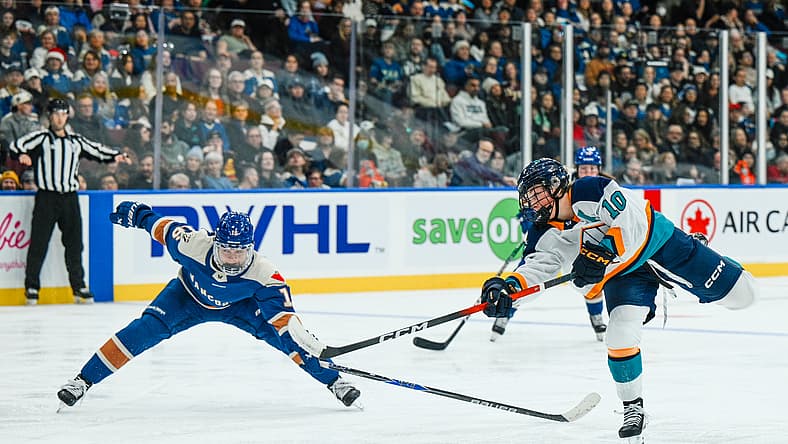
WEST ORANGE, N.J. — A good power play solves a lot of problems. That’s why the New York Sirens need to get theirs going.
Through six games, the Sirens (2-0-0-4) are dramatically inconsistent. In their victories, the Sirens outscored opponents 9-1; in losses, they’ve been outscored 12-1. Though a sample size that small isn’t cause for panic, it’s a trend that won’t translate into sustainable success.
One constant in all six games is New York’s historic inability to score on the power play.
The Sirens are 0-for-16 on the power this season. It’s the longest stretch without a power-play goal in Sirens history, and longest season-opening skid in PWHL history, eclipsing the Minnesota Frost’s 0-for-11 to start to the inaugural 2024 season.
“I think there’s been good moments for the power play,” coach Greg Fargo insisted at practice last week. “But we’ve got to get more pucks to the net. I think that’s a big one.”
It shouldn’t be an issue of talent. New York boasts reigning Rookie of the Year Sarah Fillier, who tied Hillary Knight for the League lead with 29 points last season. She’s joined by a host of other notable contributors, including Team Canada forward Kristin O’Neill and 2025 No. 1 overall pick Kristyna Kaltounkova.
“We’ve got two really great shooters out there with ‘Kalty’ and ‘Filly’, and I just feel like we haven’t got enough pucks to the net yet,” Fargo continued. “It doesn’t matter what league you look at — whether it’s the NHL or the PWHL — goals are scored in and around the net. We just gotta find ways to get through there.”
Sirens won’t panic about power play: ‘We’re getting chances’
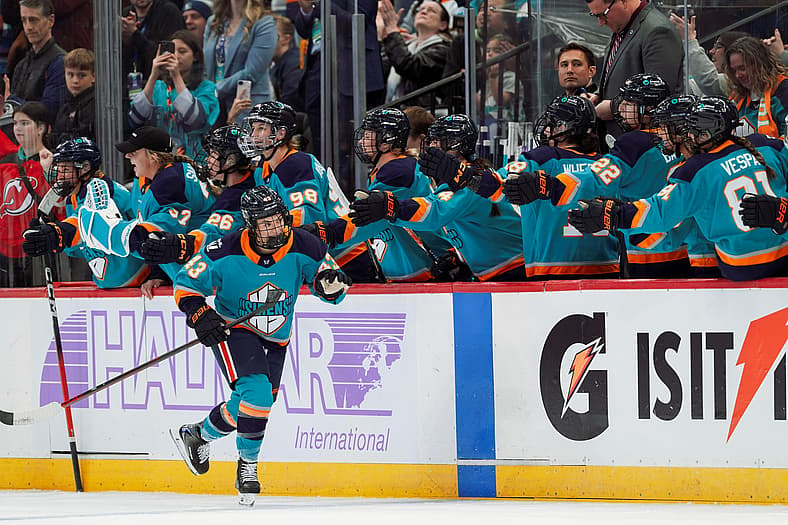
Ahead of a game Sunday against the Toronto Sceptres, the Sirens remain confident in their process, even if the results aren’t there.
“I think we have the right people,” said assistant coach Josh Sciba, who runs New York’s power play. “We have very skilled people there that can make plays. And I think we’re right there.”
“We’re getting chances,” Fillier noted. “In practice, we really love our looks. In games, we’ve had a lot of really close chances. I think we just can’t panic. We have to trust in what we’re doing. And if one of those goes in, it’s maybe not a conversation we’re having about our power play.”
It’s nice to get good chances, but ultimately, a power play is assessed on results. And until they come, the conversation persists.
“I think we have to score more goals,” defender Jincy Roese said bluntly. “I think that’s the key to any power play.”
Roese quarterbacks New York’s second unit. Last season with the Ottawa Charge, she finished fifth among all PWHL defenders in points, tallying four on the power play.
“Our breakout can be a little bit sharper,” Roese continued. “And then in-zone, we’re a newer team than most other teams. We’re still figuring each other out. So get a little more chemistry on the PP, but I’m not worried about it.”
Fargo made a subtle switch on his top unit ahead of a 2-0 loss to the Boston Fleet, swapping out right-handed rookie forward Anne Cherkowski for lefty Casey O’Brien. It’s a decision their coach insists is purely about handedness.
“Our power play, to me, is not anything personnel related. It’s just about how we can generate more at the net,” Fargo said Tuesday. “Just changing where people are on the power play to put them in favorable spots from a handedness standpoint, and the ice that they see — that’s something that we thought we could improve upon.”
“We’re looking at things in a different way,” explained Sciba. “Where are our shots coming from? Can we put people in places to get more shots on the net and create some more chaos at the net front?”
New York’s power play looked more dangerous on Wednesday, but it didn’t translate to the stat sheet. The Sirens came up empty on three opportunities, extending the season-long skid.
“As a coach, it’s really just about what small adjustments can we make along the way to keep improving,” Fargo added. “Some things you’re gonna try that don’t work. Other things, you’re going to have some success right away, and it’s going to feel like that’s the reason for it, but it’s just about continuing to evolve.”
New York capitalized on the PWHL’s international break last week, placing a heavy emphasis on skills work at practice. On Thursday, Fargo brought in New Jersey Devils assistant skills coordinator Chris Gragnano to lead a series of drills. Together, they harped on quick shot releases and getting pucks on net.
Fillier, O’Neill, and Kaltounkova were among those absent, joining their respective national teams for one final tune-up before the Olympics. Nonetheless, the message is clear. The Sirens must, who already have three shutout losses on their ledger, must generate more offense, especially on the power play.
“You want to score on a power play, but you also want to create momentum for your team,” said O’Neill, who mans the bumper position on New York’s top unit. “I do think we’re succeeding at that right now. We have a great coaching staff that’s putting a lot of time into the power play. With more practice and learning each other’s tendencies, I’m not worried.”
The notion that the power play can influence a team’s performance at even strength isn’t lost on Fargo. Fillier, O’Neill, and Kaltounkova each remains stuck on one goal this season. Roese, O’Brien, and Cherkowski have yet to score at all.
“Typically, we all have our top offensive producers on the power play. And so when they’re getting good looks on the power play and feeling good about the work that they’re doing, they take pride in it,” he explained. “When you’re getting what you want out of that, I think it just builds confidence throughout your lineup, and certainly specifically for those players that are on it, I think it translates exceptionally well to the 5-on-5 play, for sure.”
They got a glimpse of that momentum on Wednesday. New York failed to convert after Boston’s Jill Saulnier took a penalty at 14:55 of the first period, but the Sirens tilted the ice the rest of the period, outshooting the Fleet 6-0 in the final five minutes.
“I thought it started to change the game a little bit for us,” Fargo agreed. “The next few shifts were back in our favor when we got [to] 5-on-5. So a lot of good things there, but we’ll continue to evolve and find ways to break through eventually.”
Sirens share theories on declining PWHL power-play numbers
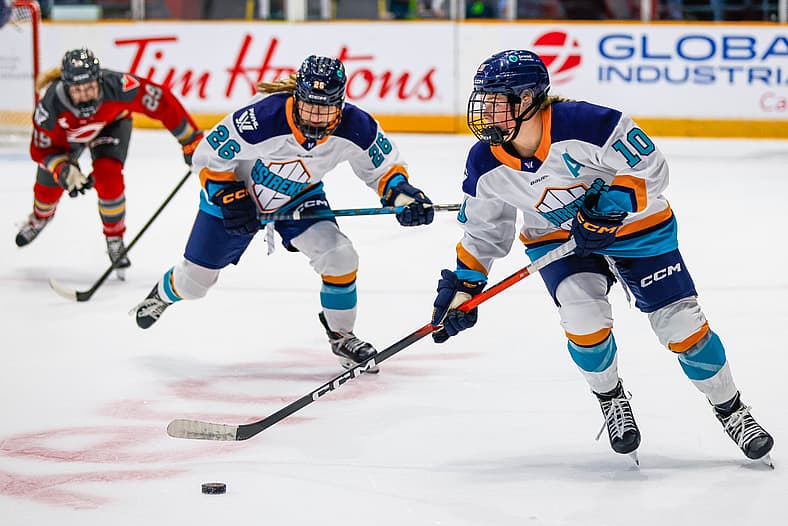
The Sirens are the only team in the PWHL without a power-play goal in 2025-26. But they’re not the only one falling short of expectations.
New York is one of three teams converting on less than 10 percent of their power plays. Last season, no team finished lower than 14.9 percent.
“Power-play numbers are down across the league, in general,” Fargo noted last week. “I don’t know why that is.”
In 2024-25, the PWHL power-play percentage was 18.1 percent — a 1.4 percent rise from the inaugural season. Through 21 games in 2025-26, the average power-play percentage has fallen to 14.2 percent, which would be the lowest in League history.
Fillier has a theory.
“My mind honestly goes right to expansion,” the 2024-25 PWHL All-Star said Monday. “I think you’re pulling apart teams who maybe had some chemistry on the power play. You’re losing top-end talent on every team. It’s getting more diverse, diversified across the league. I think that probably plays a part in it.”
Take the Sirens, for instance, who parted ways with four of their top five goal scorers from 2024-25 ahead of the 2025 expansion draft.
“Obviously, we lost 90 percent of our PP1 from last year,” Fillier added. “So I think maybe that’s a factor affecting it.”
New York’s power-play coach isn’t sure if that’s the only explanation for the dip in power-play success.
“I think with every team, you’ve got your players on the power play that can make plays across the League,” said Sciba. “I mean, [penalty] kills work hard. They also are out there influencing that. You’ve got really good goaltenders in the League as well. So there’s a lot of factors, I think, that play a part in that.”
Either way, it’s not a trend he thinks will carry on throughout the entire season.
“I think you’re starting to see some power play goals go in at different times,” Sciba explained. “People are evolving, finding new ways. And I think with skilled players, they’re going to find a way eventually.”