

 Marc Dumont
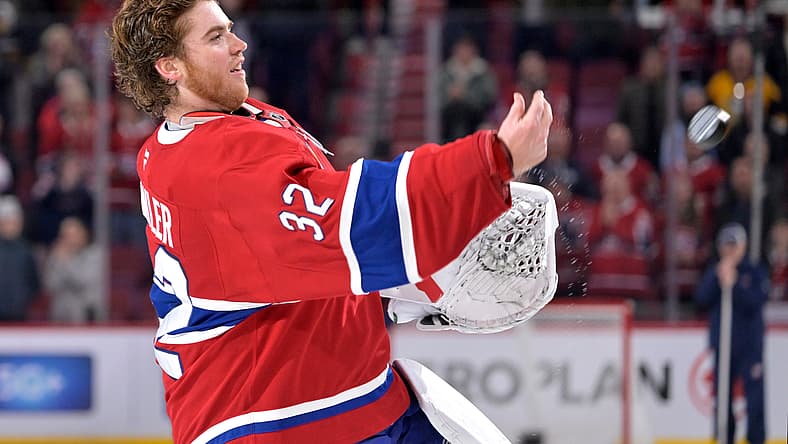
With just two players left to discuss, we’ve reached the cream of the crop in our annual Montreal Canadiens top 20 prospect rankings, as chosen by Habs fans.
Heir apparent Jacob Fowler nabbed the No. 2 spot, a testament to his incredibly encouraging development.
N.B.: To qualify for the project, prospects must be 23 years old or younger and currently playing outside the NHL. In other words, even though Canadiens players such as Lane Hutson, Juraj Slafkovsky, and Ivan Demidov are young enough to qualify age-wise, they’ve already established themselves as NHL players and are no longer considered prospects.
Previously Published Montreal Canadiens Prospect Profiles
Canadiens Prospects Who Just Missed the Cut
Canadiens Prospects Ranked 20-16
Canadiens Prospects Ranked 15-11
No.10 – Towering Hayden Paupanekis
No. 9 – Truculent Florian Xhekaj
No.8 – Highly Skilled L.J Mooney
No.7 – Extraordinary Bryce Pickford
No.5 – Highly Mobile Adam Engstrom
No. 4 – Enigmatic David Reinbacher
No. 3 – Brilliant Alexander Zharovsky
Jacob Fowler
2. Goaltender, Catches Left, 21, Laval Rocket (AHL), 6’2″, 214 lb. Picked 69th overall in 2023.
From the moment Jacob Fowler took over as Boston College’s starting netminder, it was quite clear he had the potential to one day become a starting goaltender in the NHL.
Of course, there were some hints pointing to his excellence prior to the Canadiens selecting him in the third round of the 2023 NHL Entry Draft. Fowler was fresh off a dominant stretch in the USHL which powered the Youngstown Phantoms to a Clark Cup Championship, serving as the team’s Most Valuable Player due to his impressive .952 save percentage.
And yet, there were no guarantees that his game would translate to the NCAA, as it represented a significant uptick in quality of competition.
Fowler didn’t just adapt to college hockey, he quickly established himself as one of the best goaltenders in the country, putting together a 25-7-2 record in his second year with the Eagles, paired with an impressive .940 save percentage.
It was the driving force behind the decision to convince him to sign an entry-level contract, putting an end to his NCAA career after just two years in the league. It should be noted that Fowler was not the first Canadiens netminder to spend just two years in the NCAA. Both Cayden Primeau and Jakub Dobes made their jump to the professional ranks after two seasons playing college hockey, a reminder that rushing a goaltender carries a certain amount of risk.
That being said, now that we’ve had the chance to watch Fowler play in a professional league, it’s safe to say he’s offered up excellent performances despite his lack of experience, which means he’s excelled in every league, from the USHL to the NHL.
His 10-game audition with the Canadiens was not perfect, and yet, he provided the team with their best chance to win games, to the tune of a .902 save percentage. That may not seem like an excellent result, but when we consider both Samuel Montembeault (.874) and Jakub Dobes (.892) have struggled at times due to the elevated number of high-danger chances the Habs allow every night, not to mention the fact that the teams around the league are scoring more goals in recent years than the previous era, it goes to show that Fowler performed admirably in a rather difficult situation.
To put a fine point on his impressive results, we can also turn to the AHL, where Fowler has emerged as one of the best goaltenders in the league. He has a .915 save percentage, good for sixth overall in the league. This led to a well-deserved All-Star nod for the rookie netminder, yet another feather in his crowded cap.
Strengths
Fowler is a supremely boring, which is the highest compliment you can pay to a young netminder. He wastes very little energy, using elite anticipation, vision, and tracking to ensure he’s set before most shots.
That’s not to say he’s immune to being caught out of position at times, but for the most part, Fowler has shown that he can make life very difficult on opposing teams by always being ready to make a save, rather than reacting to the situation at the last moment.
This eliminates the most vulnerable situation for a goaltender: having to adjust their position as they react to a shot.
Fowler out there making casual saves on Crosby in crunch time. #GoHabsGo pic.twitter.com/oME2vlsrHY
— Marc Dumont (@MarcPDumont) December 12, 2025
His rebound control is well above average, which became very apparent during his short tenure in the NHL. Both Montembeault and Dobes can struggle when it comes to holding onto pucks, whereas Fowler showed a penchant for eliminating the second-chance opportunities that have plagued the Canadiens in 2025-26.
When rebounds were inevitable, Fowler did a great job redirecting pucks to low-danger scoring areas, once again mitigating the scoring opportunities for opposing players.
He also approached every game with the confidence and mental preparedness you’d expect from a 10-year veteran, a good reminder that he has the right type of mentality to thrive in a hockey-crazed market such as Montreal.
Weaknesses
I’ve followed Fowler’s progression closely since he made his NCAA debut, and though I maintain he’s one of the most well-rounded goaltending prospects I’ve had the chance to monitor, he does have an Achilles heel.
When the puck goes down low, and then quickly back to the slot, Fowler’s tracking, which is usually elite, suddenly becomes mediocre. This results in him sitting back a little too far in his net, giving shooters too much open net to work with.
His lateral transitions can be clunky at times, but it’s one aspect of his game that has improved by leaps and bounds over the course of the last few seasons.
He’s prone to having stretches in which he seems a little overwhelmed, at least when compared to his usual NCAA standard. I’d argue this is a result of playing behind an elite Boston College team for two years, a situation that led to many wins, but a distinct lack of shot volume.
It’s also important to note that I’m looking for nits to pick at this point.
All the issues in his game essentially require one simple solution: more experience.
In that vein, Fowler’s greatest weakness is that he’s still a rookie netminder, which isn’t necessarily a weakness, but rather, a realistic assessment of his encouraging development.
What To Expect From Fowler Moving Forward
All things considered, Fowler clearly has what it takes to become Montreal’s starter once he has accumulated enough experience, but we should guard against rushing him into the NHL, especially as the Canadiens navigate the final stretch of the season.
Yes, Fowler played well during his short stint with the Habs, but there’s something to be said about allowing him to develop in a slightly less pressure-packed situation.
In other words, the AHL is the perfect league for Fowler in 2025-26.
That may not the be case next season, especially since the Habs are dealing with goaltending woes, but despite his excellent numbers, the Canadiens cannot afford to risk his long-term potential to solve a short-term issue.
He’s a great goaltending prospect, arguably the best the team has had in decades, and his time will come sooner than later.
However, for the time being, he’s still learning on the job.
Montreal Canadiens player statistics via Elite Prospects.