Marc Dumont
With the NHL on hiatus due to the Olympic break, it’s the perfect time to discuss the top Montreal Canadiens prospects, as voted on by you, Habs fans.
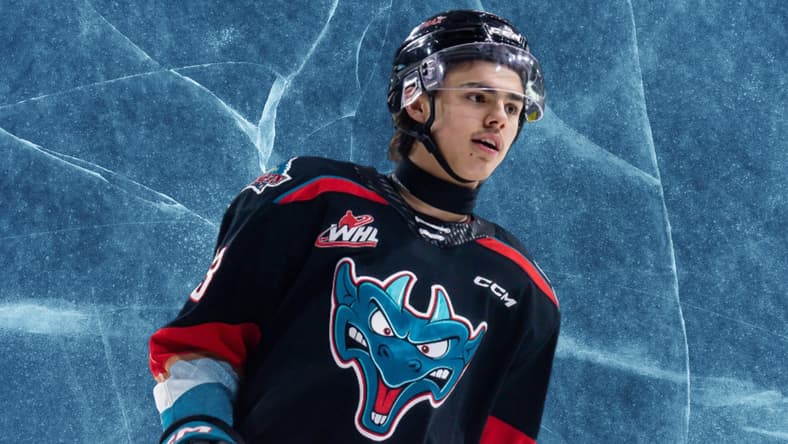
Today’s article will take an in-depth look at the first player in the top 10, Kelowna Rockets forward Hayden Paupanakis.
To qualify for the project, prospects must be 23 years old or younger and currently playing outside the NHL. In other words, even though Canadiens players such as Lane Hutson, Juraj Slafkovsky, and Ivan Demidov are young enough to qualify, they’ve already established themselves as NHL players and are no longer considered prospects.
Previously Published Montreal Canadiens Prospect Rankings
Canadiens Prospects Who Just Missed the Cut
Canadiens Prospects Ranked 20-16
Canadiens Prospects Ranked 15-11
Hayden Paupanekis
10. Centre, Shoots Right, 19, Kelowna Rockets (WHL), 6’5″, 203 lb. Picked 69th overall in 2025.
They say time heals all wounds, but there are certain rivalries that take more time than others to overcome, and that was certainly the case when discussing the Canadiens and the Boston Bruins.
In 1964, the Canadiens traded with the Bruins to acquire the rights to a 16-year-old goalie named Ken Dryden. In exchange, they sent two players to the Bruins: Paul Reid and Guy Allen.
Dryden went on to become one of the best players in the history of the league, while neither Reid nor Allen ever suited up for an NHL game. From that point to the 2025 NHL Entry Draft, the Canadiens and Bruins completed a grand total of three trades.
A few months after the Dryden trade, Montreal acquired Orval Tessier for cash, but once the Bruins became aware of their franchise-altering fumble in the Dryden trade, the relationship between the organizations broke down, as evidenced by the fact that the next trade took place in 2001, when the Canadiens traded Eric Weinrich for Patrick Traverse.
It would take another 24 years before the next trade materialized. The trade involved sending picks No.79 and 108 to the Bruins in exchange for pick No.69 at the 2025 NHL Entry Draft, which allowed the Habs to pick Paupanekis in the third round.
In other words, Paupankis held the type of potential that made a deal with the devil a logical path forward, a testament to the heightened level of interest from the Montreal Canadiens.
At 6’5″, Paupanekis has the type of frame that would interest most NHL teams, and though he didn’t set the WHL on fire during his draft season, his raw talent was too tempting to ignore. Paupanekis ended up producing 15 goals and 24 assists in 71 games, splitting his time between the Spokane Chiefs and the Kelowna Rockets following a blockbuster trade that involved Washington Capitals draft pick Andrew Cristall.
It should be noted that he had to deal with a bout of mononucleosis to start the 2025-26 season, forcing him to miss the Canadiens rookie camp. This led to a relatively slow start to the year, but he has since picked up his play, scoring 14 goals and 16 assists in 43 games for the Rockets. This represents a 25% uptick in scoring compared to the previous season.
Strengths
When it comes to his scoring prowess, he tends to defer to his heavy one-timer if he has enough time and space in the offensive zone. If the shot does not beat the goaltender cleanly, he puts enough power behind it to generate a second-chance scoring opportunity for his linemates.
As for his wrist shot, the release tends to be somewhat slower, which leads to a fair amount of blocked shots off the rush. Paupanekis has some work to do when it comes to increasing the fluidity of his shot mechanics, but that’s par for the course when evaluating a player who has grown four or five inches over the course of the last two seasons.
His size and strength allows him to carve out precious ice near high-danger scoring areas, with an onus put on deflecting point shots or pouncing on rebounds in near the slot.
It’s important to note that taller players tend to be described as ‘good skaters… for their size’, which is code for a big prospect who struggles in the skating department.
But Paupanekis is a good skater, full stop.
This allows him to quickly drive the net and stake out a claim, something he was specifically told to work on after the Canadiens drafted him in 2025. This is the same directive the team gave prospect Owen Beck in 2022, which points to the organization’s desire to add players who not only possess an interesting skill level, but can also survive the rigours professional hockey once they’re ready to make the biggest jump in their career.
“Being 6’5, I’m a big guy, I want to play big,” explained Paupanekis. “That’s the biggest thing for me this year, playing big, getting open around the puck.”
Weaknesses
Even though he’s usually the biggest player on the ice, Paupanekis could stand to improve his overall physical game. He’s not a particularly truculent prospect, and though it may not seem fair, a hockey player standing at 6’5″ will always be expected to carry the physical play.
That being said, he’s doing a much better job of getting involved in puck battles this season, and he’s also improved his defensive prowess, thanks to ability to anticipate the play, not to mention his impressive reach.
His playmaking leaves a little to be desired, especially in transition, as he can sometimes force a pass in the offensive zone, leading to turnovers or scoring chances for his opponents. He tends to take the path most travelled, lacking a certain level of innovation when it comes to creating time and space for his teammates.
What To Expect From Paupanekis Moving Forward
Paupanekis is a classic project, in the sense that he has to polish many of his skills before he’s ready to make the jump to the NHL.
Spending a few seasons in the AHL is the likeliest path forward, giving him an opportunity to work on his speed of execution, offensive awareness, and release.
It also remains to be seen whether he can handle the physical play involved in professional hockey. Hitting players who are much smaller in the WHL is a world away from facing grizzled veterans who have thrown and absorbed more than their fair share of hits in a professional league.
In terms of projecting his potential, I’d argue he may one day become a fourth-line centre in the NHL, though he could end up in a third-line role should he be able to add a little more consistency when it comes offering a reliable amount of secondary or tertiary offence.
The most encouraging aspect of his development is that Paupanekis seems to take a step forward every week, a sign that he’s only scratching the surface when it comes to his full potential.
All Montreal Canadiens and Hayden Paupanekis statistics via Elite Prospects.