

 Marc Dumont
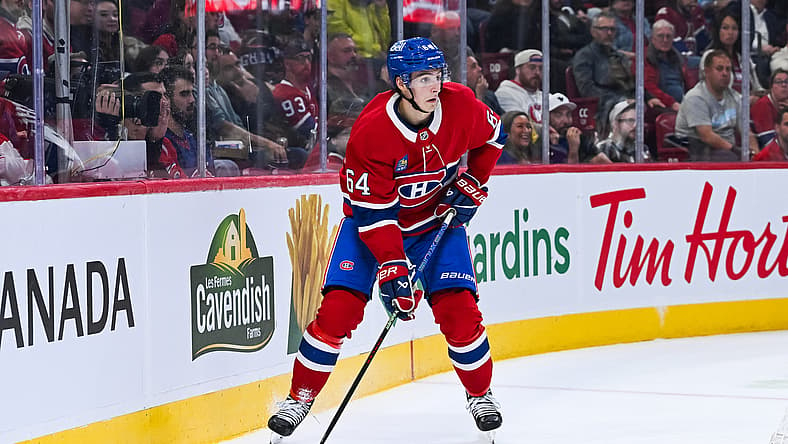
With just four players left to discuss in our annual Montreal Canadiens top-20 prospect rankings, we’ve reached one of the most intriguing players in the prospect pool: defenceman David Reinbacher.
N.B.: To qualify for the project, prospects must be 23 years old or younger and currently playing outside the NHL. In other words, even though Canadiens players such as Lane Hutson, Juraj Slafkovsky, and Ivan Demidov are young enough to qualify age-wise, they’ve already established themselves as NHL players and are no longer considered prospects.
Previously Published Montreal Canadiens Prospect Rankings
Canadiens Prospects Who Just Missed the Cut
Canadiens Prospects Ranked 20-16
Canadiens Prospects Ranked 15-11
No.10 – Towering Hayden Paupanekis
No. 9 – Truculent Florian Xhekaj
No.8 – Highly Skilled L.J Mooney
No.7 – Extraordinary Bryce Pickford
No.5 – Highly Mobile Adam Engstrom
David Reinbacher
4. Defenceman, Shoots Right, 21, Laval Rocket (AHL), 6’2″, 194 lb. Picked 5th overall in 2023.
Much ink has been spilled when it comes to Reinbacher’s rocky development with the Canadiens.
Due to numerous injuries, Reinbacher has only managed to play 61 games split between three seasons in the AHL. As it stands, he’s the only player drafted in the top 10 of the 2023 NHL Entry Draft who is yet to make his NHL debut.
Of course, we must consider a few factors, including how defencemen usually require a longer developmental runway than forwards.
It’s also important to remember that when the Canadiens opted to draft Reinbacher, there was a clear-cut dearth of talent on the right side of the blue line, a situation that has been rectified now that Noah Dobson has signed an eight-year contract with the team.
By paying a relatively high price tag to acquire Dobson, the Canadiens not only upgraded one of their most crucial positions, they also acknowledged that Reinbacher was not quite ready for NHL duties. Consequently, the Dobson trade afforded a few more years of development for a player who still represents one of the most important prospects in the system.
In retrospect, it’s fair to argue that Reinbacher’s potential was slightly exaggerated by most prospect analysts, though the fact that other NHL teams were interested in drafting him in the top 5 suggests a certain consensus around the league as to his eventual ascension to the best hockey league on the planet.
Now that we’ve had a chance to watch him play for a few seasons, it’s probably time to adjust our expectations, using a more realistic approach to project his long-term potential.
In that vein, rather than simply describing his strengths and weaknesses, we will assess which aspects of Reinbacher’s game have improved in recent years, and which continue to require substantial development.
Strengths
For the most part, Reinbacher has been used by Laval Rocket head coach Pascal Vincent on the second pairing, alongside William Trudeau. That being said, he can often feature on the team’s top powerplay unit, with Adam Engstrom serving as his defensive partner.
Reinbacher has managed to score four goals and 12 assists in 40 games this season, and while that may not seem like an impressive production rate, it’s a significant step forward when it comes to his individual results.
He’s shown a heightened level of confidence in 2025-26, which has resulted in much fewer giveaways.
In other words, he’s not throwing away the puck blindly when under pressure, displaying much more poise, both in the offensive and defensive zone. This improvement has led to an uptick in passes that generate high-danger scoring chances, as well as a more reliable brand of defence.
His puck retrievals, in particular, have been much cleaner, and he’s using an active stick with a much higher frequency to disrupt opposing players who are attempting to score off the rush. He’s also doing a better job when it comes to protecting the puck during battles along the half wall and below the hash marks.
As for his strength, he’s still not a dominant force, but I’d argue he’s doing a respectable job protecting the slot, which certainly was not the case when he first arrived in North America.
To get a better idea of his overall development, I invite you to take 30 minutes to watch both videos embedded in this article. They cover every shift in two separate games, giving us a good idea of the good, the bad, and the ugly involved in Reinbacher’s game.
He’s not a perfect player by any means, but it’s clear that he has improved on several weaknesses during his time with the Rocket.
Weaknesses
In most cases, a player who has spent at least two years in the AHL will have roughly 140 games worth of experience under their belt. Reinbacher, on the other hand, has played fewer than 70 games.
With that in mind, his defensive coverage still needs a fair amount of work, as he can sometimes get lost in the coverage when opposing teams install a cycle down low. The positioning issues are also apparent when evaluating Reinbacher’s gap control. He tends to give up precious ice, preferring a passive approach when forwards bear down on him.
The most glaring positional issue arises when he’s used alongside Engstrom, on the left side of the ice. He will instinctively make his way to the right, his natural position, which can lead to considerable defensive breakdowns.
Now that he’s playing with more confidence, his puck-handling skills have improved, but there’s still a very real risk that he’ll bobble a pass, or struggle to corral a puck without any semblance of pressure from opposing players.
His speed of execution also leaves something to be desired, a significant red flag when evaluating his NHL potential. Simply put, if a player finds the AHL to be a very fast league, they’ll almost certainly struggle in the NHL, where there’s no time or space afforded to the skaters, particularly puck-moving defencemen such as Reinbacher.
What To Expect From Reinbacher Moving Forward
Ideally, we would forget that he’s a top 5 draft pick, and treat him like every other prospect in the system.
This would remove some of the unrealistic expectations, and set the table for a more pragmatic evaluation of his long-term potential.
That’s not to say Reinbacher is a bust, a sentence uttered by many frustrated Canadiens fans in the last few seasons. He’s just 21 years old, and since his contract slid during his time in Europe, there’s absolutely no rush to sign him to a new deal.
In fact, 2025-26 represents just the first year of his three-year, entry-level contract, which means the Habs will not have to consider a contract extension until 2028.
It’s fitting, because Reinbacher essentially only has one year’s worth of AHL experience in the bank, having dealt with several injuries since the was drafted by the Montreal Canadiens.
In that regard, a slow-cooker approach is ideal.
Set it, and forget it.
There’s absolutely no rush in his case, both when it comes to Montreal’s pressing needs, and his individual development.
Reinbacher clearly still has NHL potential, but we shouldn’t count on him to one day become a top-pairing defenceman, as was suggested by some prospect experts. He could defy the odds, making me eat a heavy dose of crow in the process, but there’s really nothing in his game, nor his numbers, that suggest that’s a fair projection.
And by expecting him to do so, we’re really setting the bar much too high, especially since he has a long history of injuries.
If Reinbacher ends up playing an important role in Montreal’s top four—which is a very realistic expectation—he’d still be defying the odds, given his unorthodox development.
Montreal Canadiens player statistics via Elite Prospects.