

 Marc Dumont
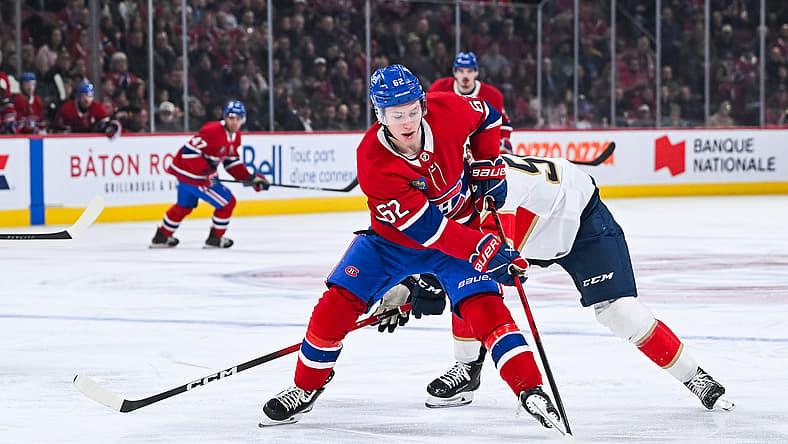
Up next in our Montreal Canadiens top-20 prospect rankings, as voted on by Habs fans, is well-rounded forward Owen Beck. He nabbed the No. 6 spot in the fan vote, ahead of 40 other players in the prospect pool.
N.B.: To qualify for the project, prospects must be 23 years old or younger and currently playing outside the NHL. In other words, even though Canadiens players such as Lane Hutson, Juraj Slafkovsky, and Ivan Demidov are young enough to qualify, they’ve already established themselves as NHL players and are no longer considered prospects.
Previously Published Montreal Canadiens Prospect Rankings
Canadiens Prospects Who Just Missed the Cut
Canadiens Prospects Ranked 20-16
Canadiens Prospects Ranked 15-11
No.10 – Towering Hayden Paupanekis
No. 9 – Truculent Florian Xhekaj
No.8 – Highly Skilled L.J Mooney
No.7 – Extraordinary Bryce Pickford
Owen Beck
6. Centre, Shoots Right, 22, Laval Rocket (AHL), 6’0″, 198 lb. Picked 33rd overall in 2022.
Now that we’ve had a chance to evaluate Beck’s transition from Junior hockey to the professional ranks, we have a much better understanding of what he can bring to the table for the Canadiens. It also helps that Beck spent 15 games in the NHL earlier in the season, as it allowed us to evaluate the underlying numbers he produced in his short tenure with the Habs.
As per usual, context is key in hockey, which is why his usage with the Canadiens, involving mostly fourth-line duties, is important to note. It was clearly not a situation that’s conducive to scoring, though Beck did manage to score his first career goal on December 20, versus the Pittsburgh Penguins.
More importantly, when Beck was on the ice, the Canadiens controlled the flow of the game, an important step for a player who will soon be expected to play a defensive role in the NHL in a full-time basis.
In fact, during Beck’s shifts, the Habs held a 52.1% share of the shots, the fourth-best result among all players who have spent at least 100 minutes on the ice at 5v5 this season. Only Cole Caufield (52.8%), Alex Texier (52.7%), Nick Suzuki (52.5%), and Lane Hutson (52.2%) have managed to produce better shot share numbers. In other words, beyond Montreal’s top line and best defenceman, Beck stands out as the most impressive young player in the lineup when evaluating his impact on shot share.
It’s also worth noting the Habs outscored opponents 5-1 during his time in the NHL this year, yet another very encouraging number. Of course, it’s not a sustainable ratio, but his 52.2% expected goal share suggests Beck’s time in Montreal was a good indication that a permanent jump to the NHL is in the cards.
In Laval, Beck has anchored the second or third line for the most part, with his current line configuration featuring Joshua Roy and Filip Mesar on the wings. He’s on pace for nine goals and 18 assists in 58 games, which is a downtick in production compared to his rookie season.
This represents a red flag when evaluating his overall development, but a slow start to the season, as well as the aforementioned NHL call-up, explains some of the lack of consistency in his production.
Strengths
Beck is almost always among the smartest players on the ice, using his anticipation, vision, and defensive prowess to offer stalwart shifts to the coaching staff on any given night.
He quickly understands the assignment, and takes very little coaching once the game begins, making him a plug-and-play forward who wastes no time establishing a heightened trust level with the head coach.
He’s also a dominant force at the faceoff circle, as evidenced by his 58.7% success rate during his 15-game audition with the Canadiens. This is a key factor when evaluating Habs prospects, as head coach Martin St-Louis clearly puts an onus on using centres who can win more than their fair share of draws. The downside to this obsession with faceoffs is that some players tend to be good at the dot, but fail to control the play once their faceoff duties conclude.
Beck, on the other hand, has shown he can not only win draws, but also help the team control the play throughout the rest of the shift, a key factor for a player who is expected to spend most of his time in the bottom-six once he’s ready to make the jump to the NHL.
He’s quite adept in transition, giving him the ability to quickly adapt from defence to offence, using high-end skating to generate scoring chances off the rush.
Owen Beck scores his first career NHL goal, via a sweet shot off the rush.
— Marc Dumont (@MarcPDumont) December 21, 2025
This one will definitely count. 2-0 #GoHabsGo pic.twitter.com/fRV916LQ3m
Weaknesses
Beck is unlikely to win the Art Ross Trophy, an acknowledgment that his scoring prowess, or lack thereof, will prevent him from playing in a top-six role in the NHL.
While most expect him to eventually take over Jake Evans’ role, there’s nothing in the numbers to suggest that he will be able to provide the same level of offence while playing as the team’s fourth-line centre. That’s not to say Beck will purely be a defensive player moving forward, but producing in a bottom-six role is very difficult.
Additionally, holding onto the fourth-line centre role isn’t as easy as some assume. Evans has solidified his position within the team after many years of hard work, and brutal assignments.
Beck is well-suited for the job, but it remains to be seen whether he can thrive in that role.
He will have to continue to hit the gym with regularity, as he’s not the strongest player on the ice, but that’s one aspect of his game that has improved by leaps and bounds since he was told by several NHL teams at the draft that he needed to add a certain element of truculence to his game.
Owen Beck was told by a lot of teams at the NHL draft that they thought he should be more physical.
— Marc Dumont (@MarcPDumont) February 5, 2025
He listened.
Here he is on the forecheck, creating a scoring chance with two heavy hits. #GoHabsGo pic.twitter.com/74julZ3aPb
What To Expect From Beck Moving Forward
While many prospects require powerplay usage and top-six minutes to make an impact in the AHL or NHL, that’s not necessarily the case for Beck, which should give him the inside track on his counterparts at training camp next season.
A full-time NHL job in 2026-27 is far from a guarantee, but Beck’s well-rounded game means that he’ll continue to hover near the front of the call-up line when the Canadiens look to the AHL to bolster their lineup.
He’s already proven he can survive in the NHL, with his encouraging underlying numbers providing strong evidence that he can immediately make a positive impact with the Habs.
In that vein, I’d argue that—as long as expectations are kept realistic—it’s a matter of when, not if, Beck secures a long-term job in the best hockey league on Earth.
Montreal Canadiens prospect statistics via Elite Prospects.