

 Daniel Amoia
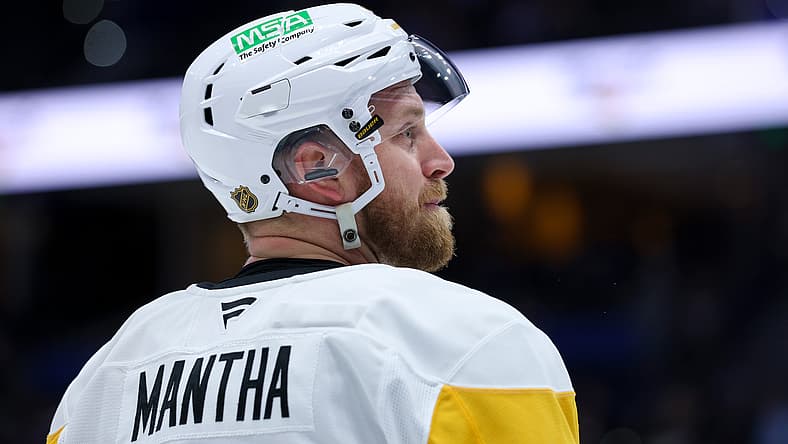
After the New Jersey Devils were unable to land forward Barrett Hayton via offer sheet, everyone knew general manager Sunny Mehta would pivot to another forward. On Tuesday, the team announced the signing of free-agent winger Anthony Mantha.
The move brought quite the mixed reaction from analysts and fans alike.
Mantha will be 32 years old when the 2026-27 season begins. He’s battled inconsistency and injuries throughout his career, his effort level has been questioned at times, and he’s never scored in 20 career playoff contests.
On the other hand, he’s coming off the best offensive season of his NHL career, scoring 33 goals and 64 points with the Pittsburgh Penguins.
That’s exactly why this signing is so fascinating. For better or worse, Mantha, along with the health of Jack Hughes, will be one of the biggest X-factors on New Jersey’s roster. There are legitimate reasons he remained unsigned through the frenzy of July 1st. But there are also legitimate reasons why this could wind up being the best value signing of the offseason — and restore the Devils to ‘contender status’ for the first time since 2022-23.
If Mantha comes anywhere close to repeating last season, he quietly changes the entire complexion of their lineup.
Devils in Desperate Need of Finishing
Mantha’s biggest strength last season directly addresses what was far and away the Devils’ biggest weakness. Per Natural Stat Trick, they scored ~48 goals below expected last season. Just average finishing would’ve flipped their minus-24 goal differential to a plus-24.
That’s the difference between being the 23rd-ranked team and the 11th. And that’s excluding all injury problems, inconsistent goaltending, etc.
Among 488 NHL skaters to appear in at least 60 games, Mantha’s 21.7% shooting percentage ranked fourth in the league. Aside from Cody Glass (30th, 18.3%) and Connor Brown (89th, 15.5%), no other current Devil ranked inside the top 150.
Mantha also finished tied for 29th in the NHL with his 33 goals. The 21 players who finished between 30th and 50th in NHL goal scoring last season are scheduled to earn an average annual cap hit of approximately $7.32 million in 2026-27. Mantha, meanwhile, signed for just $4.5 million.
His impact wasn’t limited to five-on-five, either. Mantha scored seven power-play goals, a total that would’ve ranked second on the Devils last season behind only Nico Hischier (11). Considering finishing was such a glaring issue across the lineup, adding another legitimate power-play scoring threat only strengthens an already dangerous unit.
Finishing isn’t always just about talent, either. There’s a significant mental component to it. The Devils played in their fair share of tight games last season where every missed opportunity seemed to carry a little more weight than the last. Sometimes, all it takes is seeing a few more pucks find twine for that confidence to spread throughout the lineup.
Head coach Sheldon Keefe has talked multiple times about the mental side of it — and it matters, even if it can’t always be measured in numbers. Players stop gripping their sticks so tightly, trust their instincts, and begin converting chances that previously stayed out of the net. If Mantha can provide some of that finishing touch, there’s a legitimate argument that his impact could extend beyond his own stat line by helping create a more confident offensive group as a whole.
It’s Not Just the Goal Scoring…
But one of the biggest reasons this signing makes sense goes beyond Mantha’s goal totals.
The Devils have built their identity around speed. They’re built to attack off the rush and create offense through quick transition. Despite his 6-foot-5 frame, Mantha can certainly keep up.
According to NHL EDGE, his maximum skating speed of 22.86 MPH ranked in the 81st percentile across the league last season. Among current Devils, only Connor Brown and Luke Hughes recorded faster top skating speeds.
He also brings something the Devils simply didn’t have enough of: elite shot power.
Mantha’s hardest shot reached 95.95 MPH, ranking in the 98th percentile league wide. In fact, no current Devil recorded a harder shot all of last season.
It Wasn’t Just Sidney Crosby and Evgeni Malkin
Of course, it’s necessary to address the criticisms. One of the biggest of them surrounding Mantha’s career year is that he simply benefited from playing alongside Sidney Crosby and Evgeni Malkin. That couldn’t be further from the truth.
According to MoneyPuck, the line Mantha spent the most time on (31 games) featured Justin Brazeau and 18-year-old Ben Kindel. That trio controlled an outstanding 64.7% of the goals scored while they were on the ice.
Not only was that the most success Mantha had on a line, but he played 19 more games with them than any line with Malkin or Crosby.
That doesn’t guarantee Mantha will repeat his 33-goal campaign…but it does suggest his production wasn’t simply the byproduct of playing next to two future Hall of Famers. (And by the way, even if it were, Jack Hughes isn’t too shabby of a player to ride shotgun with…)
Despite his 33 goals being a career-high, Mantha hasn’t shot below 20% since 2022-23. This is who he’s been for three seasons.
The Risks Are Still Real
If Mantha were a perfect player, he wouldn’t have still been available after the opening wave of free agency. And he certainly wouldn’t have signed for just $4.5M.
In the last five seasons, he’s only been healthy for 66.3% of his games (272/410). That’s 138 games missed. For comparison purposes, Jack has missed 98 games in the same span. But Mantha only missed one game last season, giving reason for optimism.
Then there’s the inconsistency, too. Throughout his career, Mantha has struggled to show up when things intensify in the playoffs. Just a day before he signed in NJ, Penguins’ beat reporter Josh Yohe wondered, “if [Mantha’s] playoff showing — no goals, bad penalties, teammates literally suggesting that certain forwards weren’t good in front of Philly’s net — is costing him a bit.”
Yohe reported that Mantha’s starting point for negotiations was three years. Clearly, there was (reasonable) apprehension from teams for him to end up signing for fewer than three.
All of the concerns are valid.
Why the Risk Is Worth Taking
At the same time, the downside isn’t nearly as scary as it may seem.
The Devils aren’t asking Anthony Mantha to be their best player — or even close to it. They’re asking him to complement an already talented core featuring Jack, Nico, Timo Meier and Jesper Bratt.
Yes, the playoff concerns are real. But before a team can become a perennial Stanley Cup contender, it first has to become a perennial playoff team. Mantha has every opportunity to help the Devils accomplish exactly that during the regular season.
At $4.5 million, there’s no no-movement clause attached to his contract. Those words probably bring happy tears to any Devils fan’s eyes since they’ve previously handed them out like candy.
As long as he’s healthy and available, other legitimate depth forwards (Lenni Hameenaho, Arseny Gritsyuk, Connor Brown, Evan Rodrigues, Jesper Boqvist) can move around the lineup where necessary. Barring a boatload of injuries, gone are the days of unproven AHL-caliber veterans in the forward group.
To put it simply: The Devils’ season won’t be ruined if Anthony Mantha regresses. But if it plays out as well as it could, Mantha’s prowess in the lineup could turn them into an Eastern Conference powerhouse.
No signing is ever a sure thing. But as we know with Mehta, every move he makes is calculated. This one seems like the potential pros far outweigh the cons. If both he and Jack are healthy for a majority of the season, they could compete for first in the Metro.
Even with this signing, they still have $3,850,000 in cap space to work with. As Mehta said in his presser a couple weeks ago, it’s never fair to assume he’s done. We’ll see if any other significant changes come before Training Camp.