
 Scott Gulbransen
Five years ago, an American Formula 1 fan had two options on a Sunday morning: find ESPN on their cable package or miss the race. The broadcast was fine. Commercial-free, Sky Sports commentary, respectable production. It moved the needle from niche to mainstream, especially after Drive to Survive turned the paddock into a Netflix drama in 2019.
That era ended on March 7, 2026, when the Australian Grand Prix became the first F1 race ever broadcast in the United States exclusively on Apple TV.
The sport didn’t just change platforms. It changed what watching Formula 1 in America actually means.
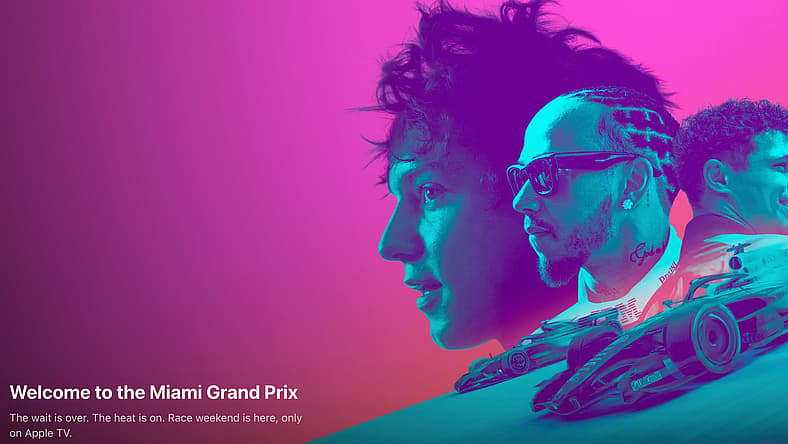
Watch Formula 1 Action LIVE at the Miami Grand Prix: Now Available on Apple TV
From Netflix to Apple TV: How the Door Got Blown Wide Open
Drive to Survive did something no broadcast deal could have done on its own. It introduced F1 to an audience that had no idea it was missing anything. By the time Netflix released season one in 2019, the sport’s American fan base was around 25 million. By 2025, it was 52 million — up 11% in a single year — and growing faster than any other major sport on the planet.
ESPN rode that wave well. Formula 1 averaged a record 1.32 million viewers per race across ESPN, ESPN2, and ABC during the 2025 season, its last year on the network, with 16 individual races setting event viewership records. The Abu Dhabi finale alone drew 1.5 million. That’s a 53% jump from the previous year’s finale. The growth was real and it was accelerating.
Then Apple paid $750 million over five years to take it exclusively. No cable bundle. No channel flip. One app, one subscription, $12.99 a month.
The skeptics had a point — moving sport to a paywall has historically caused viewership to crater. Ask NASCAR, which saw a 14% drop in 2025 when it shifted some races to Amazon Prime. But Apple was betting on something different: that the F1 fan ESPN created was a streaming-native, device-forward consumer who would follow the sport anywhere. Apple’s senior vice president of services, Eddy Cue, confirmed after the Australian Grand Prix that viewership was up year over year compared to 2025, exceeding both F1 and Apple’s expectations.
The bet is paying off so far.
Apple TV’s Approach to Formula 1 Coverage
The production gap between what ESPN delivered and what Apple launched is not subtle.
ESPN showed Sky Sports’ feed with British commentary and a ticker at the bottom. It was fine for fans who already knew the sport. It was not designed to pull in new ones.
Apple redesigned the entire viewing experience from scratch. Every Grand Prix now streams in 4K with Dolby Vision and 5.1 surround sound — the first time F1 has ever been broadcast in that format in the United States. That alone is significant. An F1 car at full speed in 4K Dolby Vision is a fundamentally different visual experience than what American fans have had before.
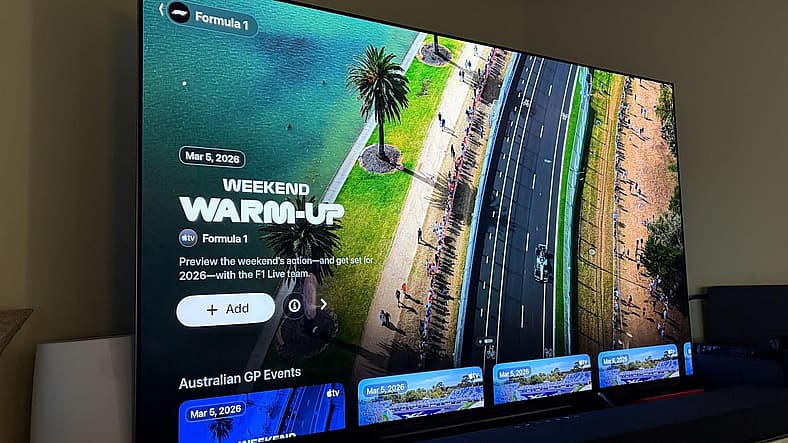
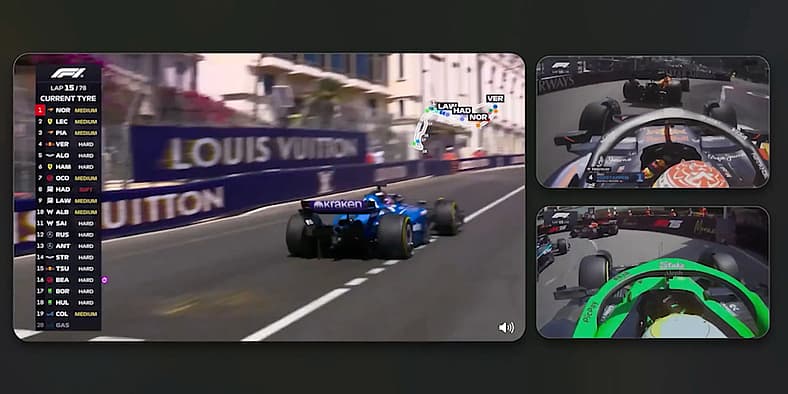
But the bigger shift is what’s underneath the main broadcast. Apple TV offers up to 30 simultaneous live feeds across all sessions — Driver Tracker for a bird’s-eye view of the race, real-time telemetry, a mixed onboard feed that automatically switches between driver cameras as the action unfolds, and Podium feeds that dynamically follow the top three throughout. Fans can watch up to four feeds at once through Multiview, with preconfigured team layouts or fully customized setups. Apple Vision Pro users get five simultaneous feeds.
The casual fan taps one button and gets a curated experience. The hardcore fan builds their own broadcast. No other sport in America offers this.
And it goes beyond the screen. The Apple Sports app delivers real-time leaderboards and live updates. Apple Maps has custom circuit guides with 3D grandstands and turn-by-turn navigation for fans attending in person. Apple Music runs free live audio broadcasts during races. They’ve also partnered with free streaming service Tubi to offer exclusive live F1 altcasts for multiple races, available at no cost across every device. Yahoo Sports gets practice and qualifying streams. The Canadian Grand Prix will simulcast on Netflix.
This isn’t a broadcast deal. It’s an ecosystem play.
The Audience Apple Was Built For
Here’s the thing about the American F1 fan that Drive to Survive built: they didn’t fall in love with lap times. American fans fell in love with Lewis Hamilton’s championship hunt in 2021. They fell in love with Max Verstappen being relentlessly competitive. Viewers fell in love with the paddock politics, team orders, driver feuds, and the whole dramatic production.
They are, in other words, exactly the audience Apple has spent a decade cultivating — streaming-native, content-forward, device-loyal, and accustomed to paying for premium experiences they actually use.
The United States is now Formula 1’s largest market for YouTube viewership, with 171 million video views in 2025, and social media followers are up 17% year over year. The 18-49 demographic — the one every advertiser and platform wants — watched F1 on ESPN last season, averaging 511,000 viewers per race, a 24% jump from 2024. These fans weren’t watching because F1 was on cable. They were watching in spite of it.
Apple gives them a reason to lean in harder. The Multiview feature alone is designed for the fan who follows a specific driver. It’s getting the viewer who wants George Russell’s onboard in the corner, with the main feed in the center and driver’s championship leader Kimi Antonelli‘s telemetry in the third window. That’s not a traditional sports viewer. That’s a fan who got into this through a streaming show and now wants to go as deep into the sport as it allows.
2026 Miami Grand Prix: Where It All Comes Together
The coverage and the spectacle are now co-designed. That’s the part that gets overlooked in the broadcast conversation.
Miami’s visual identity — the fake marina, the palm trees inside a stadium complex, the paddock that looks like a luxury brand activation — was always built for cameras. But now it’s built specifically for the kind of cameras Apple brings. The cinematic 4K production that Apple deployed in Australia, China, and Japan wasn’t accidental. It was purpose-built for a circuit that was purpose-built for television.
F1 CEO Stefano Domenicali said at Apple’s press day in February that Apple’s reach through its streaming and connectivity platforms will ultimately be bigger for Formula 1 than ESPN’s ever was. That’s a significant statement from a man who watched ESPN help turn his sport from a niche European import into a 52-million-fan American phenomenon.
Miami Grand Prix week is the clearest expression of what F1 has become in America, and now it has a broadcast partner whose entire business model is built around exactly the kind of fan that showed up for it. The celebrities, the 4K cameras, the 30 simultaneous feeds, the multiview layouts, the Tubi altcasts for fans who don’t want to pay, the Netflix partnership for fans who already do.
Drive to Survive opened the door. Apple walked through it and remodeled the house.
American fans don’t flip to F1 on cable anymore. They open an app, pick their camera feeds, and watch a 19-year-old break records in 4K Dolby Vision on a circuit built specifically to look good doing it.
That’s the new normal. Miami is just the most obvious proof of it.