
 Scott Gulbransen
The second day of F1 pre-season testing brought reliability headaches for two of the sport’s heavyweights and a Hollywood cameo in the paddock.
Charles Leclerc posted the fastest lap of the entire test so far on Thursday, steering his Ferrari SF-26 to a 1:34.273 that put him comfortably clear of McLaren’s Lando Norris. But the real story of Day 2 at Bahrain International Circuit wasn’t who was fastest. It was the teams that couldn’t even get out of the garage.
Red Bull and Mercedes, two teams widely expected to contend for the F1 2026 championship, spent most of the morning sidelined with mechanical problems while their rivals racked up miles in the desert heat. For newcomers trying to figure out the 2026 pecking order, here’s the honest truth: don’t read too much into it yet. Teams run different fuel loads, tire compounds, and engine modes during testing. But reliability? That matters. And Thursday was a rough one for two big names.
Red Bull’s Hydraulic Headache
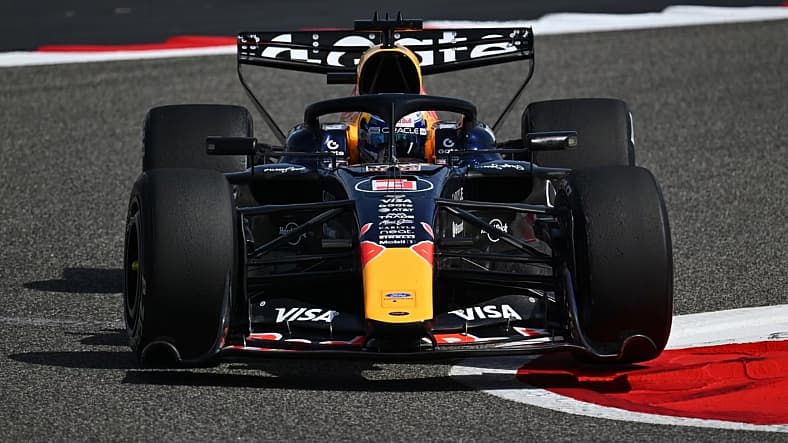
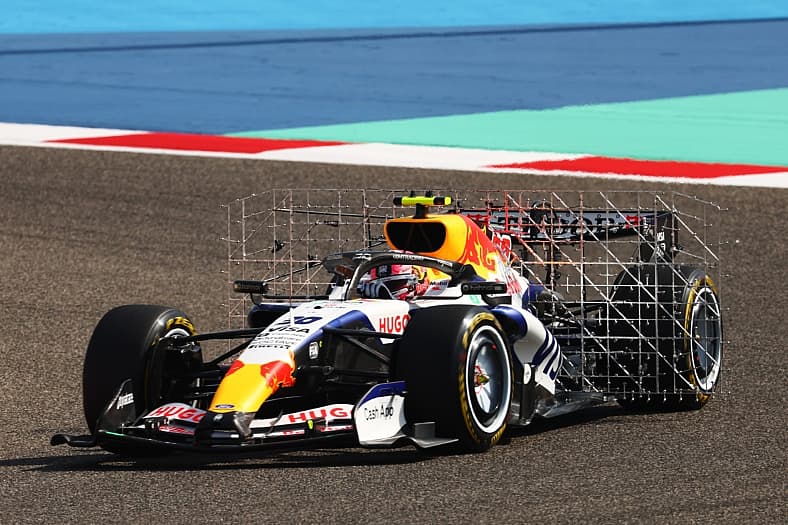
Red Bull’s Isack Hadjar, who replaced Yuki Tsunoda in the team’s second seat this year, managed just a single installation lap all morning. The team discovered a hydraulic leak during the car build and couldn’t resolve it until after the lunch break. Things improved in the afternoon with Hadjar banging out over 20 laps — but the lost time stung, especially after Max Verstappen’s monster 136-lap effort on Day 1 had the entire paddock buzzing about Red Bull’s new homegrown engine.
Williams driver Carlos Sainz was among those who noticed something special from Red Bull on Wednesday.
“It’s still extremely early days, but if I would have to judge by the GPS data of yesterday, right now it is true that whatever Red Bull Ford powertrains were doing yesterday was a clear step ahead of anyone else,” Sainz said. “A clear step, not only a small step, but a clear step and it was mighty impressive.”
He didn’t stop there.
“If they manage to turn up to race one with a completely new set of regulations, with a completely new engine, new people and turn up to be the fastest and most reliable engine, you will have to take your hat off to them.”
Mercedes Changes Entire Power Unit
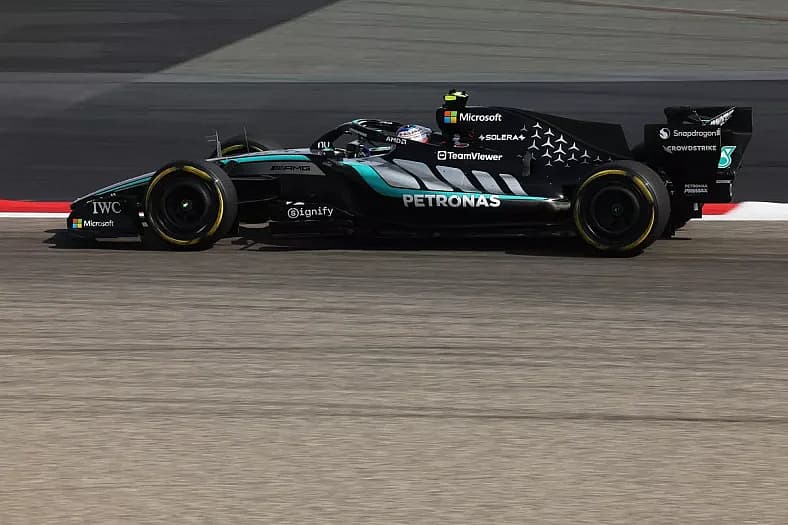
Mercedes had an even rougher morning. Kimi Antonelli, the 19-year-old Italian in just his second F1 season, managed only three laps before an engine problem forced the team to swap out the entire power unit. That meant hours of work in the garage and virtually no data collected. George Russell eventually got the repaired car on track in the afternoon, but the damage to the team’s test program was done. Mercedes had already lost time on Day 1 when a suspension issue limited Antonelli’s afternoon running.
The engine trouble is particularly awkward timing for Mercedes, given the swirling controversy around their power unit design. Rival teams have questioned whether Mercedes’ compression ratio trick — an engineering interpretation that other manufacturers say exceeds the spirit of the rules — should be allowed. The FIA is still sorting it out. Team boss Toto Wolff has addressed the situation publicly, but the political undercurrent in the paddock is hard to miss.
Cadillac’s Bumpy but Promising F1 Debut Continues
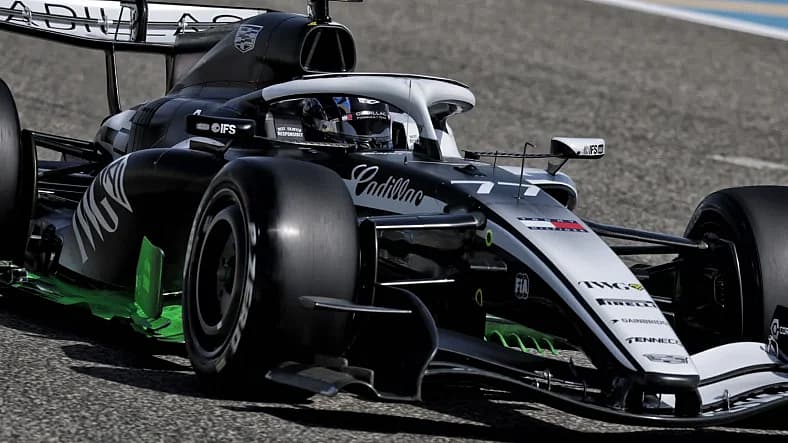
Cadillac, the American team making its first-ever F1 appearance this year, triggered the day’s only red flag when Sergio Perez’s car coasted to a stop on his very first out-lap. A throttle setup issue was the culprit. The team got it sorted within an hour, though, and Perez went on to complete 42 laps by the end of the morning session. Valtteri Bottas took over in the afternoon.
And speaking of Cadillac — Keanu Reeves was spotted in the paddock on Thursday. The actor is filming a documentary series about the team’s journey to the grid, a follow-up to his Emmy-winning Brawn: The Impossible Formula 1 Story on Disney+.
The F1 Start Problem Nobody’s Talking About Enough
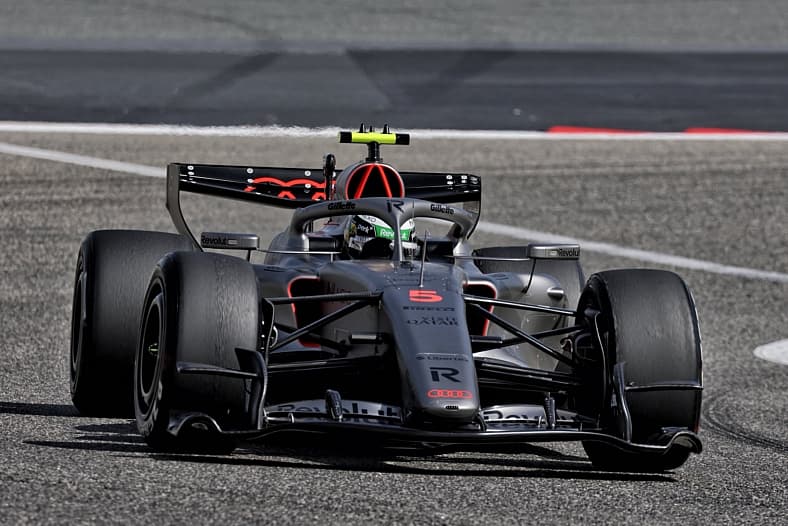
One of the more fascinating storylines coming out of Bahrain has nothing to do with lap times. It’s about race starts, specifically how much harder they are under the 2026 rules.
The new F1 engines no longer have the MGU-H, a component that previously used exhaust gases to spin the turbocharger. Without it, drivers face significant turbo lag off the line. They have to rev much higher and hold it much longer before releasing the clutch. It’s a completely different procedure from what they’ve done for the past decade.
Audi’s second-year driver, Gabriel Bortoleto, tried a practice start and came away shaking his head.
“Oh man, it’s complicated,” Bortoleto said. “The 10 second thing and then after five seconds I already lost the count and then engines revving up, gear in and out, and you need to release the clutch. It’s quite a mess. It was much easier last year.”
Reigning world champion Norris put it in strategic terms.
“As soon as you start to use any battery to help in any situation, you’re just taking away a lot of battery to use for the rest of the lap,” he said. “I can maybe have a better start, but you can also run out of battery by the time you get to Turn 1.”
Translation for new fans: the first few races could feature some genuinely wild starts. And Bottas, who’ll serve a five-place grid penalty at the season opener in Australia due to a collision from his last race in 2024, is already wondering how it’ll work from the back of the grid.
“If I’m towards the back of the grid, is there enough time when the light starts to go on to actually get that turbo spinning?” Bottas asked. “Now, it takes like 10 seconds. So that’s one thing we’ve got to figure out.”
The Big Picture
Hamilton put the whole new era in perspective after Day 1, calling the 2026 rules “ridiculously complex” and warning that fans may struggle to follow along. “None of the fans are going to understand it,” he said. “It’s like you need a degree to fully understand it all.”
He’s not wrong that there’s a learning curve.
Here’s the short version of where things stand after two days: Ferrari and McLaren look sharp. Red Bull’s engine is turning heads when it’s running, but reliability is a question mark. Mercedes is dealing with both mechanical and political fires. And Cadillac, for all the bumps, is out there turning laps. For a brand-new team, that counts as a win.
Testing continues Friday with Day 3. A second three-day test starts February 18.