

 Marc Dumont

With the third game of the series in the books, the Montreal Canadiens have now established a 2-1 lead over the Tampa Bay Lightning.
It’s still very early in the series, and things can change in a hurry, but the fact that the Canadiens have an advantage in the first place is rather encouraging, given they’re the clear-cut underdogs in the series.
With that in mind, let’s take a look at some of the factors that have helped the Canadiens gain a series lead.
Quality Scoring Chances
The Lightning have controlled the majority of the shots at 5v5, to the tune of 55.4%. However, it’s the Montreal Canadiens that have managed to create the most high-danger scoring opportunities.
And it’s not a relatively close contest, either.
In three games, the Canadiens have generated 24 high-danger shots, while allowing the Lightning to take just eight. This means the Habs have controlled 75% of the high-quality shots throughout the series, which isn’t just a slight advantage, it’s the epitome of a dominant edge in a crucial statistical category.
To make matters more interesting, the Habs allowed the Lightning to generate a grand total of two quality scoring chances in Game 1 and 3, combined.
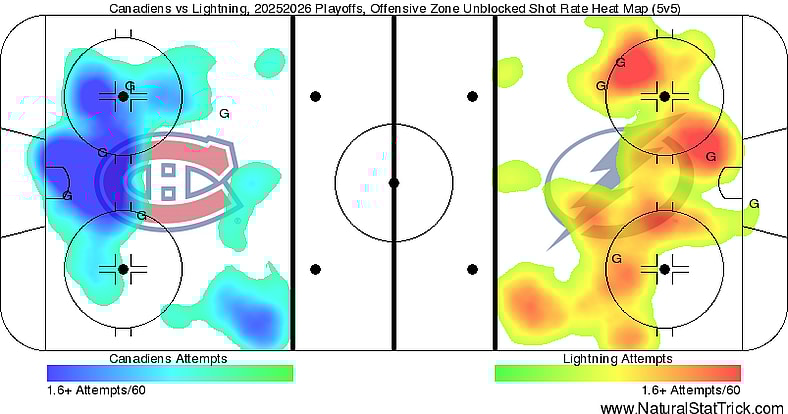
This is coming from a team that was ranked 27th in the league in high-danger scoring chances throughout the regular season, with a very concerning 46.4% share.
Secondary And Tertiary Scoring
With Juraj Slakovsky’s powerplay hat trick in the rearview mirror, it’s become clear the first line is having a hard time generating much offence at 5v5.
Even at the Bell Centre, where head coach Martin St-Louis controlled the matchups, Montreal’s first line barely broke even in shot share.
Given that Slafkovsky, Nick Suzuki, and Cole Caufield did much of the heavy lifting during the regular season, it’s fair to say the rest of the team must make up for the lack of goal scoring at 5v5 in the playoffs, but that’s much easier said than done.
Heading into Friday’s game, only Josh Anderson (2) had managed to find the back of the net at 5v5, making Alexandre Texier, Kirby Dach, and Lane Hutson’s goals very important from a roster construction standpoint, giving the first line a little more time to work out their issues.
Kirby Dach ties the game after Arber Xhekaj keeps the play alive.
— Montreal Hockey Now (@MTLhockeynow) April 25, 2026
2-2 #GoHabsGo pic.twitter.com/AqPB3WOkTX
Third Pairing
When evaluating defencemen, it’s always essential to acknowledge that usage tends to drive results.
An easier assignment, such as playing on the third pairing, makes life easier on depth blueliners.
However, Arber Xhekaj and Jayden Struble aren’t just playing well on the third pairing, they’re offering dominant performances, both physically, and when it comes to keeping the puck as far away as possible from Jakub Dobes.
To put a fine point on Xhekaj and Struble’s excellence, they lead the entire NHL in expected goal share. Xhekaj is yet to be on the ice for one high-danger scoring chance against at 5v5, a reminder that consistent usage can lead to great things for players who are attempting to find their own consistency in the NHL.
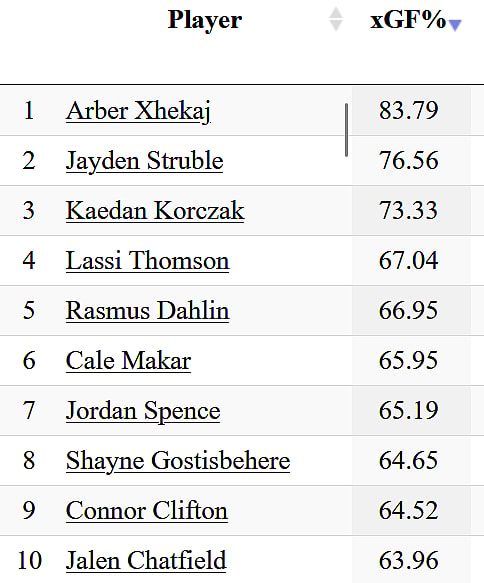
Of course, they face a lower quality of competition than most, but if it were so easy to produce 80 xGF% on the third pairing, we’d see it quite often around the league.
The reality is that few, if any other pairings have managed to control the same percentage of shots, goals, scoring chances, and expected goals as Xhekaj and Struble.
All Montreal Canadiens statistics are 5v5 unless otherwise noted, via Natural Stat Trick.