Roni Hermo

Nick Suzuki’s constant progression has been leading him into another career year for the Montreal Canadiens. In addition to being on pace to score 95 points, his underlying numbers at 5v5 suggest that he’s having the best play driving year of his career.
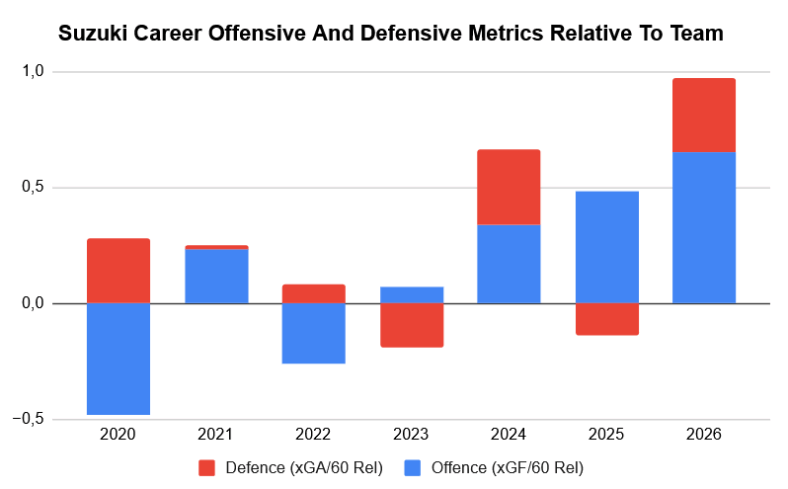
When compared to his teammates, his offensive metrics stand out more than they’ve ever done, but his defensive numbers are also at a career-high level.
This has sparked discussion whether the Canadiens’ captain should be in the conversation for the award for the best defensive forward in the NHL, the Selke Trophy.
Why Suzuki Cannot Win
Thanks to Reddit user Bokchoy’s statistical analysis on seasons 2007/08–2019/20, we know quite well what the statistical profile for the most Selke Trophy winners and finalists looks like.
According to Bokchoy’s analysis, the Selke Trophy winners most often meet the following six criteria:
1. They are centres.
2. They score at least 50 points.
3. They win at least 53% of their faceoffs.
4. They spend at 1:30 per game on the penalty kill.
5. They have shot attempt (Corsi) share of above 53%.
6. They are on a team that has a top-10 goals against average in the NHL.
Even if quite many of these criteria are problematic for measuring defensive or two-way performance, almost all Selke winners since 2007–08 have met all six when they’ve won the award, and most of the finalists have, as well. After Bokchoy’s analysis, the trophy has been awarded five times to two players (Aleksander Barkov and Patrice Bergeron), and they have checked every box of Bokchoy’s list of qualifications.
Although the members of the Professional Hockey Writers’ association most likely do not explicitly follow this list of rules, they tend vote players that match all six.
And that can mitigate Suzuki’s chances of improving his career-high Selke vote finish of 13th (2024, 2025) any further.
When we compare his season to the criteria, we notice that he checks only two boxes. He is a centerman, and he’s already scored 64 points.
His shot attempt share of 52.8% – when not rounded up – is just short of the number mentioned in Bokchoy’s rules. The difference is non-existent, so that most likely would not hurt his chances, but the other three are more problematic.
His faceoff percentage of 49.5% is the worst he’s had since the 2022–23 season, and it’s quite far away from the 53% mark. He’s also averaged only 55 seconds on the penalty kill per game, so that criterion is not met either. In fact, Suzuki has played at least a minute and a half per game on the penalty kill only twice in his career, 2021–22 and 2022–23.
Also, the Canadiens are quite far from being a top-10 goals against average team in the league. They currently rank 22nd in that statistical category.
Thus, without voters drastically deviating from the usual formula, it seems Suzuki will have to wait his turn to take pictures with the trophy named after the former Montreal Canadiens and Maple Leafs general manager Frank J. Selke.
But that doesn’t prevent us from speculating whether he deserves it or not.
Why Suzuki Can Win
To understand Suzuki’s defensive success this season better, we can compare him to players with similar profiles using the relative to teammates expected goals as our measuring stick, as it’s the statistic that measures defensive play driving the best.
Suzuki!
— Marc Dumont (@MarcPDumont) January 30, 2026
He scores a great shorthanded goal to give the #GoHabsGo a 3-1 lead. pic.twitter.com/wooxo4UuRc
Suzuki has averaged 14:34 of 5v5 ice time and 0:55 of PK per game this season, and he has a positive relative to teammates expected goals per 60 stat line. The positive relative xGA/60 is our first criterion.
As mentioned, for a Selke candidate, the penalty kill TOI is low, but to find prominent players close to him, we’ll use one minute per game on PK as our second criterion. For the third criterion, we’ll use 12 minutes per game at 5v5 as our TOI limit. Approximately six to eight forwards per team average that much ice time a night in the NHL this season.
Of the almost 400 forwards who have played 300 minutes or more at 5v5, only 41 meet the criteria. To compare their defensive results, I created a simple Defence Score metric which is based directly on their relative expected goals against numbers and nothing else. The top-25 among those players looks like this:
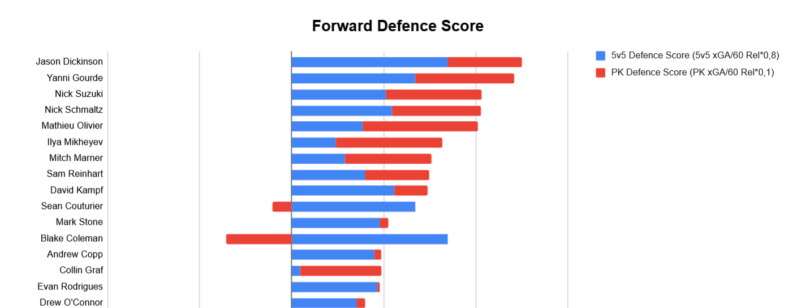
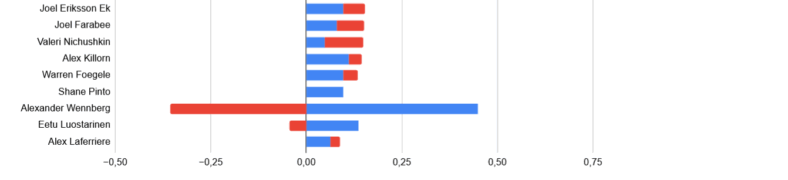
As we can see, per this metric, only four forwards have a better Defence Score than Nick Suzuki this season. While Suzuki’s overall score is probably better than it should be because of a relatively light workload on PK, only eight forwards of the above-mentioned group of 41 have put up better defensive numbers at 5v5 than Suzuki.
In addition, four of those eight players (Wennberg, Coleman, Couturier and Jack Drury) are PK workhorses who have averaged more than 2 minutes of PK time per game, but their relative on-ice results have not been good. Of those with similar 5v5 stats, only Stone, Schmaltz and Wennberg are scoring at, at least, 50-point pace over 82 games.
We can therefore state with good conscience that only few players in a similar role in the NHL have had a better or even similar impact to their team’s defence as Nick Suzuki. And they, like Suzuki with his PK workload, have some flaws on their résumés when compared to the stereotypical statistical profile of a Selke Trophy winner.
Suzuki wins the faceoff, but is forced to make a huge block in the dying seconds of overtime. #GoHabsGo pic.twitter.com/K9aNoHXDt8
— Marc Dumont (@MarcPDumont) November 5, 2025
Montreal Canadiens Brass Tacks
Nick Suzuki has made a strong case of being in the Selke Trophy conversations over the two thirds of the season. If he can keep the same pace up after returning from the Olympics, there would only be justice and fairness if he simply crushes his current record of 30 Selke Trophy votes.
It remains to be seen if the voters consider not spending some more time on the penalty kill a big issue, or if not winning enough faceoffs hurt his chances to actually win the award.
On the other hand, the Canadiens’ penalty kill has struggled to suppress chances this season. Perhaps using the captain more often in that situation can lead to greatness for both the team and the player.
All Montreal Canadiens statistics are via Natural Stat Trick.