

 Marc Dumont
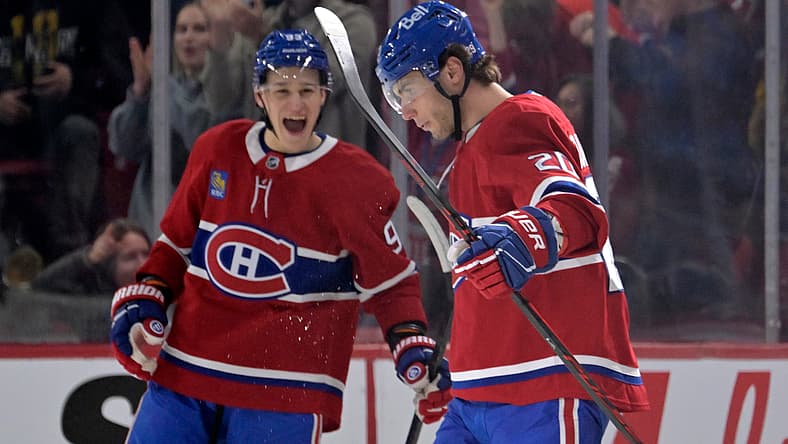
The Montreal Canadiens are plowing forward with their second line, which features Juraj Slafkovsky, Oliver Kapanen, and Ivan Demidov.
We discussed their play several weeks ago, and the results were far from encouraging. In fact, they were getting outshot and outchanced regularly at 5v5.
But like all things, we also had to allow for some time for the players to get used to each other, which is why we’re revisiting their numbers in January.
Second Line Statistics
The first thing we’ll do is examine their underlying numbers since the moment they were placed together on the second line. This includes a 5v5 sample size of roughly 190 minutes.
As it stands, the Demidov, Slafkovsky, and Kapanen line has managed to control 45.6% of the shots (CF%), 39.2% of the high-danger chances (HDCF%), and 45.8% of the expected goals (xGF%.)
They’re far from dominant numbers, and they show a clear discrepancy with the actual results, which includes controlling almost 62% of the goals, and the projected results.

However, if we focus on their stats since we last evaluated the second-line’s performance on December 17, the numbers are much improved.
It’s an arbitrary cutoff to a certain extent, and the sample size is only 84 minutes at 5v5, but it still gives us a good idea of how they’ve played since they’ve had enough time to build chemistry.
Not only have they improved their shot control (52.8%), they’re controlling even more goals (72.7%), and their expected goals has risen above 50%. They’re still controlling fewer than 50% of the high-danger chances, but it’s a notable improvement on a team that generally struggles when it comes to high-quality scoring chances.

Fantastic play by the 2nd line.
— Marc Dumont (@MarcPDumont) January 4, 2026
Slafkovksy starts it with a great pass, and then Demidov does what he does best, carves out time and space in the offensive zone.
Kapanen converts.
2-2 #GoHabsGo pic.twitter.com/w27kZnAWuO
Montreal Canadiens Brass Tacks
I have to admit that I did not foresee the second line, which has essentially produced at a first-line level recently, would end up improving its underlying numbers so quickly.
There’s still some work to do, but when we consider they’re among the youngest lines in the NHL, with rookie Oliver Kapanen serving as the elder statesmen at 22-years-old, I’d say their recent uptick in results is the epitome of encouraging.
It’s also important when it comes to Slafkovsky’s ascension as a player who can drive the offence. He went from a player who rarely had the puck on his stick, to one that has enough confidence to attempt end-to-end rushes. He’s also generating more controlled entries than ever before.
Juraj Slafkovsky goes end-to-end and scores from a tough angle. His 14th goal of the year.#GoHabsGo up 6-4. pic.twitter.com/k0rFjdZXR0
— Marc Dumont (@MarcPDumont) January 2, 2026
However, it does lead to other questions.
How will the first line look moving forward? Can another winger find the same level of comfort as Slafkovsky once did alongside Nick Suzuki and Cole Caufield?
And is this play from the second line sustainable?
The first two questions remain to be answered, but it’s fair to say that based on the 10 last games, we have enough evidence to suggest that the second line is emerging as one of the most exciting and dynamic lines in the Atlantic Division, with the potential to become a dominant combination for the Canadiens if they shore up their share of high-quality scoring chances.
All Montreal Canadiens Statistics are 5v5 unless otherwise noted, via Natural Stat Trick.