

 Roni Hermo
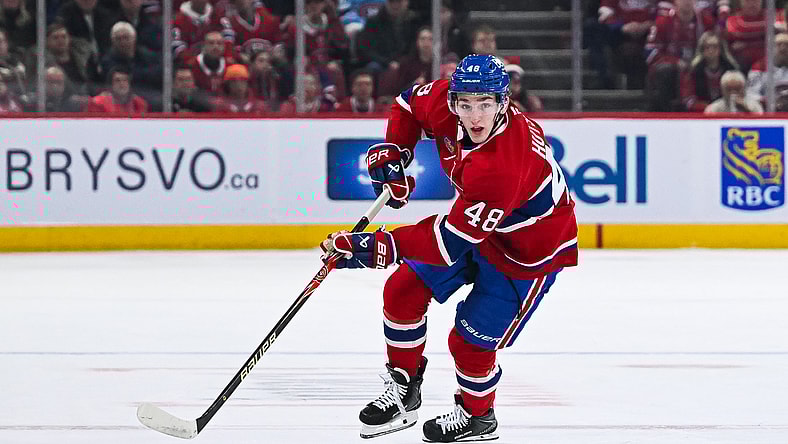
Lane Hutson becomes the fastest Montreal Canadiens defenceman to reach 50 career points. Lane Hutson ties the record for most assist by a rookie defenceman in NHL history. Lane Hutson becomes the 2nd-fastest defenceman to record 100 assist in NHL history.
So on and so forth.
Montreal Canadiens Record At Risk
With 58 points in 57 games this season, Lane Hutson currently ranks 3rd among all the NHL defencemen in scoring. Since being moved (primarily) on his natural left side, he’s been scoring at a 105-point pace, and no defenceman has more points than him.
If he can keep the pace up for the rest of the season, he’ll become the first Canadiens defenceman since Larry Robinson (1985–86) to produce over a point-per-game pace. And if he can keep the pace of his last 28 games up, he’ll seriously threaten the Canadiens single season record of 85 points set by Robinson during the Canadiens historical 1976–77 run.
Based on the former Boston University defenceman’s record-shattering NHL career so far, it’s a likely result, but it’s still worth verifying whether his underlying numbers support his chances.
Hutson time!
— Marc Dumont (@MarcPDumont) December 14, 2025
Lane Hutson creates time and space for his teammates, then finds Josh Anderson with a perfect pass.
4-2. #GoHabsGo pic.twitter.com/5zNCnxYxCP
What It Means To Be a PPG Defenceman
In the current scoring environment, since the 2017–18 season, a defenceman who’s played at least 60 games (40 in 2020–21) has scored at a point-per-game pace 22 times, the ongoing season included.
Shown in the table below are the average underlying numbers of the defencemen who have scored at least a point-per-game between 2017–18 and 2025–26 in all situations, Hutson excluded.
As those defenders have scored more than a point-per-game (1.09) on average, I’ve also added the calculated averages for a point-per-game blueliner with an average time on ice per game (25:07) among those defenders, and a defenceman with Hutson’s time on ice per game (23:42). All the average numbers are also compared to Hutson’s current scoring and play driving pace.

In terms of actual goals, everything is looking fine for Hutson. The Canadiens are scoring more goals than you’d expect of a point-per-game defenceman when he’s on the ice. Hutson is also contributing to 55.2% of those goals.
It does become trickier when we take a look at the play driving. The Canadiens have been able to create 1.46 expected goals per game and 3.69 per 60 minutes, which are just short of what the point-per-game defencemen are producing on average (1.55 per game, 3.71 per 60). In addition, Hutson ice time is limited in comparison, with roughly 1:30 less time-on-ice per game, which makes it even harder to sustain his pace.
Despite the mitigating factors, Hutson is still scoring 1.02 points-per-game, because his on-ice shooting percentage of 16.3% is much higher than his counterparts.
In a nutshell, it means that even if high-scoring defencemen seem to maintain somewhat higher on-ice shooting percentages, maintaining the current scoring rate may be borderline impossible for Hutson.
To clarify what the somewhat unsustainable finishing has meant to his production this season, we can compare it to the averages of the other defencemen in question. Had the Montreal Canadiens shot at 12.4% with Hutson on the ice, Hutson would be on pace to score 63 points. Had the Canadiens exceeded their expected goals at the average rate (approximately by 11%), Hutson would be on pace to 73 points over an 82-game season.
Predicting Hutson’s Points Total
While it’s unlikely that Hutson’s scoring pace drops to even so low as 73, the numbers show quite well how hard of a task it is for a defenceman to score on a point-per-game basis. It’s worth noting that Hutson has, in fact, been on ice for 3.93 xGF/60 – the exact number expected from a point per defender – since being moved to the left side. On top of that, his scoring has gotten a boost from an even higher on-ice shooting percentage of 18.6%.
Lane Hutson, ladies and gentlemen.
— Marc Dumont (@MarcPDumont) February 5, 2026
A great pass by Anderson, and a perfect finish by Hutson, who was the last guy back before the rush started.
It's Hutson's 10th goal of the year.#GoHabsGo up 3-1. pic.twitter.com/n6WlQdstZj
With this in mind, Hutson’s on-ice shooting percentage most likely will not drop to 12.4%. The Montreal Canadiens would need to score only 9 goals with 282 shots (3.1%) with Hutson on the ice in the next 25 games, if they keep generating shots at the same rate as they’ve done so far this season. The on-ice shooting percentage dropping to 14% would mean 25 goals with 282 shots (8.9%), and even that is unlikely.
If they keep generating the same amount of shots, and Hutson keeps contributing to 55.24% of the goals, the Canadiens would need 44 goals with Hutson on the ice in the last 25 games to keep Hutson at a point-per-game pace, with an on-ice shooting percentage of 15.6%. With an on-ice shooting percentage of 12.4%, they’d score 35 goals, which would lead Hutson’s total for the season to 77 points.
If they generate shots at the same rate as in the last 28 games, Hutson would need an on-ice shooting percentage of 14.5% in the last 25 games to maintain a point-per-game pace. With an on-ice shooting percentage of 12.4%, he’d hit 78 points over the full season.
To sum it up, because Hutson is registering his name on the scoresheet once per game, and while all his underlying numbers do not fully suggest that he should be able to achieve such a feat, it’s still very possible to be a point-per-game player at the end of the season.
But there’s a relatively strong argument to be made that he may fall a few points short of the milestone.
There are, nevertheless, some things the Canadiens as an organization can do to help his chances
Montreal Canadiens Brass Tacks
The most observant fans might have noticed from the previous table that on top of playing almost a minute and a half less per game than his counterparts, Hutson also has spent only 42.6% of his total ice time with the Canadiens top-scoring forward, Nick Suzuki.
On average, the point-per-game defencemen spend more than 52% of their ice time with their teams’ top-scoring forward. Noteworthy is the fact that although Hutson spends little less time with Suzuki, some players (Brent Burns, Erik Karlsson, Roman Josi) have managed to score a point-per-game playing even less with their top-scoring forward. It is up for debate, though, that they have had better secondary players on the ice than Hutson has.
As Hutson’s total ice time might be hard increase in a fashion that would really help him to score more, since quite many of those players who have played more than him, have also killed penalties, adding some more time with Suzuki could help him boost his scoring and play driving to a more sustainable production rate.

The main reason for the Canadiens’ coaching not to give Hutson more time with Suzuki has been the in-game matchups. They’ve wanted Hutson to spend less time against the opponents’ top lines, and more against their grind lines, which keeps him away from Suzuki.
The only extended stretch in which that was not the case took place between mid-December and mid-January, when Hutson was primarily paired with Alexandre Carrier. During those 18 games, Hutson not only played more against the opponents’ top lines and less against their fourth lines, but also – and more importantly – spent more than 47% of his total time on ice with the team’s captain.
For some reason, the Hutson and Dobson pairing has not been trusted to play against the toughest opponents as much as Hutson and Carrier, and that has reduced Hutson’s time on ice with the Canadiens’ top forwards even further.
This leads us to the question: should Hutson and Dobson play separately to give them both enough time with the top forwards?
Most likely, if the Canadiens’ coaches gave the Hutson–Dobson pairing the exact same deployment as Hutson–Carrier – and maybe even a little more both with Suzuki and against elite competition – they would do well enough.
But, if that isn’t set to happen, should Hutson be paired with Carrier again, or should the Canadiens pursue for an even more defensively established top-4 right-handed defenceman to play with him and by that, give him more ice time with Suzuki?
These are the questions the Canadiens’ management have time to think of during the Olympic break and before the March 6 NHL Trade Deadline.
All Montreal Canadiens statistics are 5v5 unless otherwise noted, via Natural Stat Trick.
