

 Marc Dumont
The main sticking point when Kent Hughes took over as the Montreal Canadiens general manager was the organization’s lack of developmental strategy.
Another way of putting it would be to remind everyone the Canadiens essentially did not have a development plan in place for well over a decade, which resulted in very few prospects making their way to the NHL, and even fewer making an impact.
Of course, draft position is a key factor, which is why it was important for Hughes and Company to enjoy successful drafts when they were set to pick in the top five.
2022 resulted in one of the best drafts in recent franchise history, with Lane Hutson, Juraj Slafkovsky, Adam Engstrom, and Owen Beck, among others, joining the prospect pool.
2023 was a little different. The Habs opted to pick David Reinbacher with the fifth overall pick, and the success of that draft will always be linked to his results. As it stands, you could easily argue it was an underwhelming draft, even if the Habs did end up landing Jacob Fowler in the third round.
Simply put, without hitting on your first-round pick, the potential impact of any draft will come into question.
That’s part of the reason 2024 is considered a quality draft for the Canadiens, as Ivan Demidov, the fifth overall pick, has already shown he can make a significant offensive impact in the NHL.
No. 5 – Ivan Demidov – Winger – 6’1″, 192lb, 82GP, 19G, 43A, 62PTS
Seeing as the Habs had ignored forward Matvei Michkov the previous year, many fans were hoping the scouting team would focus on offence, with Demidov emerging as the clear-cut favourite.
The Habs obliged, though we have to give some praise to the teams that decided to ignore one of the most talented players in the draft. Politics aside, Russian prospects are usually a safe bet. They may take a little more time to come to the NHL, but they report. That’s not always the case for NCAA players, a situation that’s at risk of repeating itself ad nauseam in the near future.
Demidov spent one frustrating season in the KHL before making his way to Montreal, where he was immediately placed in the top-six by head coach Martin St-Louis. While there’s no doubt Demidov deserves credit for producing a 62-point season in his rookie campaign, St-Louis has established himself as a head coach who does not hesitate to trust rookie players with important ice time. There are limits to his generosity, but the fact remains that St-Louis put Demidov in a situation that’s conductive to succeeding, much like he did for Hutson the previous year.
A creative forward, Demidov is arguably the most talented player on the team, displaying the type of puck-handling skills that could propel him into the NHL’s elite in the near future.
By picking Demidov, the Habs also ensured they’d get at least one prospect with star potential, making it a very encouraging draft class from the very get go, thanks to a little help from their friends (enemies).
No.21 – Michael Hage – Centre – 6’1″, 198lb, 39GP, 13G, 39A, 52PTS (NCAA)
With Demidov already in the prospect pool, the Habs opted to make an aggressive move to ensure they could select Michael Hage with the 21st overall pick. They traded the 26th overall pick, as well as two sweeteners, to the Los Angeles Kings, in exchange for pick No. 21.
Moving up in the draft has become one of Montreal’s calling cards in recent years. Following the Hage trade, the Canadiens would go on to move up in 2025 to pick both Alexander Zharovsky and Hayden Paupanekis, before moving up in the first round of the 2026 NHL Entry Draft to pick Gleb Pugachyov.
If the Canadiens want a particular player, and there’s any risk they won’t be able to secure his rights, they’ll pursue a trade that will allow them to select said prospect as soon as possible. It’s somewhat risky, but at the very least, it ensures the hard work the scouting team provided throughout the year is maximized by the organization.
Hage is yet to make his NHL debut, and is likely to return to the University of Michigan for a third year in the NCAA, but there’s no denying he’s one of the most dynamic prospects outside the NHL.
His first season with the Wolverines resulted in a 13-goal, 21-assist, 33-game campaign, an encouraging debut to say the least, as running at over a point-per-game as an NCAA rookie is one of the most important signs they have the right tools to one day become a star player in the NHL.
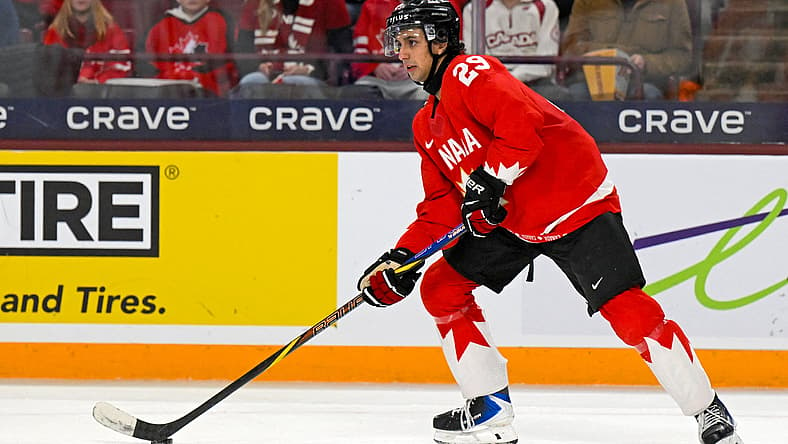
He followed it up with a 52-point sophomore season, yet more evidence that he possesses the type of skill set necessary to earn a top-six role with the Canadiens. In addition, Hage enjoyed a fantastic stretch at the World Junior Championship, where he scored 15 points in seven games for Team Canada.
Hage is a smooth-skating centre who is addicted to creating chaos in the offensive zone. He approaches every play with the intensity of a thousand suns, carrying and distributing the puck at full speed. This differentiates him from the majority of his counterparts, as most players have to slow down to get a handle on the situation.
But slowing down simply is not in Hage’s vocabulary. In a sense, it’s similar to Connor McDavid’s style of play, though we’re not here to suggest he’s going to become one of the best players in NHL history.
Rather, Hage represents an important, valuable asset who will be able to enter the lineup in the near future, and have a positive influence on the entire team.
2024 Best Of The Rest
Admittedly, it’s a little more difficult to get a read on a draft class that is just a couple of years old, but there’s a chance a few more players selected in 2024 will end up making their way to the NHL.
Aatos Koivu just missed the cut in our Top 20 Montreal Canadiens prospect rankings, while players like Owen Protz, Tyler Thorpe, and Logan Sawyer are yet to have their rankings revealed. Protz and Thorpe, in particular, have a better chance of impressing Canadiens management, as they represent the Hughes doctrine quite perfectly: combining size and skill.
With that in mind, you could argue that the 2024 NHL Entry Draft was successful for the Habs, as they acquired two forwards with elite potential, but there’s a chance it may end up being upgraded to elite if some of the players selected in later rounds develop into important hockey players.
Montreal Canadiens 2024 Draft Grade: A