

 Marc Dumont
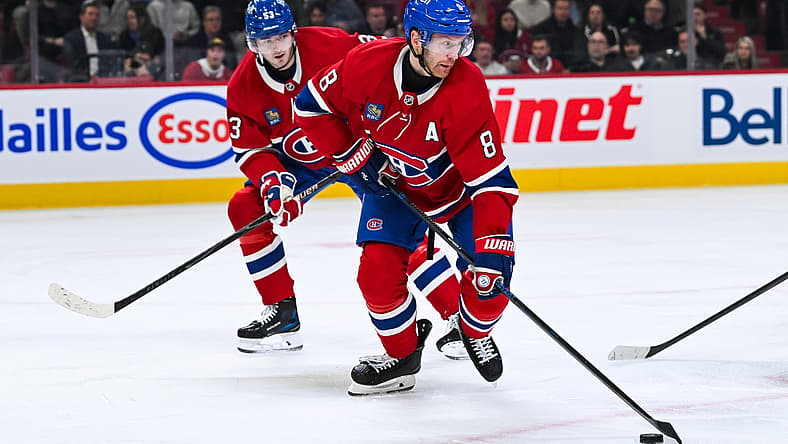
The Montreal Canadiens have an emerging problem among their defensive pairings.
We’ve seen several plays in which various players struggle to contain the play, or yield too much open ice to opponents attempting to score off the rush.
It’s important to remember that most plays involve more than just two defencemen. For example, in the play embedded below, both Mike Matheson and Noah Dobson fail in their defensive coverage, however, there was very little support from the other skaters on the ice.
Connor outworks the top pairing before Scheifele makes it 1-0 Jets. pic.twitter.com/OfwF5MoFZc
— Marc Dumont (@MarcPDumont) December 4, 2025
We also have to consider the defensive setup, which is a man-to-man system. This somewhat archaic strategy can be effective, but it requires an intense focus on positioning. If a single player loses his man, things quickly go awry.
With that in mind, let’s take a look at the numbers produced by the three pairings since November.
Defensive Pairings At 5v5.
To get a good idea how they’ve performed, we’re going to look at four different metrics (5v5).
The first is shot control (CF%), which represents the percentage of shots a particular pairing, player, or team controls in any given situation. If a player is on the ice for 8 of his team’s shots, while allowing opponents to take 2, he will have controlled 80% of the shots, and thus have an 80 CF%.
The second is high-danger shot control (HDCF%), representing the percentage of high-quality shots controlled.
The third is expected goals (xGF%), which projects the percentage of goals that should be controlled going forward.
The fourth is simply goals for (GF%), which measures how many goals have been scored and allowed in a particular situation.
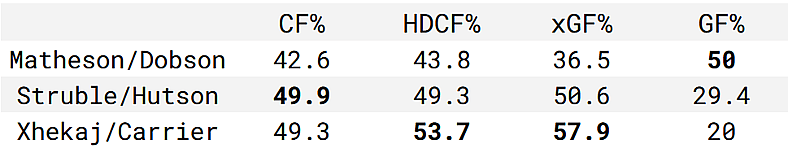
The first thing that becomes apparent is that the Matheson and Dobson pairing has actually managed to control 50 percent of the goals (16-16), which is a better result than any other pairing, and by a decent margin, too.
However, that number is bound to drop significantly, as Matheson and Dobson have controlled fewer shots, fewer high-quality chances, and fewer expected goals than the other two pairings. It should also be noted that the top pairing tends to play with Nick Suzuki‘s line, which is a clear-cut advantage when discussing the strength of their teammates.
As for the second and third pairing, it’s almost a polar opposite situation. They’ve both done a good job controlling shots, and their share of high-danger chances is much healthier, which leads to a higher share of the expected goals.
However, Lane Hutson and Jayden Struble have been outscored 5-12, while Alexandre Carrier and Arber Xhekaj have been outscored 2-8.
In other words, while the process has been very encouraging, the results are yet to catch up.
Montreal Canadiens Brass Tacks
The major sticking point is that the Habs are having to play without Kaiden Guhle, a player who is tasked with absorbing some of the most difficult minutes in the league.
But we also have to consider Guhle rarely finds himself on the positive side of 50% in any key metric. He’s not an immediate solution, though he does make life easier on the other pairings whenever he’s healthy enough to play.
The biggest problem is that the top pairing is in a free fall from a statistical standpoint, and though they’re barely treading water when it comes to the goals scored and allowed, the rest of the numbers suggest a Thelma and Louise-style drop off a cliff is looming.
A change in defensive pairings is likely to be necessary in the very near future, with the statistics telling us they’re already overdue.
All Montreal Canadiens statistics are 5v5 unless otherwise noted, via Natural Stat Trick.