

 Roni Hermo
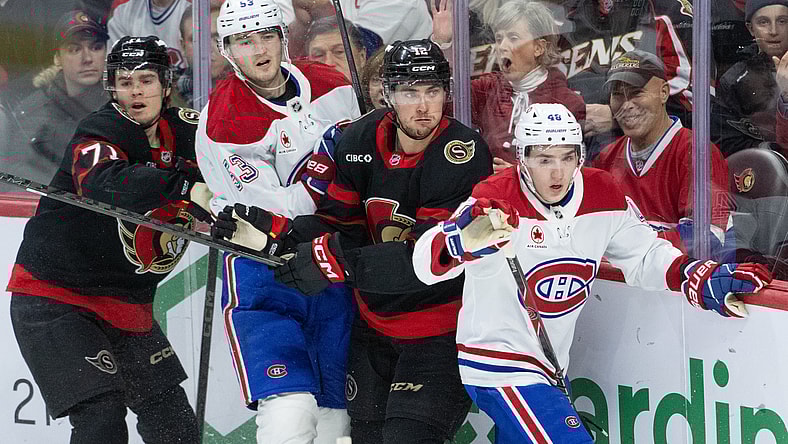
The acquisition of Noah Dobson was supposed to put all Montreal Canadiens defencemen in their right chairs, and especially reduces Mike Matheson‘s time on ice. That has not exactly been the case, as Matheson is still used as a hard-matched, shutdown number one defenceman, while Dobson has averaged almost a minute less of 5v5 time on ice per game.
The actual impact of the PEI-native’s acquisition – on the other hand – seems to show more in the underlying numbers of the surrounding players than in his individual ones.
Dobson’s Individual Impact
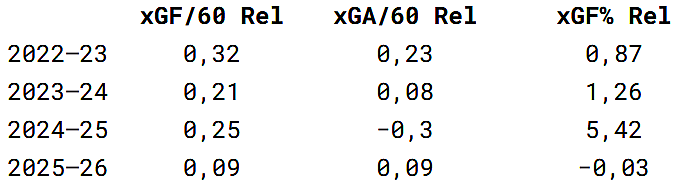
Despite not being able to control the expected goals at 5v5 at the same level as he did with the Islanders, Dobson is still on pace to score a career-high 11 goals and tying his career-high 37 points at 5v5, while playing almost a minute and a half less than with the Islanders during the 2023–24 NHL season.
On top of that, Dobson has blocked 10.5% of the shot attempts he’s been on the ice against at 5v5, and he currently ranks 8th among the NHL defencemen with at least 300 minutes of 5v5 time on ice, just a little behind teammate Alexandre Carrier.
The point production is boosted by a high individual shooting percentage of 9.3%. On top of that, he’s been enjoying a favourable on-ice finishing luck, as more than 11% of the shots that have been taken with Dobson on the ice have ended up in the back of the net.
Noah Dobson makes it 1-0 #GoHabsGo early. His eighth of the year. pic.twitter.com/1whnhHzsCu
— Marc Dumont (@MarcPDumont) January 9, 2026
Thus, it’s possible that the points might start to stop coming at some point, especially given that expressly the offensive underlying numbers have been down compared to his time with the Islanders. Although, it is worth noting that since the beginning of the year 2026, the on-ice expected goals for numbers have been nearing the same territory as with the Long Island team.
However, even if the underlying numbers might seem a bit underwhelming for the highest paid defenceman on the team, it’s when we look at the development of his deployment over the years, we notice that this is actually the first time in his career that he plays very hard minutes.
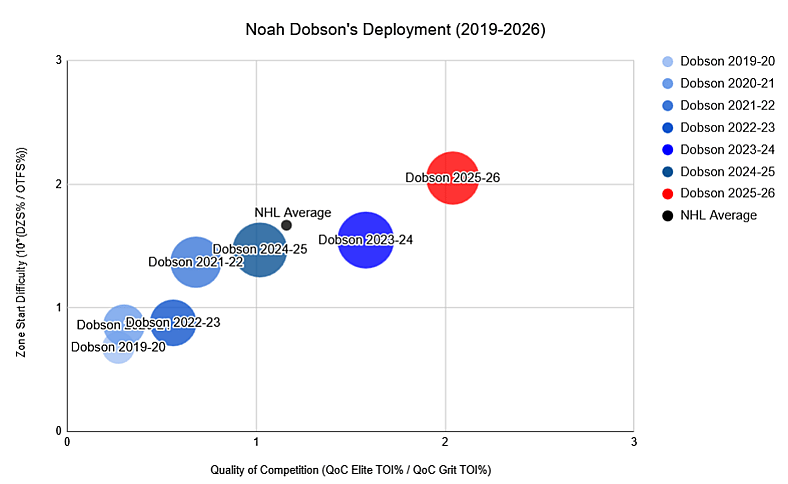
Before moving on, it’s worth noting that every chart that tries to visualize the differences in deployment, fails. The statistical impact of deployment difficulty is ultimately quite small, but not completely meaningless.
Dobson is currently playing more against the opponent’s top players than before, and taking a bigger share of defensive zone starts relative to the share of on the fly starts than he’s ever done, doing both at a way higher rate than an average defenceman.
That is almost solely because he’s paired with Mike Matheson, who the Canadiens’ coaching staff love to use in hard defensive situations, even if the results before this season have been very poor. Given the circumstances, Dobson’s underlying numbers could actually look much worse than a 49.6% expected goal share.
And that brings us to his impact on the other players on the team.
Holding The Fort With Matheson
The Matheson–Dobson pairing has been playing together for the whole season, except for the two mid-December games where Dobson was set up to play with Lane Hutson, and for the three games that Matheson missed with injuries. They’ve been trusted with one of the hardest deployments in the entire NHL, and only 8 pairings have played more together this season. To help them with their difficult job, they’ve also had the chance to play with the top Montreal Canadiens players more than any other defencemen.
That has led to them playing a somewhat high-event hockey; putting up just a little better than average offensive underlying numbers and below average defensive numbers. Given their role, the expected goal share of 48.5% is very decent, although it’s not what one should expect of a top pairing of a sustainably successful team.
But what makes their numbers even better, is the fact that they’ve been outplaying the other hard-matched pairings that Matheson’s been a part of during his tenure with the Montreal Canadiens, by a decent margin.

Looking at the current roster, neither Carrier nor Kaiden Guhle has been able to bring the same kind of impact with Matheson. Carrier and Matheson have put up great numbers over their 140 minutes together this year – especially offensively – as an irregular pairing, but their time together last year in an exceptionally difficult role was not great.
Playing with Hutson has boosted both of their underlying numbers quite significantly, but their role has also been a very different one when paired with him. We’ll get back to Hutson–Dobson pairing shortly.
Reflecting on past results, it seems that playing with Dobson has finally made Matheson, if not a top-pairing, at least a top-4 defenceman with results fitting to that role. How much of the pairing’s success is because of Dobson, is hard to pinpoint exactly, but it’s notable that both Matheson and Dobson have been more successful without each other and – more importantly – their very difficult deployment.
What makes it even more fascinating is the fact that Matheson’s most common partner not named Noah Dobson has been Carrier, and they’ve played in a much more defence-first role than Dobson has played with Hutson.
Thus, statistically speaking, the very decent success of the Matheson–Dobson pairing cannot be fully credited to Dobson, but more to them finding real chemistry in complementing the Canadiens’ top lines.
But would the Montreal Canadiens find even more success if Matheson and Dobson were not playing together all the time?
Dominating With Hutson
If you take a look at the stats of any defensive pairing that’s played a somewhat reliable amount together, there’s one pairing that stands out: Hutson–Dobson, 144 minutes together, 69% goal share, 63% xG share. The difference between them and the next best pairing (Hutson–Carrier) is chasmic.
The stats seem to indicate that Dobson and Hutson should be paired, but why aren’t they?
To answer that we need to address to these two questions first:
1. To what degree is their success sustainable?
2. What would it mean for the success of the other four defencemen in the lineup?
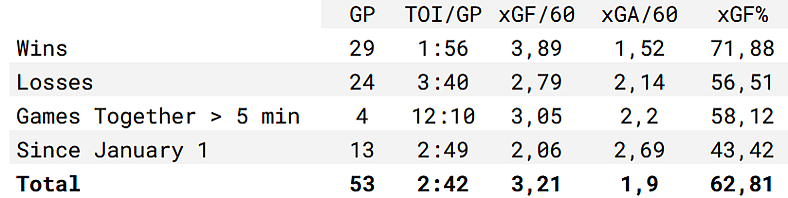
There are some interesting data points that may help us to answer the first question a little better.
The short answer to question number one is, that it’s very likely Hutson and Dobson would put up at least similar numbers to those of Hutson and Carrier, because Dobson is inarguably a better player than Carrier, and pairings that have Hutson in them tend to drive play whether they are sheltered (like Struble–Hutson) or play in a harder than average role (like Hutson–Carrier).
But will they be able to keep up above 60% expected goal share as a regular pairing? That’s a bit more complicated.
If we use the 4-game sample as a somewhat of a regular pairing as an example, the answer is: almost, but not quite. In a more purely offensive role than Hutson–Carrier, they’ve managed to control 58% of the expected goals and won their minutes in 2 out of 4 of the mentioned games.
Another interesting angle to this evaluation is to look at their time on ice together in losses and in wins. Their results in those games are not the most important thing here, as one would expect the players to play better in wins than in losses. But them playing almost twice as much together in losses than in wins paints a certain picture of their deployment.
They are on ice together when the defence doesn’t matter as much as trying to score.
That might be boosting their numbers a little, but most likely not to a fraudulent extent.
Montreal Canadiens Brass Tacks
What’s slightly concerning, is that in the year 2026 they’ve lost their 40 minutes together, while struggling to create quality chances despite controlling the overall shooting. This should, of course, be taken with a grain of salt, as the sample is very small, but it should act as a warning to those who expect them to start constantly dominating right away if they’re put together for an extended stretch.
While it is more likely than not, expected goal shares above 60% are still quite rare over larger samples. And if they could keep that up, what would that mean for the rest of the defensive group?
As noted earlier in this post, the past has shown that Matheson’s results in a shutdown role without Dobson have not been great. At all.
And that role isn’t set to diminish any time soon. Matheson’s earlier results have actually been poor enough that they could outdo (almost) all the good the Hutson–Dobson pairing could provide.
But, seeing as the Guhle–Dobson option is off the table (for now), and given Matheson’s success with or without Dobson this year, it could be worth the risk for the Montreal Canadiens, if losses start to pile up.
All Montreal Canadiens statistics are 5v5 unless otherwise noted, via Natural Stat Trick.
