Marc Dumont
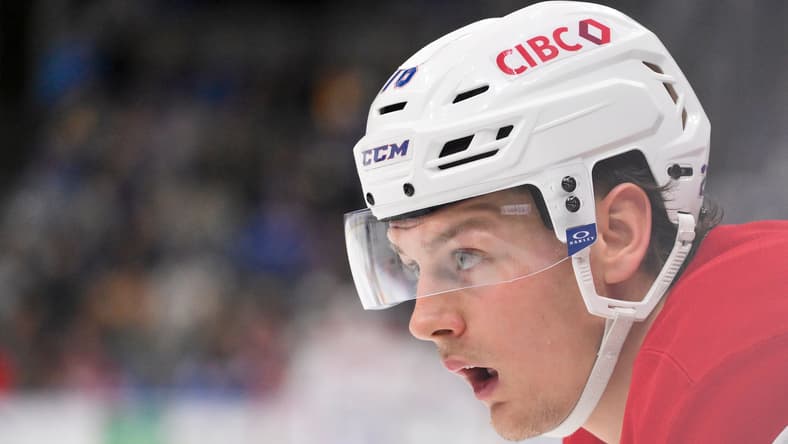
With the 2025-26 season in full swing, and several injured players set to return to the Montreal Canadiens lineup, it’s the ideal time to discuss Zachary Bolduc’s results with his new team.
Editor’s Note: This article was written by Montreal Hockey Now special contributor Roni Hermo. You can follow Roni on Twitter by clicking on this link.
Bolduc is a player whose effectiveness relies heavily on two factors: goal scoring and forechecking.
As it stands, he is on pace to score 17 goals this season, but he has only found the back of the net once in the last 10 games.
His checking game, on the other hand, has improved throughout the season, but overall, it has been more inconsistent while playing for the Canadiens than it was during his time with the St. Louis Blues.
In this analysis, I will focus on his 5v5 production in a bid to find answers to the question of why he isn’t scoring as often as expected. I will also analyze which player in the lineup could serve as the ideal linemate for the 22-year-old forward.
Carrier's shot has eyes. 4-1 #GoHabsGo. Good work by Bolduc on the forecheck, puck looked like it almost deflected off his stick. pic.twitter.com/Y0LYiDT3Dx
— Marc Dumont (@MarcPDumont) October 10, 2025
Bolduc with the Blues vs. with the Montreal Canadiens
Before joining the Canadiens, Bolduc played two seasons with the Blues. During his 97-game tenure, he established himself as a very effective scoring threat, both at 5v5 and on power play. Maintaining a high shooting percentage of 14.8%, he scored 5v5 goals at the same rate as players such as Leon Draisaitl, Sidney Crosby and Brady Tkachuk, despite failing to generate expected goals or shot attempts at a higher rate than an average NHL forward.
When he was traded to Montreal in exchange for defenceman Logan Mailloux, many saw him as a top-6 winger who could keep scoring goals via passes by Nick Suzuki or Ivan Demidov. Unfortunately, he has not been able to maintain his position in the top-6, and has now played at least four games with six different lines.
In other words, there’s been a lack of consistency from a usage standpoint.
And his results have been as diverse as his linemates.
He’s had long stretches with little to no production, and has struggled to maintain proper defensive positioning at times, leading to limited ice time alongside the best players on the Canadiens roster.
Nevertheless, despite his goal-scoring being down compared to his time with St. Louis, there’s much to like – and hate, too – in his underlying shooting numbers.
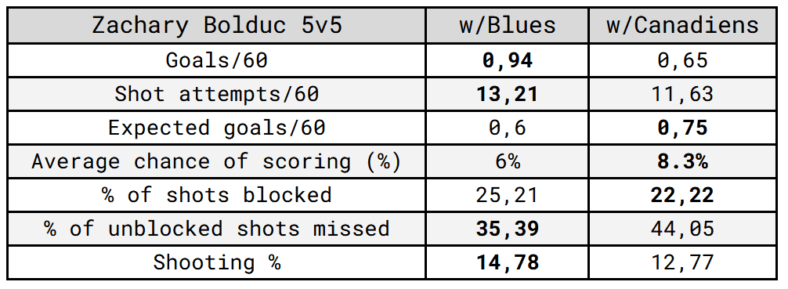
As we see from the table, Bolduc’s been able to create expected goals more effectively than he did with the Blues, even if he has not been shooting (or more precisely: attempting shots) on a nearly as high of a rate as with St. Louis.
He’s also getting shots through the defenders at a higher rate. All this has led to him having much better odds of scoring with an unblocked shot attempt than beforehand.
Why Isn’t Bolduc Scoring?
The easy explanation is bad luck.
His shooting percentage is still relatively high, but it has dropped recently, and he’s scoring less often than expected.
Of course, it’s important to remember that most NHL players struggle with consistency from a production standpoint, and even though Bolduc has a great track record of sniping his way through the QMJHL and NHL, a young player hitting a production wall is certainly not unprecedented, especially if they’re dealing with a new, pressure-packed environment such as Montreal.
The more complex explanation relates to shots that have missed the mark.
As we can see from the aforementioned table, the percentage of Bolduc’s shots that have missed the net have gone way, way up since joining the Canadiens.
The miss percentage of 44.1 is not only the highest among the Habs forwards, but also one of the highest in the league. Even if the missed shots pile up expected goals from a statistical standpoint, it’s literally impossible to score if you don’t hit the net.
Missing the net can be a matter of bad luck, but quite often it has something to do with the defenders interfering with the shot, or the shooter not being able to be in a right stance prior to taking the shot. It’s likely that whenever Bolduc gets the puck in the slot, he’s facing a more stalwart brand of defence than he did as a rookie with the Blues.
It’s also notable that the miss percentage seems to be getting worse whenever he hits a cold streak, as we can see from these charts showing the weekly progression of his season average ixG/60, G/60, miss percentage, and blocked shot percentage.
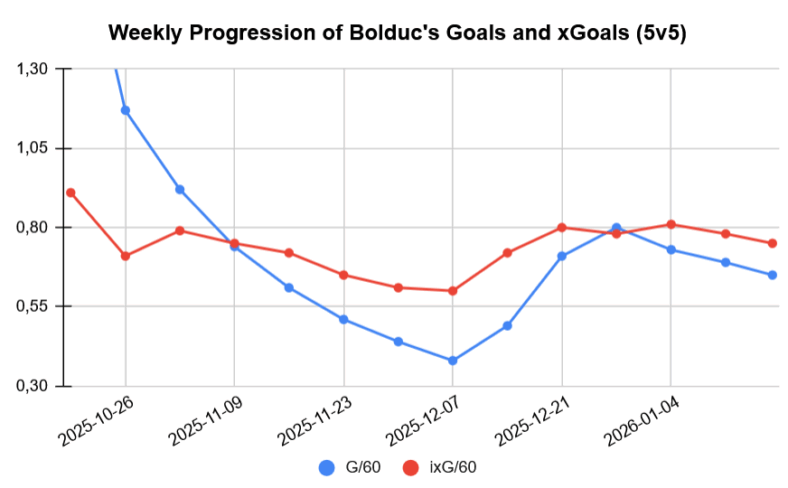
The miss percentage has steadily been going up for the last month, while the expected goals have stayed somewhat the same.
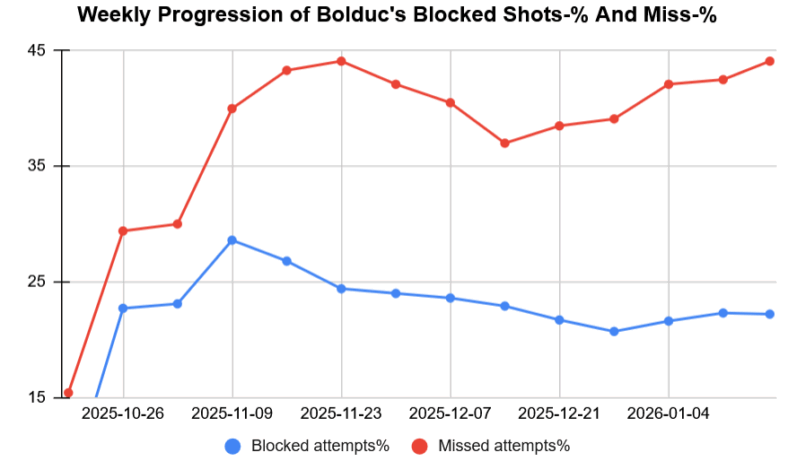
Whatever the reason is for missing the net with such frequency, it’s an issue that must improve going forward.
Next, I’ll take a quick look at which linemates could help him in that department.
Finding The Right Linemates For Bolduc
As mentioned earlier, Bolduc has played at least four games with six different lines this season.
I’ve gathered their underlying numbers in the table below.
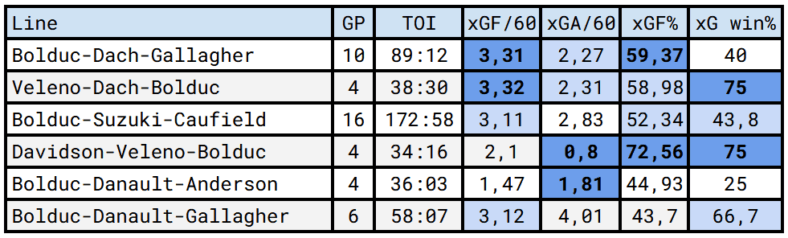
The only line combination that has offered a reasonable sample size has been when Bolduc played alongside Suzuki and Caufield. Therefore, the numbers should be taken with a grain of salt.
With that in mind, I’ve also added the ‘xG win%’ column to the table, to give context on how many games the various lines ‘won their minutes’, or have controlled at least 50 percent of the expected goals.
The numbers seem to indicate that outside of playing with Caufield and Suzuki, the best linemates Bolduc has had have been Kirby Dach, Joe Veleno and Brendan Gallagher.
Bolduc, Dach and Veleno have won their minutes with ease. So have Bolduc, Dach and Gallagher, but it’s worth noting that even if their overall results have been good, they have also been on the losing side of expected goals on 4 out of 10 occasions.
The lines with Phillip Danault have seemingly awful underlying numbers, but even they have something positive to offer.
The Bolduc–Danault–Anderson combination has played very low-event hockey in terms of expected goals, but they’ve also suffered through a very low save percentage while they’re on the ice, to the tune of just .780%.
Bolduc–Danault–Gallagher is also an interesting option. They struggle to tread water when it comes to defensive numbers, but when you take a closer look, they’ve ‘won’ four of their six games together, while getting absolutely caved in the other two.
They also connected on a goal versus the Washington Capitals that displayed the strengths of the players in question.
Bolduc –> Danault –> Gallagher.
— Marc Dumont (@MarcPDumont) January 14, 2026
It's not in this clip, but the play was started by another smart pinch by Noah Dobson.
2-0 #GoHabsGo pic.twitter.com/yH2QoJoExV
Given the relatively encouraging results, I see the aforementioned combination as the best possible option moving forward, as long as both Bolduc and Gallagher remain in the lineup.
I’d also suggest playing with Dach as their centre could yield interesting results upon his return to play.
If Veleno stays in the lineup, I could foresee a line of Bolduc–Veleno–Gallagher getting some reps, seeing as Veleno and Gallagher have done a pretty good job on the fourth line job, and Bolduc could bring the much-needed finishing element to the equation.
That being said, all three players staying in the lineup when everyone is healthy is unlikely.
Montreal Canadiens Brass Tacks
The biggest issue holding Bolduc back is inconsistency.
Some underlying numbers suggest he could start piling up goals in the near future, while others raise significant red flags in his game.
But if the Canadiens want to help Bolduc become more consistent, they’ll need to reciprocate when it comes to his usage.
Finding the right linemates — with whom he can build chemistry through a healthy dose of ice time — is crucial for both his and the Montreal Canadiens’ success.
All Montreal Canadiens statistics are 5v5 unless otherwise noted, via Natural Stat Trick.