Marc Dumont

With 14 goals and 16 assists in 40 games to his credit, Juraj Slafkovsky is on pace for a 29-goal, 33-assist season, which would set a career best with 62 points.
There’s still plenty of hockey left to play, but since we’re approaching the halfway mark of the season, it’s a good time to evaluate how Slafkovsky has managed to improve his production.
Juraj Slafkovsky Production In 2025-26
We’ve seen an interesting evolution since Slafkovsky was placed on the second line with rookies Ivan Demidov and Oliver Kapanen.
Rather than serving as a complementary player on the first line, we’re witnessing Slafkovsky drive the charge, a situation that has led to a significant increase in puck control time, as well an uptick in controlled entries.
Juraj Slafkovsky goes end-to-end and scores from a tough angle. His 14th goal of the year.#GoHabsGo up 6-4. pic.twitter.com/k0rFjdZXR0
— Marc Dumont (@MarcPDumont) January 2, 2026
But what about his production?
As it stands, he’s earned 17 points at even-strength, while contributing 13 points on the powerplay.
In fact, when evaluating goals per 60, primary assists per 60, secondary assists per 60, and points per 60, his production at 5v5 has actually gone down this season.
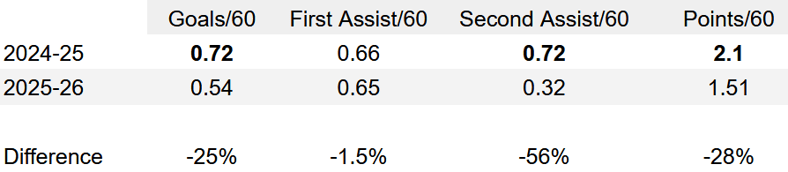
One of the major factors is that he’s no longer playing with Nick Suzuki and Cole Caufield, the two most productive players in the lineup.
With that in mind, it’s clear that the answer to Slafkovsky’s increased production lies elsewhere.
Juraj Slafkovsky Powerplay Production (2025-26)
Once we start to evaluate his powerplay scoring, the answer becomes quite clear.
Slafkovsky has increased his production on the man-advantage by leaps and bounds.
He’s scoring almost 200% more goals per 60, while offering over 250% more primary assists per 60. The result is a 175% increase in points per 60 while playing on the powerplay.
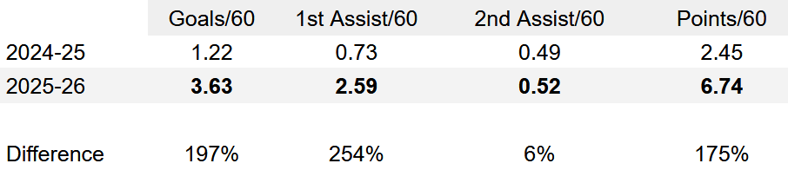
The driving force behind his increased goal scoring is his inflated shooting percentage, which sits at 35% on the powerplay, a clear discrepancy with his 5v5 shooting efficiency of 9%.
An absolute snipe by Slafkovsky on the powerplay gives the #GoHabsGo a 1-0 lead. pic.twitter.com/XrAIymYLN2
— Marc Dumont (@MarcPDumont) December 21, 2025
However, we cannot attribute his overall improvements simply to his shooting percentage, as we can clearly see in his increased ability to generate primary assists.
Montreal Canadiens Brass Tacks
We tend to downplay the value of powerplay points, as modern hockey analysis mostly focuses on how a player will perform at 5v5.
Of course, it’s easier to score on the powerplay, but that does not mitigate the overall value. The best teams in the NHL usually have a solid powerplay, and the best players in the league will always feature heavily on the man advantage.
It’s even more important in the playoffs, where a strong powerplay can win a series, and a poor man advantage can sink a team.
At 21 years old, Juraj Slafkovsky is still a few seasons removed from his statistical prime, which connotes there’s still ample time to improve 5v5 production, while also acknowledging that he’s taken his powerplay production to a new level.
All Juraj Slafkovsky statistics are via Natural Stat Trick.