

 Marc Dumont

The Montreal Canadiens have had their fair share of rookies on their blue line in recent years, including smooth-skating defenceman Adam Engstrom.
To get a better idea of how he’s performed since being called up from the Laval Rocket (AHL), we’re going to take a look at some of his possession numbers, while also comparing his results to his fellow defencemen, but more on that later.
Montreal Canadiens Defenceman Engstrom
On the surface, it may appear that Engstrom has done little to nothing when it comes to his impact. In seven games, he’s yet to register his name on the scoresheet, which could be interpreted as a red flag for a player who was billed as a puck-moving defenceman.
After all, offence is the name of the game for players of his ilk.
But when it comes to the Canadiens, the most pressing issue isn’t offence via the blue line, but rather, a lack of focus when defending.
And that’s where Engstrom has shone brightest.
As it stands, he leads all Canadiens defencemen in expected goals (xGF%), with 51.8%. That’s slightly better than Lane Hutson (51.4%), but it doesn’t paint the entire picture. To get a better idea of his true impact, we’re going to evaluate his expected goals relative to the team average. A positive relative xGF% tells us a player is making a positive impact compared to the rest of his teammates.
Once again, Engstrom has quickly made his way to the top of the list, ahead of Hutson, who is currently playing some of the best hockey of his career.
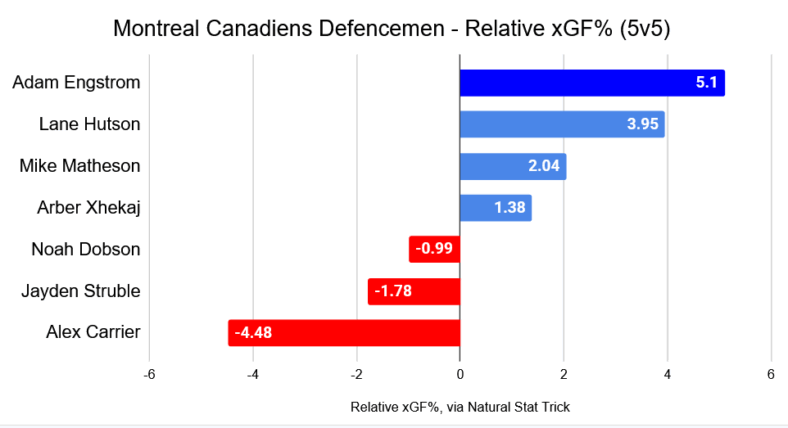
However, we’re going to filter the results one more time, while keeping in mind Engstrom’s NHL journey started in late November.
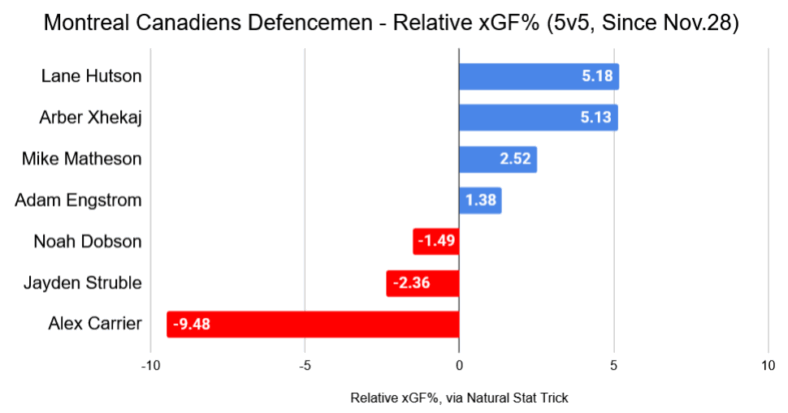
This way, we will compare the results from all the defencemen in the same time frame, rather than including all the data that was collected before Engstrom joined the Canadiens.
The results are quite interesting, in that they highlight Hutson’s ridiculously impressive play in December, while also noting a significant gap between those who are making a positive impact relative to their teammates, and those who are struggling.
Montreal Canadiens Brass Tacks
As you can see in the chart embedded above, Engstrom isn’t putting together elite numbers when we even the playing field to a certain extent, but there’s no doubt he’s played well throughout his call-up.
We can also see that his most common defensive partner, Arber Xhekaj, has enjoyed a very solid stretch since being paired with the 22-year-old Swede. The two have formed a reliable third pairing, which does entail easier defensive assignments, granted, but also means they rarely play with the best forwards on the team, which more than compensates for their relatively sheltered usage.
Regardless, we can conclude that Xhekaj doesn’t deserve to watch hockey games from the press box as a healthy scratch, at least not based on his results in December.
The most interesting factor in play is that Engstrom, who is clearly an offensively-inclined defenceman, isn’t making a positive impact from an offensive standpoint. Believe it or not, it’s his defensive stats that are powering his solid numbers.
Engstrom does a good job covering for the Struble giveaway. #GoHabsGo pic.twitter.com/6Pxh5trSvO
— Marc Dumont (@MarcPDumont) December 12, 2025
As per usual, we have to acknowledge that Engstrom has only played seven games in the NHL, and that the numbers will change going forward, however, we have a big enough sample size to suggest that his entry into the NHL has gone quite well from a statistical standpoint.
There have been some instances when he’s given away the puck, and those are the type of plays that are difficult to forget, but if we set Availability Heuristic aside and focus on the big picture, it’s fair to say Engstrom has quickly acclimatized to his new team, learning on the fly while most of his teammates and opponents had already found their rhythm in the NHL.
All Montreal Canadiens and Adam Engstrom statistics are 5v5 unless otherwise noted, via Natural Stat Trick.