Rachel Barkley
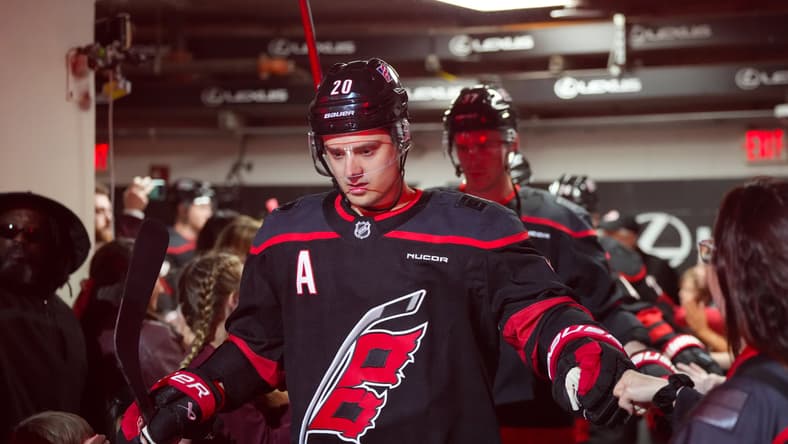
With their decisive sweep over the Ottawa Senators Saturday, the Carolina Hurricanes punched their ticket to Round Two of the 2026 Stanley Cup Playoffs – becoming the first team to do so this postseason, though they were soon followed by the Colorado Avalanche the very next day.
There was a lot to like in their first-round series, but of course, there were also a few things that they will need to wrangle in for Round Two against either the Pittsburgh Penguins or Philadelphia Flyers – two teams that the Hurricanes certainly had a time with in their respective season series.
Three Hurricanes Round One Positives
Goaltending Has Been Elite
Throughout the regular season, how goaltending would fare in the playoffs was one of the biggest questions due to Pyotr Kochetkov’s injury, Frederik Andersen’s cold streak, and fresh-face Brandon Bussi only playing in his first NHL season. However, those worries have since cleared – at least in the first round. Through four games, Andersen only allowed five goals on 110 shots against, giving him an eye-popping 1.10 goals against average. Additionally, he also notched a satisfactory save percentage of .955.
In Round One, Andersen was everything the Hurricanes needed him to be, and more.
“Can’t understate that,” head coach Rod Brind’Amour said at the end of the series. “Especially when you consider how well the other guy (Linus Ullmark) was playing there. Like, it was a goalie matchup. They were going kind of save for save. And we needed it, right? Otherwise, this thing could have looked a lot different.
“It’s probably his best hockey he’s played for us since being a Hurricane.”
Logan Stankoven’s Line Has Been Incredible
For anyone who has watched even one game of the Hurricanes’ first-round series, they would tell you that the Hurricanes’ second line has been fantastic – after all, they scored the first goal in every single game, and then some. However, it was far more than just the goals in the net that made the line great.
Throughout the entire first round, the assembled second line was not on the ice for a single goal against. They were defensively sound and responsible in their game, only having taken a combined three penalties.
“We weren’t on for a goal against all series, and he’s our centerman,” Taylor Hall said of Logan Stankoven, who leads the team in postseason goals with four. “He’s the guy down low doing the work. So, it’s not just the goals. You know, it’s a 200-foot game that him and our line has done pretty well.”
Defense Has Been Phenomenal
The Hurricanes’ defense cannot be understated. Throughout the series, Carolina had a league-leading 35:53 of time on the penalty kill. In Game 3, they allowed no shots during a five-on-three disadvantage, and in Game 4, they held the Senators scoreless during three more five-on-threes. Despite handing over so many power play opportunities, the Hurricanes allowed just one power play goal, notching a penalty kill percentage of 95.2 – the second best leaguewide, behind only the Boston Bruins, who remain spotless shorthanded.
It was notably impressive due to the Senators’ effectiveness all season long on the power play, where they ranked eighth in power play percentage, with a 24.0% success rate.
Overall, the Hurricanes’ six defenseman combined for a total plus/minus of +11, as the offense outscored the Senators 11-5.
Three Hurricanes Round One Negatives
An Unholy Amount of Giveaways
While the Hurricanes’ overall defense was great, the team struggled mightily at retaining the puck – though it was less noticeable due to the Senators’ own sloppiness with possession. Both teams are tied for the most giveaways leaguewide this postseason, with a disturbing 75.
For reference, the Bruins are in second with only 68, and the Avalanche are in third with just 61.
Too Many Penalties
Throughout their first-round series, the Hurricanes took 26 penalties, with 10 having been due to a lack of discipline with their twigs; the ever-frustrating stick infractions (including tripping).
Additionally, 16 of their penalties were in their last two games, while four of those opportunities gave the Senators the aforementioned five-on-three advantages.
Had it not been for the proficiency of the Hurricanes’ penalty killers, their time in the box could have cost them significantly.
Power Play Left a Lot to be Desired
To be fair, when it comes to the playoffs, the importance of the power play takes a back seat in favor of the penalty kill. Nonetheless, that does not make it unimportant.
In their four games against the Senators, the Hurricanes only managed to score two goals with the man advantage. What was especially alarming about that was the Senators’ regular-season record, having ranked at 29th leaguewide on the penalty kill, with a brutal penalty kill percentage of 75.7.
While there is no denying that the Senators’ defense played very well, the power play remains a point of concern heading into Round Two.
In conclusion, the next series is sure to bring more elements. Whether the Hurricanes can or cannot overcome that mountain will likely lie most in their ability to adapt while grinding away at their own brand of hockey.