

 Rachel Barkley
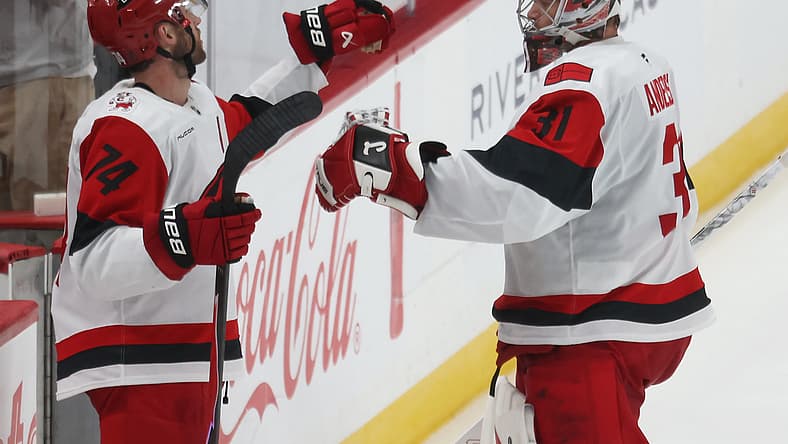
The Carolina Hurricanes are playoff-bound after having one of their best seasons on record, achieving 113 points this season, clinching the top spot in the Eastern Conference for the first time in franchise history, and scoring their most goals in team history. But with that, one of the biggest questions every year remains…
Is goaltending good enough?
Hurricanes Goaltending Follows a Different Formula
The Hurricanes’ overall goaltending save percentage is .880, which is a bit lower than the league average of .889, and significantly lower than the general standard of .900. Currently, they are the seventh-worst leaguewide in this metric throughout the regular season.
Typically, those numbers would seem bad. However, that stat works a lot differently in Carolina’s case.
Throughout the regular season, the Hurricanes held the least amount of shots against leaguewide. When fewer shots are faced, an allowed goal takes a bigger bite out of the percentage, which results in a low number.
Notably, the Hurricanes had the sixth-best goals against average of the regular season.
Ultimately, at the end of the day, statistics are merely numbers, and performance history does not always write the future. The playoffs are a different creature entirely from the regular season.
For example, in the 2005-06 season, Cam Ward posted the sixth-worst save percentage leaguewide and the third-worst goals against average. However, by the end of the playoffs, not only did the rookie netminder have the fourth-best save percentage of the postseason and the second-best goals against average, but he also won the Conn Smythe Trophy, which cemented him as the MVP of the 2006 Stanley Cup Playoffs.
Versatility is an Asset
An often-ignored upside about the Hurricanes’ tandem is the difference in play style between Frederik Andersen and Brandon Bussi.
Andersen’s style is positional, utilizing his size to take away space for oncoming shooters. He is accurate with the glove and remains cool-headed and calm throughout games.
Meanwhile, Bussi is proficient in the standard butterfly style, with flashes of the athletic style. Though he is roughly the same size as Andersen, he instead focuses on speed and instinct over technique.
Having a pair of similar goalies with dissimilar styles gives the Hurricanes an advantage when facing teams. If a style doesn’t work against one opponent, there is another to make use of.
Carolina Has a Potential Ace in the Hole
The Hurricanes may have another option at net – one who wields both rest and zest as a weapon.
Pyotr Kochetkov, Carolina’s most energetic and unpredictable goalie, has missed nearly the entire season due to an injury and the subsequent surgery to repair it. However, after a short conditioning stint with the Chicago Wolves, he was recalled and initially chosen to mind the crease in the final game of the season before a roster issue rendered it an impossibility.
Kochetkov, too, has a distinct style which differentiates him from the others – being able to flip the switch between calm and steady to frenetic, acrobatic, and even physical to make stops however possible. He brings an element of controlled (well, mostly controlled) chaos that often throws shooters off guard.
At this time, it is still uncertain if he will factor into the postseason, but if he does, the Hurricanes will have three NHL-level goaltenders at the ready – a rarity on any team, and especially so in the playoffs.
While the Hurricanes have frequently been cited in the past for not having what it takes in the net for playoff hockey, their current, unusual setup may challenge that narrative in the upcoming postseason.