Matt Weaver
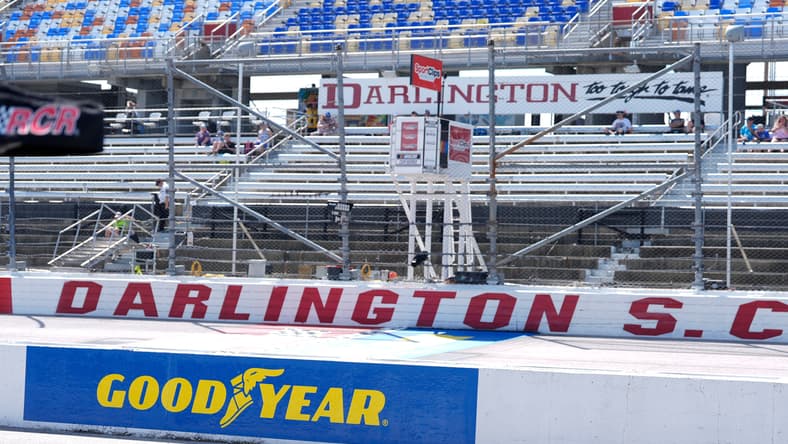
In some regards, the Lady in Black, Darlington Raceway, long regarded as The Track Too Tough to Tame, is in fact somewhat easier to tame these days not that it makes it any easier to win.
That’s to say that being able to run against the wall without hitting it used to be a superpower of sorts at the abrasive South Carolina speedway in the NASCAR Cup Series but not so much now.
Denny Hamlin says everyone is really good at running against the wall that it negates the clean air and extra counts of downforce that drivers were once able to find up there in previous generations of cars.
“It used to be because not many people ran right on it for such an extended period of time, that if you could just run within a few inches of it, you would get into better asphalt than others,” Hamlin said. “Now, everyone kind of runs so close to the wall that you’re not the only one getting the benefits of that aero effect.”
And while a lot of comparisons are made to Homestead-Miami Speedway and how speed is found by carrying momentum all the way around the outside wall, Hamlin says Darlington isn’t quite that kind of race track.
“You don’t get as big of a benefit running right on the wall as you do it somewhere like Homestead that has higher corner speeds,” Hamlin said. “I don’t think the wall has as big of an advantage as it used to have but it is typically the fastest lane around here.
“But if you have a car or a driver that saves his tires a little bit more, you can have enough disparity in speed to make passes elsewhere.”
Chase Elliott detailed how the race craft of Darlington is fundamentally different than a track like Homestead.
“I think what makes it different here is that Homestead has a very gradual entry,” Elliott said. “If you enter on the wall, it has this nice radius to the corner. This place, the wall is kind of choppy and makes it hard to get against it just right at the perfect time.
“You’ve got the SAFER barrier that juts out there in (Turn) 3. All those things kind of play a role.
“Obviously, the tire wear throughout a run here is extreme, just like it is at Homestead, too. It’s always a challenge but I think probably just the radius of the corners makes it a little different.”
Joey Logano says the fourth year current generation car has changed the approach to Darlington because it, like the Xfinity Series, both use composite shell bodies that make it less risky to get up against the wall.
“There’s still speed up there but the composite bodies make it different now,” Logano said. “When you hit the wall now, it’s not a day ender unless you clobber it. You can brush against it and the body comes back.
“You used to hit the wall and it would knock the shape out of the right side and you would have the fender rub to go along with it; or a cut tire, and it would ruin your day.”
With that said, Chase Briscoe still says this track rewards a certain driving style and that it’s a driver-specific track.
“Yeah, I feel like of all the race tracks we go to, this is definitely one as the driver, you feel like you make a little bit more of a difference,” Briscoe said. “You know, it’s still very car-dependent for sure but as a driver, I feel like this is one of those tracks that’s kind of similar to Homestead where you can carry it multiple positions, because what it asks you to do is constantly changing.
“Nobody’s car is driving good, there’s just things you can do in the car to find more than a tenth sometimes even two-tenths, whereas at another tracks, you’re just very hand-tied by the car itself.”
Kyle Busch saw first-hand, both as a team owner and then as a teammate, about how Darlington rewarded the driving tendencies of a driver like Erik Jones.
“Some guys just have a natural tick for this place,” Busch said. “I know Erik Jones since he came here early on and ever since he first started here in the Xfinity Series cars, he ran good.
“My first race here, I finished second, in the Xfinity Series so I think you can have a knack for places but you can come around to a place like this too as you race around the veteran and get more reps on the track.”
Briscoe says one of the biggest challenges with Darlington is that the abrasive surface means that teams and drivers struggle to balance speed throughout an entire run as opposed to book ends.
“I would say for me the hardest thing is just been trying to understand the balance of the short run versus long run, and how hard to go at the beginning to not burn yourself up at the end,” Briscoe said. “Still definitely don’t have that figured out but I feel like it’s always kind of been my biggest challenge here and felt like that especially in the Xfinity Series, I would be extremely fast on the short run, but I would pay for it in the long run.
“Just trying to do as much as I can to study you know the guys like Denny Hamlin and other guys that are so good, always here on the long run. So that’s kind of I feel like my biggest challenge at this place, but you know there’s a lot of challenges about this place as well.”
And that’s from someone that has won in the Cup Series at Darlington in the Southern 500 last summer. Elliott, meanwhile, has a win in the Xfinity Series and the occasional good run in Cup but it’s been more bad than good holistically.
“I love Darlington,” Elliott said. “I just haven’t gotten it to love me back. Maybe this week … maybe I can talk it into liking me this week.”