

 Lou Orlando
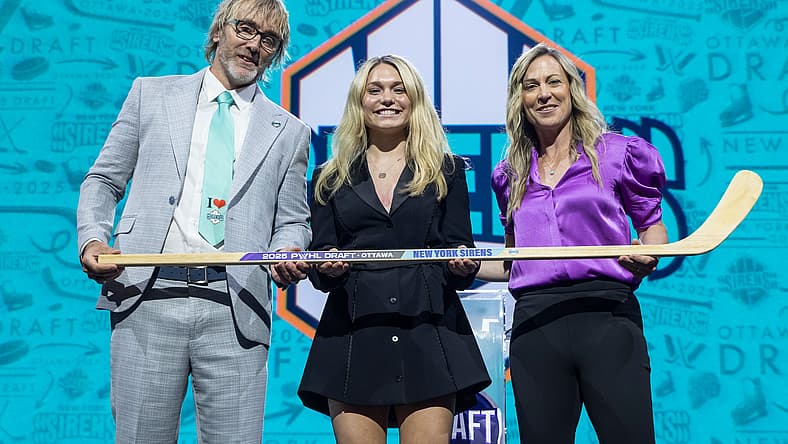
WEST ORANGE, N.J. — The New York Sirens can’t seem to break their losing cycle.
The Sirens missed the playoffs for a third consecutive season, finishing in seventh place with 36 points (9-3-3-15). They remain the only Inaugural Six team that has not appeared in the postseason since the PWHL debuted in 2024.
“It looks like it’s Groundhog Day,” general manager Pascal Daoust said Thursday. “A strong start, and then for some reason, the same end. We fell short.”
New York leaped out to a 7-0-0-3 start and held a playoff spot at the Olympic break, but the second half told a different story. The Sirens missed the postseason by eight points and managed just two regulation wins over their final 14 games (2-3-0-9).
Still, Daoust pointed to the 2025-26 season as one of growth and progress — if not reflected in the win-loss column.
“I would say that everybody was and is still very happy with the DNA, the culture, the people that are in place,” Daoust said last Monday as New York held exit day interviews. “So not saying that the standings are showing it, but definitely we’ve made huge, huge steps. The foundation is great to have, and we look forward for the next step and the next page of our storybook.”
An uncertain offseason could rock that foundation. The PWHL is expected to expand again, and while details are not yet finalized, multiple outlets reported a revamped expansion model on Sunday. A guide sent to the PWHL Players Association (PWHLPA) outlined a five-phase process with multiple signing windows that would replace last season’s expansion draft.
In an email sent to members Sunday, PWHLPA executive director Malaika Underwood said the League intends to add four expansion teams this offseason. The PWHL called the plan a “thoughtful and player-focused approach” in a statement to The Athletic.
At face value, that’s good news for the Sirens. After undergoing a major overhaul during the League’s first taste of expansion last summer, New York would love nothing more than to retain its exciting young core from 2025-26.
“When we look at data, if we are evaluating ourselves as a business, we’re definitely making some good progress in-market,” Daoust noted. “We’re heading in the right direction. We’re going to trust the process. We’re going to trust that we have great people, great players in place, and we’re going to keep digging.”
Whether New York can build on that progress depends entirely on how the expansion process shakes out.
Mysterious offseason created extra ‘challenge’ for Sirens in 2025-26
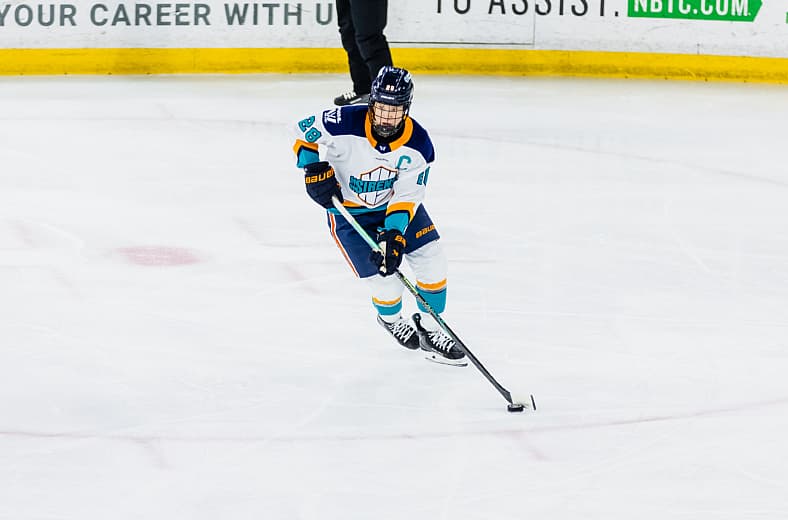
Daoust was in the dark about the League’s expansion plans when the Sirens convened at Codey Arena last Monday for exit interviews.
“I’ll be honest here, I’m a general manager of a team, and sometimes there’s rumors that I’ve never heard of. So don’t take that as any official information. We’re still waiting. We’re still waiting for this to take place.”
Little had changed when Daoust spoke to the media virtually on Thursday.
“I wish we could have [more] transparency. I think the priority for the League, at the moment, is to clarify how many teams would join, and if they join, which market, and then from there, rules,” he explained. “We’re hearing about different scenarios, but we’re not in a position at all to even have a plan in place, because we need to wait.”
“This would be a great question for the League,” Daoust added with a sly smile.
This isn’t exactly unfamiliar territory for the PWHL in its brief three-year history.
“I think the uncertainty is just something that we’ve kind of started to get used to since the start of this League,” Sirens captain Micah Zandee-Hart said Monday. “And it’s not anyone’s fault. It’s just a matter of, we’re starting a new league, and things are changing all the time.”
That uncertainty loomed over New York’s 2025-26 campaign, especially after a conscious effort to part ways with impact veterans like Alex Carpenter, Ella Shelton, and Jessie Eldridge, shifting the focus instead to a deep rookie class headlined by first-round picks Kristyna Kaltounkova (No. 1 overall) and Casey O’Brien (No. 3 overall).
The Sirens added a pair of veteran forwards — Denisa Křížová and Clair DeGeorge — in March, but Daoust acknowledged that a cloudy future produced an extra obstacle at the League’s trade deadline.
“It is a challenge. It is different. It’s not the easiest way to build,” Daoust said Monday. “But I would say that once we cross that next bridge, hopefully we might have a bit of stability in the foundation.”
Daoust insisted that the lack of transparency did not affect his decision to seek out players who fit New York’s organizational vision.
“You want to base the foundation on the values. You want to build with people that believe in it, and that embrace these values, and then you’re going to have to tweak tons of stuff every season.”
Contract updates, including Casey O’Brien’s expiring RFA deal
The Sirens have 11 players set to become unrestricted free agents (UFAs) this offseason — but don’t expect any deals to get done in the near future.
“We’re officially open to chat with them. We’re doing exit meetings, but we can’t, at the moment, sign any player,” Daoust explained Monday. “We’re going to wait to hear the rules that we need to follow.”
Daoust clarified Thursday that there will be no plausible way to sign players to contracts until the PWHL officially confirms details regarding expansion and signing windows.
“They need to come [to] us with rules where we get window to sign. It’s TBD. It’s a big picture that they’re going to come and narrow down and tell us where we can go, and we’re going to have to adjust our strategy based on the rules.”
The latest reports provided more clarity on what those rules could look like. The Leaguewide signing period will open on June 19, according to the PWHLPA’s documents, though players will have the opportunity to re-sign with their existing teams during multiple stages of the expansion process.
New York’s UFAs include Kristin O’Neill, whom Daoust acquired in a trade with the Montreal Victoire at last year’s draft, and Taylor Girard, fresh off a career-high seven-goal campaign in just 17 games. Girard suffered a season-ending knee injury on March 15, but Daoust was optimistic the 27-year-old forward could return and be impactful next season.
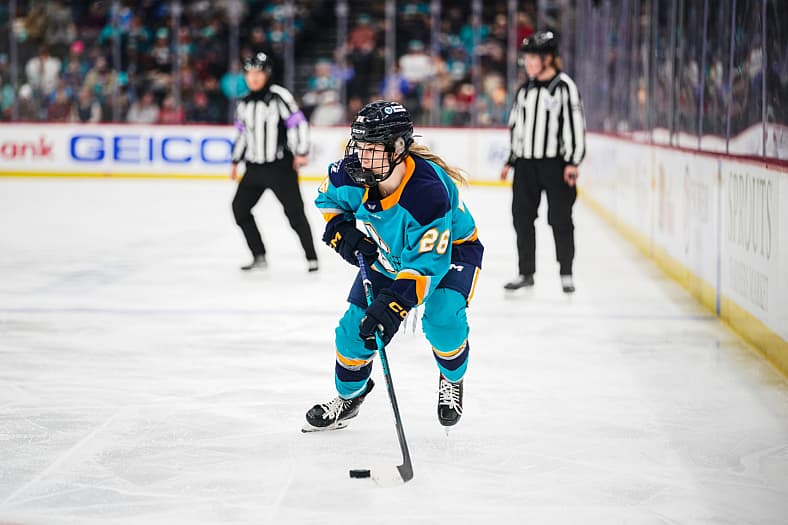
The Sirens also have six rookies that need new RFA deals, including O’Brien, who led all first-year players with 22 points (seven goals, 15 assists) in 2025-26.
“I’m just here to play hockey. I leave the contract stuff more to Pascal [and] my agent,” O’Brien said when asked about her contract status. “I just want to be at the right fit. I want to contribute what I can to the team and make sure it’s a right fit. So if that’s New York, I’m ecstatic. I can’t give you an answer on what the negotiations or anything are going to look like, but I’ve loved being here, and I’d love to keep growing what we have.”
That sentiment was reciprocated by Daoust and the Sirens.
“Casey, she wants to be in-market,” Daoust said Thursday. “We want her to be in-market. We want to build with her. So we’ll go with the flow as soon as we hear more on how we can handle things.”
New York will have the opportunity to protect three players in Phase 1 of expansion, provided each is under contract for the 2026-27 season. If the Sirens wish to include O’Brien on their initial protection list, she’ll need a new contract before the end of Phase 1, which is tentatively set to begin on May 28.
Daoust also expressed interest in retaining his two midseason additions, Křížová and DeGeorge.
“We really had a good opportunity to appreciate not only who they are, but what they can bring,” he explained. “It’s been great having them. It’s been great seeing them skills-wise and talent-wise, for sure, but also it’s important for us — for the culture — with who we’re building. They definitely are people that would fit in that locker room, in that environment.”
Player-focused expansion could benefit Sirens, but danger remains
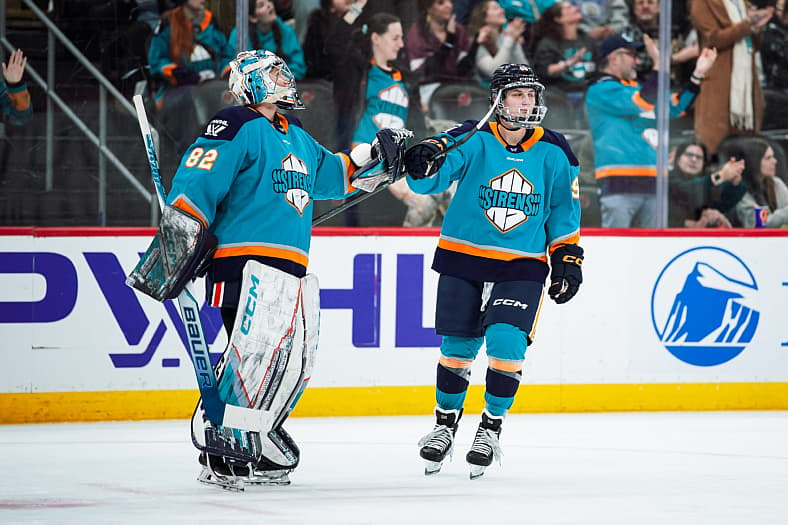
Despite a third consecutive losing season, Daoust sang an optimistic tune when looking towards the future.
“There’s a lot of people who just joined this year, and also a bunch of vets who are just saying loud and clear that they are New York Sirens. They want to be here,” Daoust stated Thursday. “Which says a lot, because it would be so easy to say, ‘Okay, we were out of playoffs, and I don’t want to be here.’ That’s not what we hear.”
That could work in New York’s favor, especially as the PWHL shifts to a more player-focused expansion model. New York fielded the youngest roster in the League in 2025-26, and it hopes to keep the majority of that young core intact.
“Can we be better? Sure. Can we get things to the next level? Of course,” Daoust said. “But the culture that we have in place, the smile on their face coming to the office — they’re not coming to work. They’re coming to do the best job in the world. To play hockey.”
A Quebec native, Daoust drew a comparison between the Sirens and his hometown Montreal Canadiens in the NHL, who also sported a youthful roster several seasons ago. His message? Give it time.
“This group was a young group with a bunch of good vets, good people to show the leadership. And in six months, they’re going to be six months older. So we need time to look at the puzzle. We need time to look at the next few weeks, and we’ll build from there. But very exciting, because we have a lot of players that showed on data and showed to the eyes of the fan that we have a good product to offer.”
Montreal isn’t a bad model to follow.
The Canadiens made the playoffs in back-to-back seasons under coach Martin St. Louis, and are set to meet the Buffalo Sabres in the second round of the 2026 Stanley Cup Playoffs. At the center of it all is a dynamic young core, including Nick Suzuki (26), Cole Caufield (25), Jakub Dobes (24), Juraj Slafkovský (22), and Lane Hutson (21).
Success wasn’t immediate. Montreal finished last in the Atlantic Division during St. Louis’ first two seasons at the helm. Things finally turned in 2025, when the Canadiens snuck into the playoffs as the lowest seed in the Eastern Conference. They followed that up with a 106-point season in 2025-26, tied for third-best in the East.
New York is hoping for a similar progression — but expansion still poses a major threat.
Existing PWHL teams can protect six players from expansion, up from four last summer. The removal of the expansion draft adds another layer of security and gives players more agency over where they end up, but it’s not a complete safeguard.
The Sirens can only protect three players in Phase 1 and won’t be able to add another three to their list until Phase 3 begins. In between that time frame, expansion teams have various means to pry New York’s talent away.
Once each existing team submits its initial three-player protection list, each expansion team will submit an “Exclusive Negotiation Target List” consisting of 20 unprotected players.
The most powerful tool up their sleeve is an Expansion Franchise Offer (EFO) — akin to the NFL’s franchise tag — which can be applied to unprotected players on expiring contracts in Phase 2, requiring them to sign with an expansion team. Each expansion team only gets one EFO. Players determine the length of the contract, but they won’t be able to block the move, even if the destination is not one they desire. Expansion teams also have Foundational Player Offers (FPOs) that, while not binding if offered, are guaranteed multi-year contracts worth $80,000 in year one and $82,500 in year two.
The importance of player protection becomes more pronounced in Phases 2 and 4. If expansion teams do not sign five players by the end of Phase 2, they may instead select unprotected players from their negotiation list and acquire their rights, provided those players are under contract or have their rights held by an existing team.
In Phase 4, expansion teams can sign any unprotected player not on their original negotiation list. If they fail to sign 10 players by the end of that window, they may again select players and obtain their rights.
This element mirrors last offseason’s expansion draft — and once again leaves unprotected players facing an uncertain future.
For the Sirens, that means a player under contract, such as starting goalie Kayle Osborne, or expiring RFAs like rookies Maddi Wheeler and Anne Cherkowski, could still be selected in expansion, even if they prefer to remain in New York.
Each existing team can lose no more than four players under contract to expansion, but that restriction does not apply to players on expiring deals.
The new format puts New York in a better position to retain its core, especially given mutual interest from players, but don’t expect to see the same exact team back on the ice in 2026-27. The threat of significant losses still looms large.