

 Lou Orlando
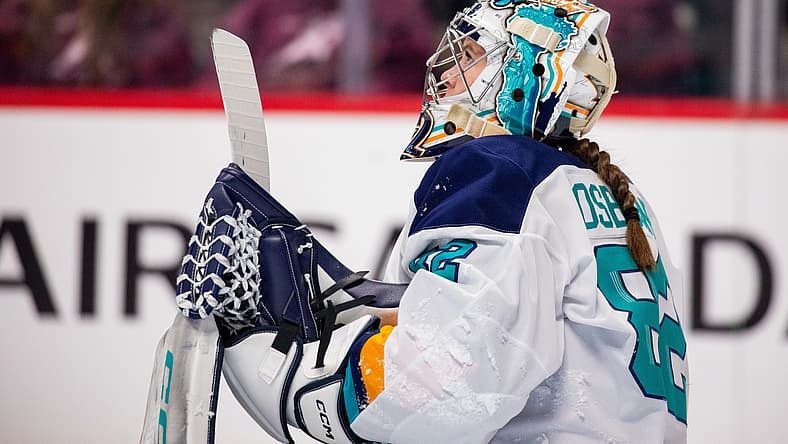
The New York Sirens’ goalie room is a major question mark heading into the 2026-27 season. Unfortunately, that’s familiar territory.
No position group faced more uncertainty ahead of 2025-26 than New York’s goaltenders. The Seattle Torrent’s signing of Corinne Schroeder during 2025 expansion left the Sirens with the youngest — and least proven — goalie room in the PWHL.
Second-year goalie Kayle Osborne assumed the reins after appearing in 10 games as a rookie in 2024-25. Two late-round rookies, Callie Shanahan (No. 28 overall) and Kaley Doyle (No. 41 overall), backed her up.
Osborne proved a capable starter in her greatly expanded role, getting the nod in 27 of the club’s 30 games. Her time in New York was short-lived, though, as expansion deprived the Sirens of their starting goalie for a second straight offseason. General manager Pascal Daoust left Osborne unprotected in Phase 1, and the Ontario native promptly signed a three-year contrat with PWHL Hamilton in Phase 2 of the League’s player distribution process.
The Sirens will turn to Elaine Chuli to help fill that void after inking the veteran PWHL backup to a two-year deal in free agency. But before shifting focus to the 2026-27 season, it’s worth revisiting the campaign that was.
A busy month of player movement interrupted our Sirens report cards (see forwards and defensive corps), but with free agency slowing down, it’s time to resume our offseason series. The spotlight now shifts to goalies as we wrap up the player portion of our end-of-season evaluations.
Positional Grade — Goalies: C-
New York had a clear-cut starting caliber goalie in Osborne. It’s the lack of support behind her that knocks this group down to a below-average grade.
Shanahan started just three games with middling results. Doyle, meanwhile, spent most of the season as a healthy scratch, dressing in five games without logging a single minute of PWHL action. That left Osborne to bear the brunt of the workload, and while she was unequivocally New York’s best option, her play faltered as the season wore on.
Osborne projects as a reliable, possibly elite, PWHL starter. But New York’s thin goalie depth placed too much on the 24-year-old’s shoulders — and likely hurt her performance in the long run. The Sirens were the only team to post a save percentage below .900 in 2025-26, finishing with a League-worst .895. They surrendered 82 goals, second-most in the PWHL, despite allowing the second-fewest shots on goal (784) last season.
New York didn’t play its best hockey in front of Osborne in the second half, but even coach Greg Fargo acknowledged that his starting netminder wasn’t at her sharpest during a lengthy March malaise.
Nonetheless, it won’t be easy for any goalie to fill her skates — especially with the workload she leaves behind.
Individual report cards: Grading the Sirens’ goalies
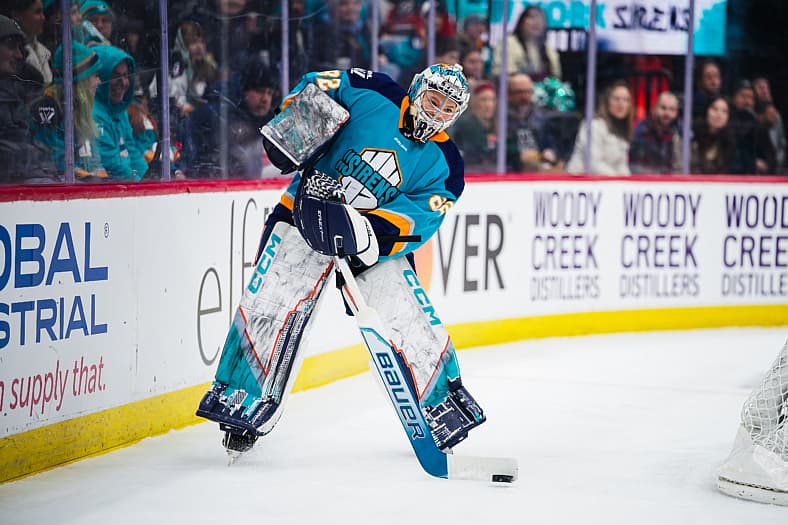
Kayle Osborne: B
Osborne seemed like an ideal fit for New York’s system under Fargo, who coached her at Colgate from 2020-24.
The Sirens largely succeeded in limited opposing scoring chances, finishing with the second-best shot rate in the PWHL last season. Still, defensive lapses and odd-man rushes remained an issue. Osborne routinely bailed New York out with highlight-reel saves — including her ridiculous paddle stop against the Toronto Sceptres.
Her puck-handling ability was merely the cherry on top for a high-volume Sirens offense built around speed. Fargo lauded her as the best puck-moving goalie in the League, and the eye-test largely backed that up. Her aggressive approach came back to bite her at times, but New York will have a hard time replacing that ability next season and beyond.
The final stats paint a complicated picture of her sophomore campaign. Chances are, Osborne isn’t losing any sleep.
“Personally, I don’t look at stats. I don’t think that tells the whole story on any goalie on any team,” Osborne stated following a 3-2 win over Toronto on April 15.
To some extent, she’s right.
Osborne posted a 2.47 goals-against average (GAA) and a .906 save percentage, the latter of which ranked third-worst among 13 qualified PWHL goalies. She finished last in goals saved above expected (GSAx) according to multiple public analytics models, including PWHL Analytics and HockeyStats.com. But it would be misleading to characterize her 2025-26 season as a failure.
Fargo and general manager Pascal Daoust both expressed resounding confidence in Osborne’s abilities going into the season. Nevertheless, it was hardly a guarantee that she’d settle into the starting role seamlessly.
She quickly eased any concerns. Osborne logged 1,579:17 of ice time in net, trailing only Gwyneth Philips (1,643:15) and Aerin Frankel (1,583:12) for the League lead. Her four shutouts would have matched the PWHL’s single-season record through its first two seasons. Instead, that total ranked third in 2025-26, overshadowed by historic campaigns from Frankel and Ann-Renée Desbiens.
A strong first half solidified her spot as the youngest player on Canada’s 2026 Olympic roster, joining Desbiens and Emerance Maschmeyer in Milan-Cortina as the team’s third goaltender. With a cap hit of just $39,000, Osborne was one of the biggest bargains across the PWHL, regardless of position.
That’s not to say her second-half struggles can be ignored.
“I think if you reflect with Kayle’s play, there’s probably some highs and lows,” Fargo said at the end of the season. “In one sense, really proud of Kayle, how she came into the year, taking on a new role as a starter for the first time. But much like our team since the Olympic break, we didn’t play as well as we needed to. And not that that all falls on Kayle at all, but upon reflection, I know that she’s going to want to be better in certain games, in certain moments.”
Osborne won just four of her final 13 starts (4-8-1) post-Olympics, playing to a 2.74 GAA and .883 save percentage in that span. Perhaps fatigue played a role, but she simply wasn’t as sharp after returning from Milan-Cortina, where she did not see any game action.
Her workload placed her in the same camp as Frankel, Philips, and Desbiens. Her performance suggests she’s not quite at that level just yet. She is, however, a more-than-qualified PWHL starter with plenty of room to grow, and no loss poses a bigger threat to New York in 2026-27. PWHL Hamilton should be thrilled to land a goalie with her upside in expansion.
Callie Shanahan: C-
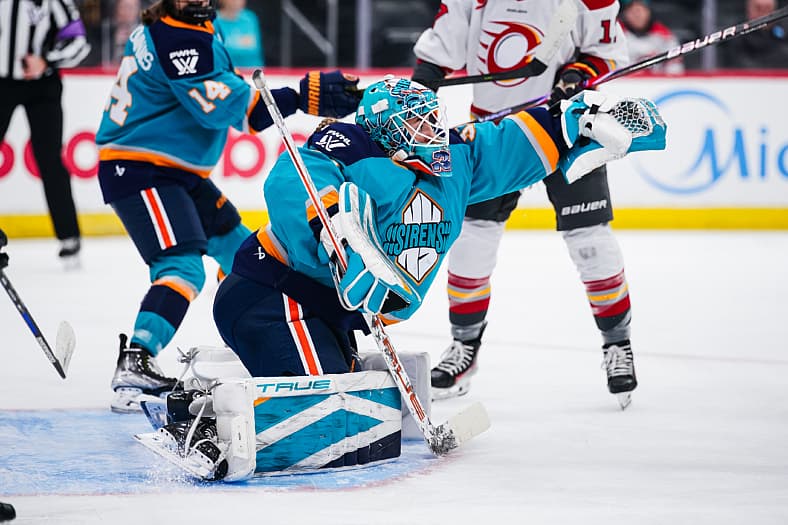
Shanahan’s rookie campaign still leaves a bevy of question marks after a limited four-game sample size.
The Michigan native went 1-1-1 in three starts, allowing 11 goals on 85 shots during her age-22 season. Among the 20 PWHL goalies who saw game action last season, Shanahan’s .871 save percentage ranked second-worst, only ahead of Marlene Boissonault (.833), who played just one game for the Minnesota Frost.
But like Osborne, the stats might not tell the full story. Shanahan flashed stretches of capable play and an ability to make athletic saves in net. Consistency proved a challenge, though.
The Ottawa Charge scored two goals on six shots in the opening period of Shanahan’s PWHL debut on Jan. 20, including a Gabbie Hughes marker that came on the team’s second shot. She’d settle down, stopping 13 of 14 shots over the final 40 minutes of regulation to help the Sirens force overtime, before rookie Sarah Wozniewicz beat her five-hole for the game-winner — on a shot Shanahan likely wanted back.
Similar peaks and valleys can be found throughout her 218:11 of ice time in 2025-26.
Shanahan shut out the Boston Fleet for two periods in New York’s regular-season finale, stopping all eight shots she faced. Things unraveled in the third period, though, as she allowed three goals on 15 shots in a 4-0 Boston win. She surrendered three goals through the first 40:44 of a crucial April 1 game against Minnesota, including Taylor Heise’s opening shot just 16 seconds into the game. But Shanahan stopped six straight over the final 22:05, including a magnificent blocker save against Britta Curl-Salemme on a breakaway in overtime, helping set up Sarah Fillier’s game-winner.
Her best work likely came in relief of Osborne on Feb. 26, coming off the bench to stop 15 of 16 shots against the Montreal Victoire in New York’s first game back from the Olympic break.
Still, it was hard for Fargo to entrust his volatile backup with a larger role, especially as the playoff race intensified in the second half. It’s no easy task for a rookie to step into a major backup role — as Osborne did in 2024-25 — but Shanahan did little to justify increased playing time.
After signing a two-year extension with the Sirens in Phase 5, she’s poised for an expanded role next season — but she’ll need to find more consistency in net to make the most of it.
Kaley Doyle: N/A
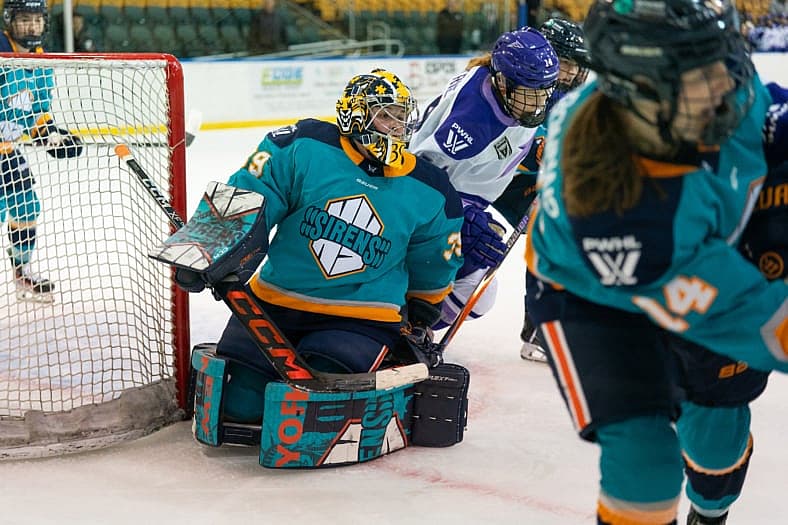
Doyle doesn’t get a grade after watching from the sidelines throughout 2025-26. The 25-year-old drew the start in New York’s first preseason game on Nov. 13, allowing two goals on 16 shots in 29:39 of ice time. That marked her only glimpse against PWHL competition, as Doyle was relegated to the bench for the final preseason game and all 30 regular-season contests.
Barring any unforeseen developments, she’ll enter 2026-27 as the Sirens’ third goalie once again. The 2025 sixth-round pick (No. 41 overall) signed a one-year extension in Phase 5, rounding out New York’s goalie room alongside Chuli and Shanahan. Doyle could conceivably make her PWHL debut next season, though that’s still not a guarantee even without a proven PWHL starter in the mix. A 30-game slate provides little room for error. Unless Doyle makes strides this offseason, it’s hard to see New York straying from a Chuli-Shanahan tandem regularly.