Lou Orlando
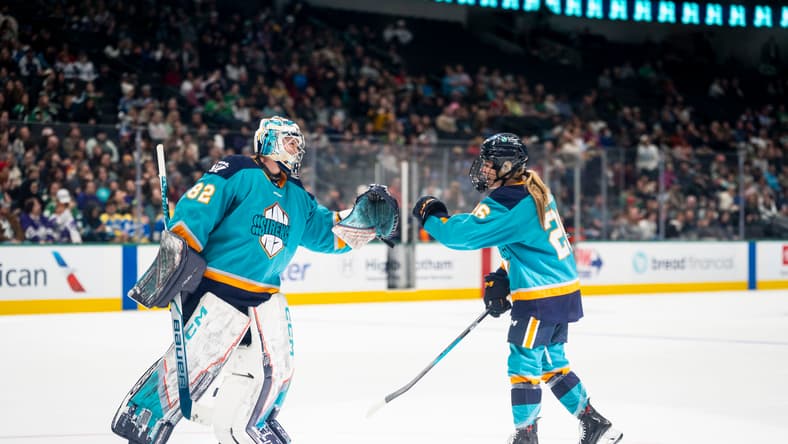
The New York Sirens can hold their heads high after a promising first half of the 2025-26 PWHL season.
New York entered the Olympic break in a playoff spot, sitting fourth overall with 24 points (7-0-3-6). They rank third in offense (2.31 goals per game), thanks in large part to a stellar rookie campaign from No. 1 overall pick Kristyna Kaltounkova.
It’s a welcome change of pace for a team that finished dead last in each of its first two seasons. The Sirens are one of the biggest surprises this season — and they’ve earned a positive midseason report card in the process.
Grading the New York Sirens at the Olympic break
First, let’s go over the ground rules. I’ll be using your standard letter-grade scale.
A is exceptional, and A-plus is the gold standard, reserved for the very best of the best. B is above average, C is average, and D is below average. If you’re unsure what F means, I shudder to ask what your own report card looks like.
Credit New York with an overall A-minus as a team. Now let’s dig into specifics.
Sirens staff (general manager and head coach)
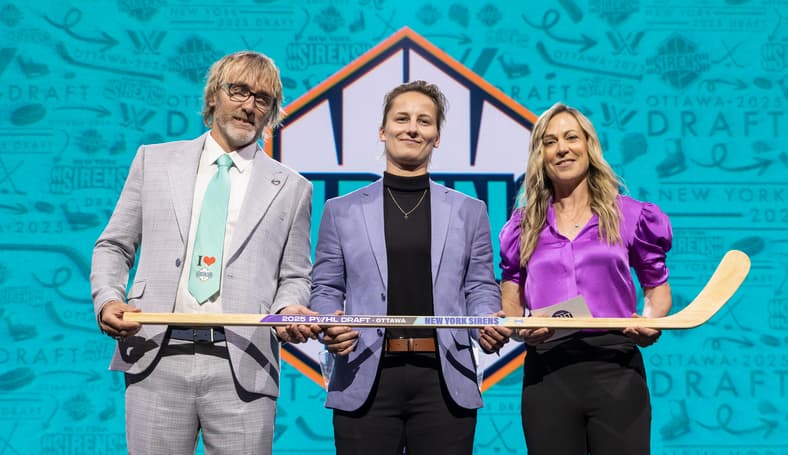
GM Pascal Daoust: A-
Pascal Daoust took some sizeable risks in the offseason. Star center Alex Carpenter, winger Jessie Eldridge, and starting goalie Corinne Schroeder were among the notable names left unprotected by New York ahead of the 2025 expansion draft. The roster shake-up continued on draft day, when Daoust shipped away star defender Ella Shelton and gritty forward Abby Roque.
It didn’t sit well with Sirens fans at the time, but it’s hard to argue with the results. Daoust’s vision for a decidedly younger roster produced some exciting early results. It helps when you hit a home run with your No. 1 overall pick (Kaltounkova), but don’t overlook other successful draft finds like Casey O’Brien (No. 3 overall), Anne Cherkowski (No. 9 overall), and Maddi Wheeler (No. 27 overall). The Sirens have 21 goals from rookie skaters — the most in the PWHL by a wide margin.
Rather than acquire an experienced goalie to replace Schroeder, Daoust instead put his faith in second-year goalie Kayle Osborne, who appeared in just 10 games as a rookie in 2024-25. Osborne rewarded that gamble with a 7-6-2 record, 2.21 goals against average (GAA), and .921 save percentage — all while shouldering the heaviest workload of any PWHL goalie in 2025-26.
It’s not to say that the Sirens are a more talented team after losing so much star power. In fact, Carpenter, Eldridge, and Roque haven’t missed a beat with their new squads; all three rank Top 20 Leaguewide in scoring at the Olympic break. But if Daoust’s mission was to resurrect a flailing team culture — as hinted in the preseason — it appears he’s found the right recipe.
New York’s goalie room lacks depth behind Osborne, and relying so heavily on rookie scoring raises questions about sustainability, but Daoust constructed a tenacious squad capable of hanging with anyone in the League.
Coach Greg Fargo: B
Through half a season of play, coach Greg Fargo has the Sirens in a playoff spot. That alone is worthy of flowers.
“Coming into the year, I think there were a lot of people that probably didn’t give us a whole lot of chance,” Fargo said at practice last week. “We’ve earned some really quality wins.”
That they have. Highlights include a comeback win over the Seattle Torrent during a Takeover Tour stop in Dallas, and a pair of one-goal wins over Marie-Philip Poulin and the Montreal Victoire.
New York could be sharper defensively at times, but the primary concern is special-teams play. The Sirens have the League’s worst penalty kill (76.0 percent) and second-worst power play (11.1 percent).
Fargo’s maintained that the power play isn’t in need of a drastic overhaul. New York leads the PWHL with 10.14 expected goals for on the power play, per PWHL Analytics, although that’s helped by a League-most 54 opportunities. The solution doesn’t necessarily lie in a personnel change, but New York will have a difficult time reaching the Walter Cup Final without sharper power-play execution.
Ironically enough, few PWHL coaches changed their even-strength forward lines as regularly as Fargo. History suggests that style can backfire in the long run, but it hasn’t bitten the Sirens yet. And that’s not to say New York’s bench boss hasn’t settled into a few important lineup constants.
Most notably, Fargo slid star forward Sarah Fillier from wing to center early in the season. Fillier hasn’t enjoyed the same goal production playing down the middle, but it’s played a big role in lengthening New York’s lineup, giving the Sirens three top caliber centers in Fillier, O’Brien, and Kristin O’Neill.
And though he may not have much of a choice given the current roster construction, Fargo isn’t afraid to put inexperienced players in major roles. Osborne’s heavy workload in net raised eyebrows, but she clearly gives the Sirens a winning chance on a nightly basis. Kaltounkova, O’Brien, and Cherkowski lead all rookie forwards in average ice time, ranking one, two, and three, respectively; Wheeler isn’t far behind at sixth.
The Sirens won’t reach the upper echelon of the PWHL without some second-half improvement, but Fargo’s faith in his lineup will go a long way.
Returning Players from 2024-25
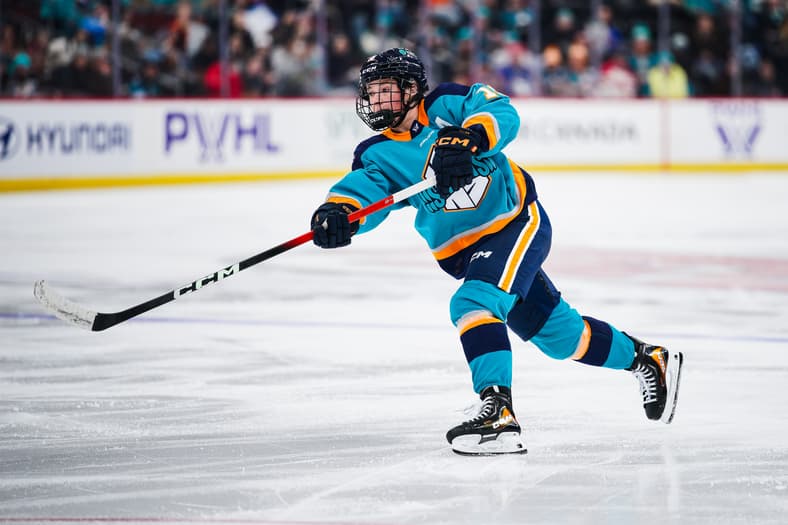
Kayle Osborne: A
The Sirens believed Osborne was capable of being a starting goalie in the PWHL. Daoust and Fargo made that clear from the start of training camp in November. But Osborne hasn’t just been a starter — she’s been one of the most reliable goalies in the League.
Osborne paced all PWHL goalies in games played (15) and minutes (897:00). She tied fellow Olympians Aerin Frankel and Ann-Renée Desbiens for the most shutouts in the League (three), and proved herself a supremely talented puck-handler for the position.
It would take quite the second-half push for Osborne to legitimately challenge Frankel and Desbiens for Goaltender of the Year, but that’s of little concern for New York. The Sirens needed Osborne to be a stabilizing presence in net, especially with two late-round rookies filling out the goalie room. She’s been that and then some.
The PWHL doesn’t give out a “Most Improved Player” award, but if they did, Osborne would be the heavy favorite. New York isn’t threatening for a playoff bid without her.
Sarah Fillier: A-
It’s no secret that Fillier isn’t scoring at the rate she’s used to. After tallying 13 goals in a stellar 2024-25 campaign that ultimately netted her Rookie of the Year honors, Fillier recorded just one goal in 15 games this season. Her 1.8 shooting percentage is the lowest of any PWHL skater with at least one goal scored in 2025-26.
But don’t let that cloud your judgment — she’s still playing high-level hockey. Even without her typical scorer’s touch, Fillier was an elite playmaker and one of New York’s best skaters in the first half. Fillier’s nine assists lead the Sirens and rank second in the League overall, tied with Minnesota Frost forward Britta Curl-Salemme. New York has talent, but Fillier is the only player with truly elite vision and a game-breaking ability to navigate through defenders at will.
She’s made the transition to playing center full-time at the pro level with relative ease. Fillier impressed defensively and logged crucial minutes on the penalty kill. Her best fit long-term is on the wing, but she’s more than capable of playing down the middle, and that’s what New York needs this season.
Fillier is due for some better puck luck in the second half — but even if it doesn’t come, she’s doing enough all over the ice to make up for the dip in goal scoring.
Taylor Girard: A-
Taylor Girard shares a grade with three very important Sirens skaters. That’s not to say that she’s of equal importance — it’s simply a reflection of her success relative to her role.
With nearly half a season left to play, Girard already matched her career total in goals. The third-year forward ranks second on the Sirens with five tallies, helped in large part by a season-opening hat trick against the Ottawa Charge. Girard scored once in 2024-25 and four times in 2024, appearing in 23 games each season.
You’ll take that production from any skater, let alone a bottom-six winger. Considering that New York struggled to get production from its bottom six last season, Girard’s contributions were a welcome addition. They’ll be happy to get her back in the lineup when the season kicks back up on Feb. 26 now that the 27-year-old completed her three-game suspension.
Micah Zandee-Hart: A-
The stats don’t leap off the page for Micah Zandee-Hart — as is sometimes the case for a quality defensive defender. New York’s captain recorded three assists and a plus-one rating in 16 games, averaging 18:09 of ice time per contest.
What the stats don’t entirely reflect is a player who’s anchored New York’s blue line and assumed the bulk of its top defensive assignments.
“I think her play is elevated from a year ago,” Fargo said last week at practice. “She’s able to play the game at a different speed. The game, in some ways, has slowed down for her.”
Not to be lost in this evaluation is the impact of her leadership. Zandee-Hart dictated the on-ice identity of the Sirens — a tenacious and chippy squad that won’t crumble as easily as previous seasons. If the mission statement was to establish a fresh culture in the locker room, Zandee-Hart delivered with flying colors.
Jaime Bourbonnais: B+
Paetyn Levis: B
Maja Nylen Persson: B-
Allyson Simpson: B-
Elle Hartje: C+
Kayla Vespa: C+
Lauren Bernard: C
Emmy Fecteau: C
There’s not much to lambast with New York’s returners. Third-year winger Paetyn Levis is on pace for a career-best offensive season after a somewhat quiet start to her PWHL career. Alternate captain Jaime Bourbonnais bounced back from a down year offensively in 2024-25; Bourbonnais ranks second among Sirens blueliners with five points (one goal, four assists). Maja Nylen Persson was serviceable as Zandee-Hart’s defensive partner and the quarterback on the top power-play unit. Elle Hartje, Kayla Vespa, and Emmy Fecteau all met the mark as disruptive bottom-six forwards. There isn’t anyone of note who’s playing significantly below expectations.
New Additions

Jincy Roese: B+
Daoust’s lone free-agent acquisition of the 2025 offseason has paid off nicely. Jincy Roese’s offensive talents were a welcome addition to the backend, giving New York a capable puck-mover on all three defensive pairings.
Roese leads the Sirens defense corps with six points and a plus-five rating; her six assists are tied for fifth-most overall among PWHL defenders. She didn’t play as large a role in New York’s power play as anticipated, but with numbers like that, no one’s complaining.
Kristin O’Neill: B-
O’Neill headlined the trade return for Roque, coming over to New York after two seasons with the Montreal Victoire. Her offensive contributions didn’t rival those of the former Sirens forward, but there’s a reason Team Canada took O’Neill to Milan-Cortina for the 2026 Winter Olympics.
O’Neill is a wizard in the face-off dot. Her 57.7 face-off win percentage leads the Sirens and ranks sixth in the League among qualified centers. She’s fast, relentless, and a responsible defensive skater who Fargo can pit against the opposition’s top line. Not to mention, she’s scored two of New York’s six power-play goals this season.
She’s certainly not the flashiest player, but every good team needs a player that can do the little things like O’Neill. Plus, her emphatic success with Team Canada suggests there’s another level the 27-year-old can reach in the second half.
Savannah Norcross: C
Norcross returned for her second stint with the Sirens after spending the 2024-25 season in Sweden’s SdHL. She dressed for all 16 games, notching a goal and an assist in 3:39 of average ice time. Her speed and energy is a good compliment to New York’s fourth line, even if it’s come in a limited role.
Sirens rookies
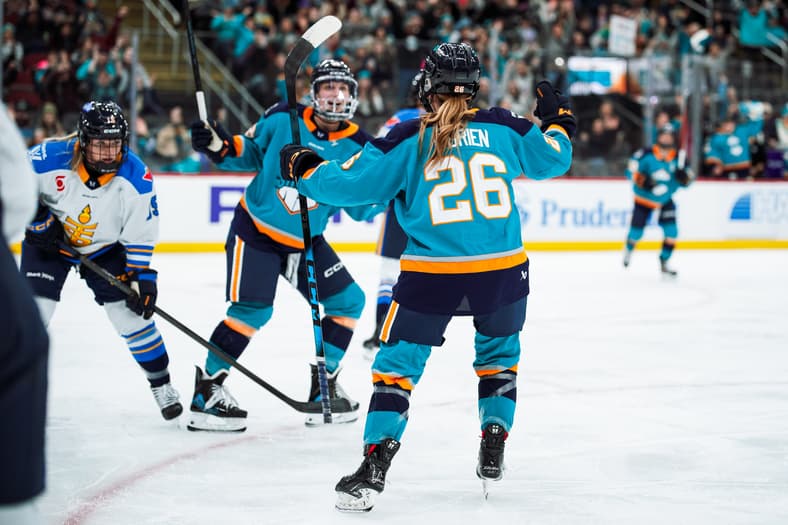
Kristyna Kaltounkova: A
Every GM wants instant validation from their No. 1 overall pick. Kaltounkova was happy to oblige. The 23-year-old rookie leads the PWHL with 11 goals at the Olympic break, making her a strong candidate for Rookie of the Year, alongside Boston Fleet defender Haley Winn and her linemate O’Brien.
Moreover, Kaltounkova’s physicality and snarl make her a uniquely disruptive offensive threat. Granted, that physicality occasionally got her in trouble; no player logged more penalty minutes (31) than Kaltounkova in the first half of the season. She needs to stay out of the box, but it’s clear she possesses the physical intangibles to be a star in this League.
If you get back-to-back No. 1 overall picks, you’d better take advantage. With Fillier and Kaltounkova, it certainly seems like Daoust landed a couple of gems.
Casey O’Brien: A-
It’s odd to say that the reigning Patty Kazmaier Award winner — given to the top player in women’s collegiate hockey — flew under the radar during the first half of the season, but that’s exactly what happened with O’Brien. While Kaltounkova drew headlines with her rocket shot and scoring touch, O’Brien quietly trailed her star linemate by one point.
O’Brien ranks second among all PWHL rookies with 11 points (four goals, seven assists). After a slow start, tallying just two points in her first seven games, O’Brien broke out with a hat trick against the Torrent in Dallas — and she hasn’t looked back since. The No. 3 overall pick closed out the first half with points in six of seven contests.
Kaltounkova and O’Brien both played center in college, but it’s O’Brien who took to the position quickly in the PWHL. The 24-year-old won 55.8 percent of her draws on 274 face-off attempts and played well in her own end. It’s rare you see a rookie skater immediately emerge as a complete 200-foot player — don’t take O’Brien’s brilliance for granted.
Maddi Wheeler: B+
The early results indicate the Sirens found the crown jewel of the fourth round in the 2025 PWHL Draft. Wheeler quickly earned a significant role in New York’s lineup and rewarded Fargo with a gritty two-way game.
Wheeler dished out 30 hits in 16 games, leaving her two shy of Blayre Turnbull for the PWHL lead. She also notched eight points (one goal, seven assists), good for fourth-most among rookie skaters. Her offensive ceiling doesn’t rival Kaltounkova or O’Brien, but she’s easily been one of the most impactful rookies in the League this season. Thanks to her physical edge, she’s got the potential to be an excellent top-six forward for years to come.
Anne Cherkowski: B
Fargo lauded Cherkowski as a first-round talent in training camp. She hasn’t quite lived up to that moniker yet, but there’s no need for panic. Cherkowski was still a semi-regular offensive contributor and a fixture in New York’s top six.
Cherkowski tallied two goals and six points in 14 games, and there’s still another level to her game offensively. A team-worst minus-five rating isn’t ideal, but the transition from college to pro isn’t always seamless. She’s an intriguing breakout candidate in the second half.
Dayle Ross: C+
Anna Bargman: C
Callie Shanahan: C-
Kaley Doyle: N/A
There’s not a large enough sample size to give the rest of this rookie class an emphatic grade, one way or the other. Dayle Ross made her PWHL debut on Jan. 6 after missing nearly two months following ACL surgery in March. She showcased a hard shot and some intriguing physical tools, but is still getting her feet underneath her. Bargman played up and down the lineup and hasn’t looked overmatched in sheltered minutes (5:15 TOI). Callie Shanahan, the seldom-used No. 2 goalie, looked shaky in her lone game, and while she eventually settled down to help New York salvage a point against the Ottawa Charge, she surrendered a couple goals she likely wants back in the 4-3 overtime loss. It’s not worthy of a failing grade, but it’s not surprising that Fargo relies so heavily on Osborne. Kaley Doyle is the third-string goalie and yet to play a game.