

 Vince Comunale
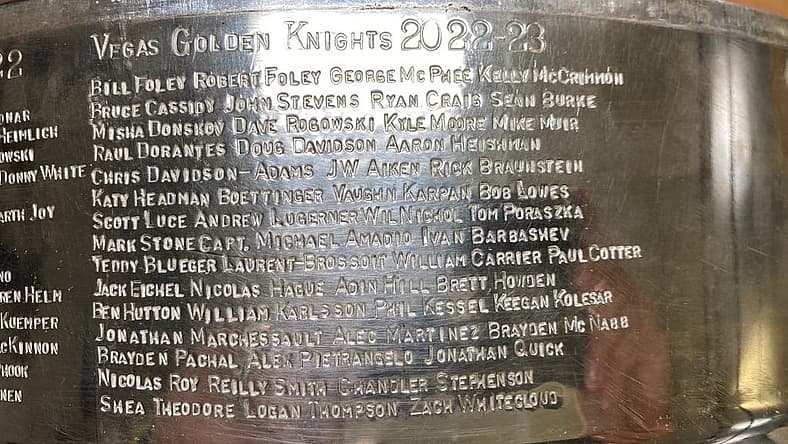
The Vegas Golden Knights are, undoubtedly, the most hated team in the NHL. The team is in the Stanley Cup Final for a third time in just their ninth year of existence. Many fans feel that the NHL “gifted” Vegas a championship-caliber team at its inception, which has led to unprecedented success. The three Stanley Cup Final appearances, one Stanley Cup Championship, five Western Conference Final appearances, five division championships, and eight playoff appearances in their first nine seasons are certainly noteworthy. However, if you really look at how the team was constructed and ownership’s continual willingness to bring in the best players, it becomes apparent that the Golden Knights took advantage of other owners’ missteps rather than being “gifted” anything.
Yes, the rules for the Vegas expansion draft were more favorable than in past expansion drafts because the NHL wanted to avoid the embarrassment of the past expansion teams. Consider that the 1974-75 expansion Washington Capitals went an unfathomable 8-67-5 and compiled a still-record goal differential of -265. The Capitals’ expansion partner, the Kansas City Scouts did not fare much better, going 15-54-11, including going 1-22-2 to finish the season.
The 1992-93 expansion Ottawa Senators went an abysmal 10-70-4, which included a 38-game road losing streak before they finally won their first, and only, road game of the season. The prior season, the 1991-92 expansion San Jose Sharks went 17-58-5, which included a 13-game losing streak. They did not fare much better in their second season, finishing an NHL-worst 11-71-2.
To avoid a repeat of the laughable records above, the NHL changed the rules for expansion drafts over the years. For the 1974 and 1979 expansion drafts, existing teams could protect two goaltenders and 15 skaters of any position. In 1991 teams could protect two goaltenders and 16 skaters of any position. In 1992 the rules were tweaked and teams could only protect 14 players of any position. In 1993 the rules were changed again and teams could only protect one goalie, nine forwards and five defensemen. For the 1998, 1999, and 2000 expansion drafts teams had the choice of protecting either one goaltender, nine forwards, and five defensemen or two goaltenders, seven forwards, and three defensemen. Finally, for the Golden Knights and Seattle Kraken expansion drafts all NHL teams had to protect one goaltender, and then could choose to protect seven forwards and three defensemen for a total of 10 skaters, or protect any combination of eight skaters.
The only “special treatment” the Golden Knights received was not having to participate in the Seattle Kraken expansion draft. However, because they were exempt they did not get a cut of Seattle’s $650 million expansion fee that was divvied up between the NHL’s other 30 teams.
Yes, the rules were such that the Golden Knights had access to a larger talent pool than their expansion predecessors in the 1990s, but also consider that the NHL had not expanded for 17 years, so there was a larger talent pool from which to choose, unlike when the NHL added the Sharks, Senators, Lightning, Panthers, and Ducks all within a three-year span, significantly diluting the talent pool.
Finally, when examining what other teams’ General Managers were offering to the Golden Knights in exchange for a guarantee to take their players in the expansion draft, Vegas just took advantage of the “bribes” other GMs were offering them. Consider the following:
- The Penguins gave the Golden Knights a second-round pick for the promise they would take future hall of fame goaltender Marc-Andre Fleury in the expansion draft. All Fleury did was backstop the Golden Knights to the Stanley Cup Final in the franchise’s first season and become, perhaps, the most beloved player in franchise history.
- The Panthers gave the Golden Knights Reilly Smith and a fourth-round pick in exchange for the promise that they would take Jonathan Marchessault. Smith is back for a second tour of duty with Vegas and Marchessault went on to play seven seasons in Vegas, including winning the Conn Smythe Trophy as the MVP of the Stanley Cup playoffs during the Golden Knights’ championship season of 2022-23.
- The Sabres gave the Golden Knights a sixth-round pick so that they would take William Carrier. Carrier went on to win the Stanley Cup with the Golden Knights in 2022-23, playing in 18 playoff games that season.
- The Wild gave the Golden Knights Alex Tuch and a conditional third-round pick so that they would take Erik Haula.
- The Ducks gave Shea Theodore to the Golden Knights so that they would take Clayton Stoner. Theodore is still with Vegas, playing over 20 minutes a game as one of the team’s top-pair defenseman. Stoner never played another game in the NHL after being selected by Vegas in the expansion draft.
- Perhaps the worst (or best) “bribe” was the Blue Jackets giving the Golden Knights a first-round pick, a second-round pick, and David Clarkson, so that they would select William Karlsson. Karlsson is still with the Golden Knights and has been a key contributor to their continued success. He is currently centering the second line with Mitch Marner and Brett Howden on his wings. Clarkson never played another game in the NHL after being selected by Vegas in the expansion draft due to a career-ending back injury. The Golden Knights later traded Clarkson’s contract and a 2020 fourth-round pick to Toronto in exchange for goaltender Garret Sparks.
As you can see, the NHL did not “gift” the Golden Knights a championship team, the other 30 General Managers did. The other 31 teams are not the victims of Vegas’ success. The only team that has a legitimate gripe is Seattle because the General Managers learned the errors of their “bribery” strategy in the Vegas expansion draft and did not allow the Kraken to benefit from the same foolishness. The success that the Golden Knights have had to begin their franchise is unprecedented, however, it all started with grifting, not gifting.