Marc Dumont
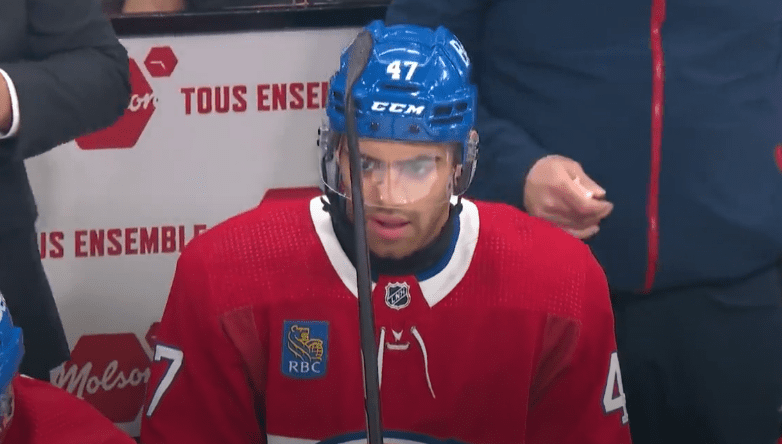
Now that the Montreal Canadiens have avoided arbitration by signing defenceman Jayden Struble to a two-year extension that carries a $1.41 million annual average value (AAV), it’s time to take a look at what type of role he can play moving forward.
Jayden Struble’s Physical Impact
Even though he doesn’t land as many hits as Arber Xhekaj, there’s no doubt Struble brings an important physical presence to the lineup. It’s even more crucial now that the Canadiens have moved on from the two players who led the pack in terms of hits per 60, Michael Pezzetta (29.5/60) and Emil Heineman (15.8/60).
Xhekaj landed 10.7 hits per 60, whereas Struble had 8.9 hits per 60, making him the second-most violent blueliner available to Martin St-Louis heading into the 2025-26 season.
He took a little time to ramp up his physical play, but once he was comfortable with every other aspect of his game, he started to land very heavy hits.
Jayden Struble delivers a huge hit on Greig. #GoHabsGo pic.twitter.com/QVPQPgHg7m
— Marc Dumont (@MarcPDumont) October 1, 2024
Struble also avoided taking himself completely out of the play whenever he wanted to line up an opponent, a key aspect to maintaining strong defensive positioning.
Struble obliterates Eklund with a huge hit. #GoHabsGo pic.twitter.com/h0XRG65rCF
— Marc Dumont (@MarcPDumont) January 12, 2024
It was similar to how he played for Northeastern University (NCAA), using the war of attrition to gain an edge on forwards who could not handle his impressive strength.
Jayden Struble’s hit on Guentzel. #GoHabsGo pic.twitter.com/JqmV46KVau
— Marc Dumont (@MarcPDumont) March 31, 2024
Struble’s Role With The Montreal Canadiens
When discussing the potential Canadiens pairings following the Noah Dobson trade, I paid most of my attention to the projected top four, which led to Struble being placed on the projected third pairing alongside Xhekaj.
I still maintain that the pair would form an excellent third pairing, and though some dismiss the value of blueliners who play a more sheltered role, the best teams in the NHL have talent throughout the lineup, including the No.5 and No.6 defencemen.
ON TOPIC: Projecting Montreal Canadiens Defensive Pairings Including Dobson
In my haste to figure out where Dobson would play, I may have sold Struble a little short, a realization that took place only after a diehard Canadiens fan commented on the piece.
At first I was daydreaming about Hutson-Dobson, but it’s clear Guhle-Dobson makes more sense, for both players and the team. I can’t dismiss the possibility of Hutson-Struble though, they were quite phenomenal together, and this would allow Carrier to stabilize the other pair
— Steady Eddy (@SteadyHabs) July 3, 2025
Jayden Struble’s Statistics
To keep things simple, we won’t delve into the numbers Struble produced with various defensive partners.
You’ll simply have to take my word for it.
Okay… we all know that’s a dream that will never be fulfilled.
Prepare for the statistics overload.
Struble’s most common defensive partners were Xhekaj, Lane Hutson, and David Savard.
Alongside Savard he only managed to control 42.5 percent of the shots (CF%), as well as 45 percent of the expected goals (xGF%). Those are well below-replacement numbers, but it must be said that every player, including Hutson, struggled while playing with Savard. If you remove Savard’s numbers from the mix, a fair experiment given that he is no longer with the team, both Hutson and Struble’s numbers immediately improve by leaps and bounds.
It’s the main reason why I’m not worried about Hutson’s early-season defensive numbers, as it was clear to anyone who watched a single shift that Savard was acting as an anchor, but I digress.
With Xhekaj, the duo controlled 54.8 percent of the shots, and 50.6 percent of the expected goals, a considerable improvement upon his time with Savard, connoting that the two could end up forming an excellent third pairing for the Canadiens next year.
But Struble’s best stats were produced when he played with Hutson, to the tune of 56.2 percent of the shots, and almost 60 percent of the expected goals.
Those aren’t just good numbers, they’re borderline elite.
Of course, Hutson acts as a cheat code for most of his defensive partners, not to mention his coach, and we do have to accept that Struble’s impact in that pairing was probably not as high as Hutson’s.
And yet, we’d be foolish to ignore the numbers, especially if the inevitable injury bug hits and St-Louis is forced to search for the best options to play in the top four.
Lane Hutson and Jayden Struble set up Cole Caufield.
Caufield’s 33rd of the year. 51st assist of the year for Hutson. #GoHabsGo pic.twitter.com/wliMzE7ctj
— Marc Dumont (@MarcPDumont) March 28, 2025
All Montreal Canadiens and Jayden Struble statistics via Natural Stat Trick.