James Nichols
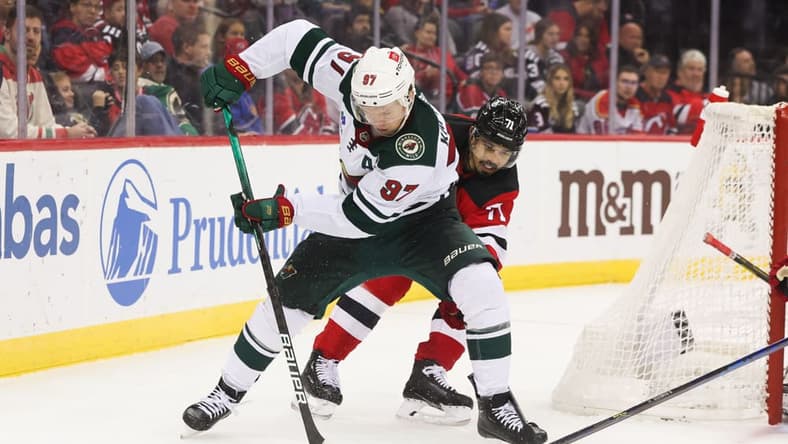
Heading into the 2025-26 regular season, the NHL is in a transitional period. It was an interesting summer, where the expectation was that more big free agent tickets and blockbuster trades would go down as a result of the jump in the salary cap. However, that didn’t happen. Instead, the significant contract extensions came more recently, for players such as Connor McDavid and Kirill Kaprizov. So, how do the recent new contracts impact the Devils?
READ MORE: Veteran on PTO Expected to Sign With Devils
In January, the NHL and NHLPA announced that team payroll ranges for the next three seasons would be an Upper Limit of $95.5 million in 2025-26; an Upper Limit of $104 million in 2026-27 and an Upper Limit of $113.5 million in 2027-28. In fact, there’s already word that the figures for the next two seasons could go higher.
Thus, the expectation, and all the chatter about upcoming free agents, has been about how the star players are resetting the market.
That’s why Devils fans saw Luke Hughes sign a new ticket for seven years, with a $9 million average annual value (AAV). He’s not quite a $9 million player yet, but the expectation is he will be. And as that salary cap increases, so will the feeling that the Devils inked the 22-year-old blueliner to a bargain.
It’s a similar feeling for Carolina Hurricanes fans with Nikolaj Ehlers. What perhaps looked like an overpay at $8.5 million for the next six seasons for the 29-year-old will look like a decent deal for a player with 30-goal, 65+ point potential.
However, once Kaprizov inked the dotted line, it changed everything.
Kirill Kaprizov’s Impact
Kaprizov and the Minnesota Wild agreed to the most lucrative contract in NHL history, making the Russian winger the highest paid player in NHL history in both dollars and AAV.
Kaprizov’s new eight-year, $136 million deal carries a $17 million average annual value, beginning in 2026-27.
Most of Kaprizov’s contract will be paid out in bonuses. He’ll have a $1 million base salary, with $18.1 million bonuses in years 1-4, and decreasing thereafter.
Kaprizov also commanded a full no-move clause through the duration of his contract, and accounts for 16.35% of the Wild’s salary cap in 2026-27.
And look, last season Kaprizov was limited to 41 games, scoring 25 goals and 56 points in that span. However, he’s a perennial 40-plus goalscorer, reached 108 points in 2021-22, and nearly touched 100 points in 75 games during 2023-24. He has the injury narrative to overcome, but the Wild were willing to make that bet.
It’s widely accepted that Kaprizov is one of the best players in the NHL. So what does this all mean for everyone else?
Well, once Kaprizov signed that contract, it was the beginning of the end of the middle class. In other words, the NHLs stars are going to command top dollar, and reach for as close to the top percentage of the cap (20%) as possible. And with the NHLs minimum salary only jumping minimally, you might start seeing a significant gap between star and role player salaries.
Connor McDavid’s Impact
That was, until Connor McDavid became everyone’s hero in Edmonton.
McDavid shocked the NHL world when he agreed to a two-year contract (starting in 2026-27) with the Edmonton Oilers that only paid him a $12.5 million AAV through 2028.
Yes, he’s likely going to walk into the summer three years from now and cash in, but until then, he’s potentially changed the market landscape for star players that will sign after him.
Now, there’s no debating that McDavid is the best player in the NHL, let alone on the planet. Thus, whatever he wants, he’ll get. So, it’s no secret that he took a significant discount so that Oilers GM, Stan Bowman, can build a suitable army around him to win a Stanley Cup.
And that’s exactly what NHL GMs across the NHL are going to bargain with. If you’re a star player on any team in the league with a chance to take a run at the Stanley Cup, there’s no reason why every GM won’t point to the best player in the world and say, “If he sacrificed, why can’t you?”
Perhaps, more star players are going to look at McDavid’s term, as opposed to the AAV, as a model to both reel in as many dollars as possible, while also maximizing their opportunities to win.
Devils Impact
So, you’re wondering how this all impacts the Devils.
In the immediate future, it doesn’t. But, two summers down the road, the Devils have a significant contract to work out with their captain, Nico Hischier.
At that time, McDavid will have one year left on his deal.
Hischier will just be coming off a contract that paid him $7.25 million for seven season, as a multi-30-goalscorer, and 60-plus point producer, one time reaching 80 points.
Plus, he’s perennially one of the best defensive forwards in the game, consistantly in the Selke Trophy conversation.
He has two years to show even more growth, but what does that mean for the Devils?
Well, you can bet that Hischier is going to receive a significant raise in two summers. It was already expected, but it’s possible it will be even higher than anticipated.
Anže Kopitar is a good comparable as a regular Selke candidate, who is similarly a career 0.88 point per-game player. The Los Angeles Kings captain just completed an eight-year, $80 million contract, paying him a $10 million AAV.
Accounting for the change in max-term starting September 2026, the most Hischier can sign for is another seven-year contract. However, is it unreasonable to see his AAV jump to $12 million, totaling an $84 million deal? Perhaps even higher?
It’s not out of the realm of possibility, and, of course, new contracts between now and then, such as Jack Eichel’s, could impact future negotiations further.
Just wait until Jack Hughes is due a new contract in 2030.
On the blueline, look at the contract Jake Walman just signed. Is it unreasonable that if Simon Nemec has a breakout season, he could receive a similar 7X$7 million extension as soon as this summer?
We’re approaching uncharted waters in the landscape of NHL salaries.