Pat Pickens
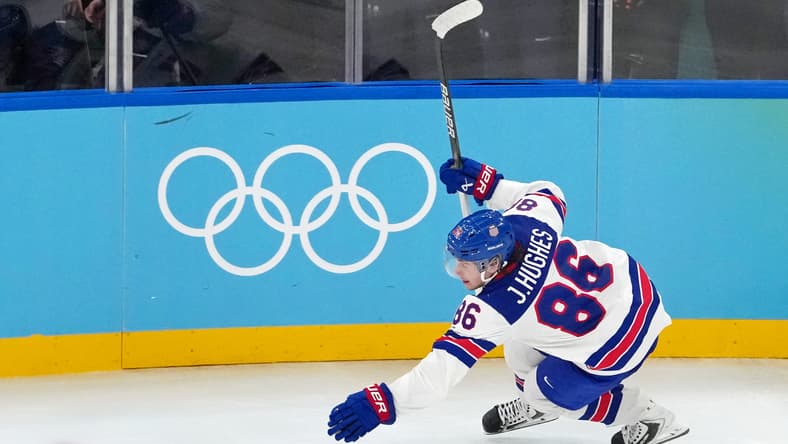
Jack Hughes nearly didn’t get to become an American hero.
Sitting in the penalty box late in the third period of a 1-1 gold-medal game against Canada on Sunday, the superstar New Jersey Devils forward seemed more likely to cost the United States the game than win it for his country.
“I pictured myself on Barstool [Sports] as the guy America hates because Canada scores on the power play,” Hughes said after the game. “I was like ‘oh my God, here it is.’
“Just glad we got out of that pickle I put us in.”
Still, after Hughes’ teammates picked him up, he made sure to return the favor by capping a monster shift at both ends of the rink with the game-winning goal at 1:39 of overtime in the United States’ 2-1 overtime win over Canada at Milano Santagiuliano Arena that sealed USA’s first gold medal since 1980.
Most Devils fans who were “done” with Jack Hughes before the tournament may need to serenade him with a “Sorry Jack” chant, a la the Lindy Ruff treatment during the 2022-23 season, especially if he uses his first Olympics as a springboard for the rest of this season and beyond.
Hughes finished with four goals and seven points, leading the Americans in both categories. He finished tied for second-most goals among all players with Nathan MacKinnon (Canada) and Juraj Slafkovsky of Slovakia.
“I think Jack had a terrific tournament,” USA coach Mike Sullivan said after the game. “The goals he scored were big-time goals. … I think Jack was at the center of a lot of the good things that happened for our team. He’s a high-stakes player. He brought his very best when the stakes were the highest.”
Hughes proved his coach’s point by authoring two elite-level plays that saved the Americans’ bacon and allowed himself to further stamp his legacy in the history of USA Hockey.
The Defense on Connor McDavid
Hughes didn’t start overtime on the ice, but he went on for the Americans’ third shift of the extra session.
His first task of overtime? Playing defense against the best player in the world.
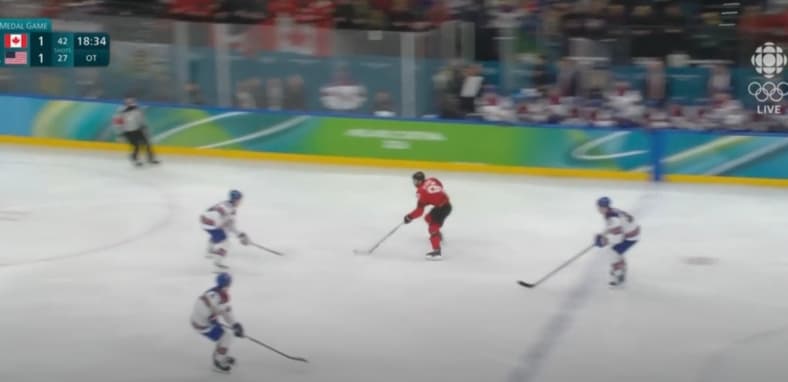
That’s Connor McDavid bearing down on Hughes and the U.S. net with a full head of steam. He took the puck from linemate, and breakout Canadian star Macklin Celebrini, at his own blue line and rushed ahead with speed.
“I came right off the bench,” Hughes said, before addressing Sullivan and saying “You probably were loving that, right Sully? McDavid coming down on me.”
McDavid eats up even elite-level NHL defensemen on rushes like this every night. He has 96 points in 58 games this season and averages 1.5 points per game for his decade-plus in the NHL and was named the MVP of the tournament after leading the entire Olympic field with 13 points.
And on this play he’s being defended by a 5-11, 175-pound forward.
“When the best player in the world — maybe ever — is comes down on you in overtime in the gold-medal game and you’re a forward, my first thought was ‘I’ve got to gap up,'” Hughes said, “and I was like ‘I can’t gap up, he’ll blow right by me.”
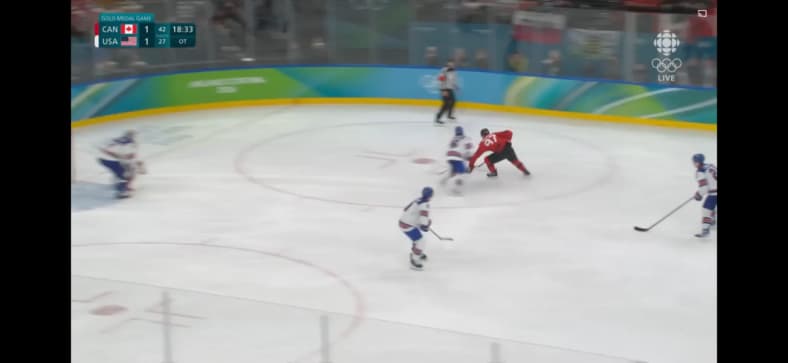
Yet, Hughes did what he needed to do to slow McDavid down and stymie any potential scoring chance.
“He did a great job,” Sullivan said. “He recognized that he didn’t have an opportunity to gap up on it. He just absorbed it. I think he did a terrific job defending him.”
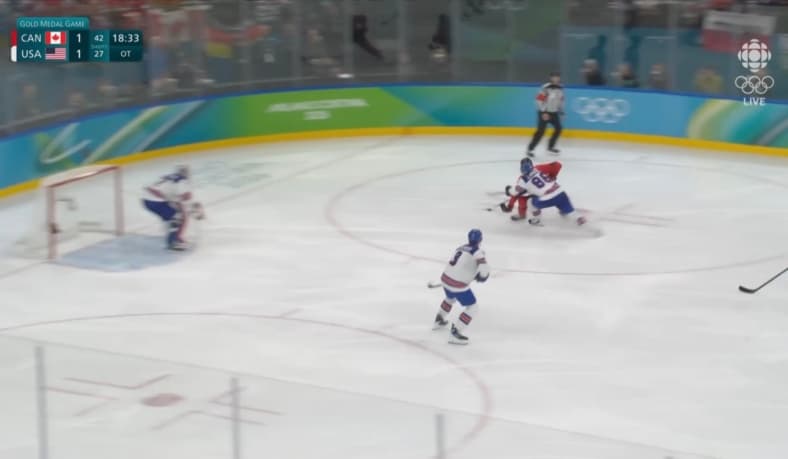
“I just sunk in, and hopefully he can’t get around me because there’s not enough space between me and the net,” Hughes said. “That’s honestly kind of what happened.”
The Poke Check on Cale Makar
Hughes’ second defensive play may be lost compared to bodying McDavid and scoring a golden goal. But his help exiting the defensive zone was no less important
Hughes dislodged the puck from McDavid and took it behind the net before kicking the puck to USA defenseman Zach Werenski. But the forechecking McDavid pressured Werenski, and he made a soft backhand pass toward Hughes to exit the zone.
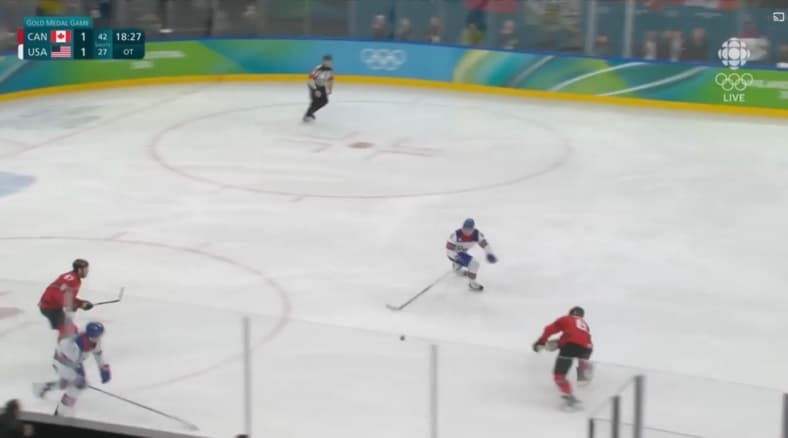
Yet, looming at the blue line was Cale Makar — the Connor McDavid of defensemen. Makar was named one of two defensemen to the All-Olympic team, along with Jack’s brother Quinn Hughes, since he had six points in six games and Canada’s lone goal in the gold-medal game.
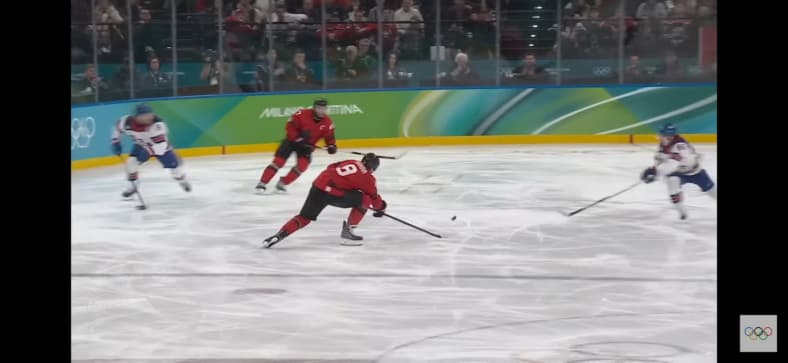
Werenski was breaking out of the USA defensive zone to play offense. So if Makar intercepts the pass — or even makes a strong tip of it — McDavid is in all alone on goalie Connor Hellebuyck and scores the OT winner for the second time in as many best-on-best tournaments.
Yet, it was Hughes who managed to tip the puck past Makar and to Werenski, creating the three-on-one that ultimately led to his goal.

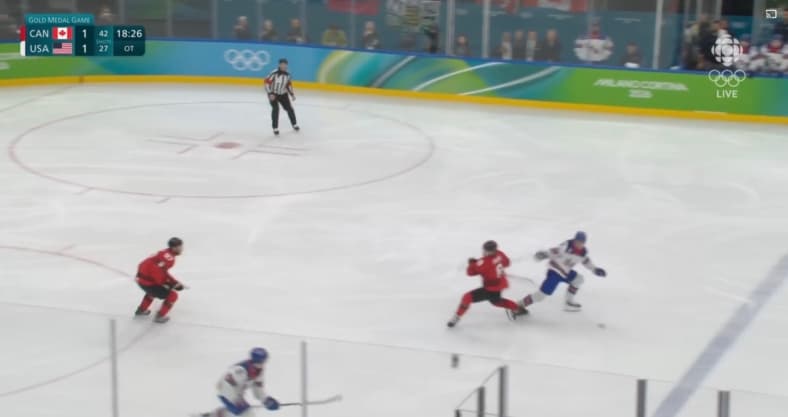
Finding the Quiet Ice and Scoring the Goal
The puck drifted all the way down to the USA offensive zone, where Werenski won a puck battle from Nathan MacKinnon. Dylan Larkin went to support Werenski while McDavid defended, and Hughes peeled off to get into prime scoring territory.
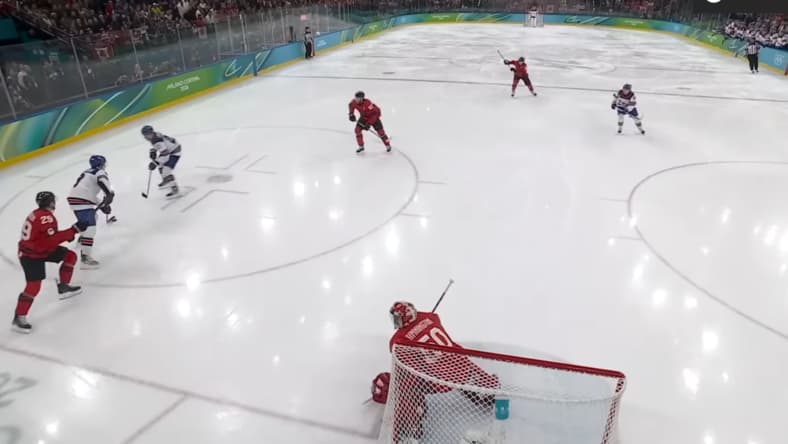
With Makar trailing the play, Werenski found Hughes. Hughes beat Binnington with a snipe between the pads that surely reminded Devils fans of what has made them one of the NHL’s elite 3-on-3 overtime teams over the past three seasons.
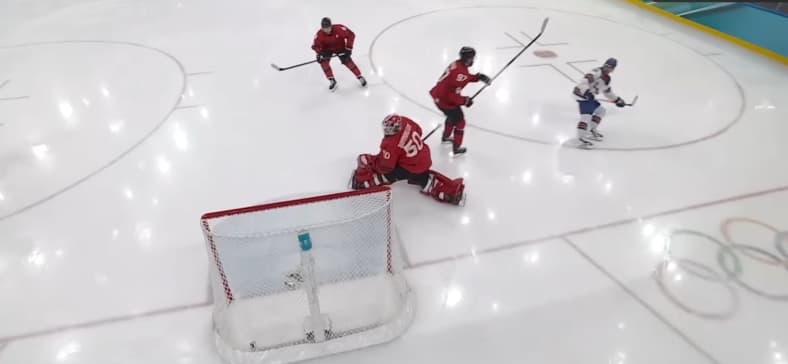
Hughes’ goal will change his life. Yet, in the moments after scoring arguably the biggest goal in American hockey history, he was more focused on fulfilling a dream and doing it with his USA Hockey brothers.
“We’re a great team,” Hughes said. “We wanted to go through Canada and beat them, and it could have gone either way tonight, but that’s an unbelievable win for the Americans.”