James Nichols
The New Jersey Devils came out of the 2025-26 season with a defense that had its moments but too often felt disjointed in transition.
Guys like Dougie Hamilton, Luke Hughes, and Simon Nemec brought offensive spark from the back end, posting respectable primary assist rates and helping generate chances, although at moderate or inconsistent rates. The rest of the group—think Brenden Dillon and Jonas Siegenthaler logging big minutes with minimal offensive input—left the blue line vulnerable to breakdowns when trying to break out of their own zone.
The Devils’ 48.5 xGF% at 5v5 told the story. They were getting out-chanced more often than not. Jake Allen had to steal a few games, and when Jacob Markstrom was in goal, it was a recipe for disaster more often than not.
Enter Jordan Spence.
The 25-year-old right-shot defenseman quietly put together a strong first full season in Ottawa after coming over from Los Angeles, and he looks like the kind of targeted addition that could smooth out New Jersey’s back end without breaking the bank or the prospect cupboard.
Spence’s Steady Climb and On-Ice Impact

Spence isn’t the flashiest guy on the ice, but he gets results in the areas that matter on the blueline. However, he makes the smart and safe plays while being a reliable puck transitioner.
He’s a perimeter defender in the offensive zone, but knows how to get shots through lanes or find lanes to pass the puck to his teammates. However, the result of his perimeter play ensures he doesnt leave himself out of position defensively. Spence can be an aggressive defender while ensuring he doesn’t battle for proper positioning.
In 73 games with the Ottawa Senators, he tallied seven goals and 24 assists while averaging over 16 minutes a night at 5v5.
His underlying numbers stood out: a 62.2 xGF% and strong possession metrics that showed he could maintain control and push play forward.
What stands out even more is the trajectory. Compare his seasons:
- 2023-24 (LAK): 53.8 GF%, 54.6 xGF%
- 2024-25: Big jump to 65.4 GF% and 57.7 xGF%
- 2025-26 (OTT): 57.4 GF%, 62.2 xGF%, with career-best offensive involvement and higher-end minutes.
He’s seemingly earning trust in tougher situations, and proving he can handle a bigger role when injuries hit.
For a Devils team that leaned heavily on its top mobile defensemen for any real puck movement—which didn’t work out all that well for them, Spence would bring another reliable option who can make crisp outlet passes, support entries, and chip in secondary scoring without forcing the issue.
Contract Realities: Affordable Now, Manageable Later

Spence wrapped up a two-year, $3 million deal at a $1.5 million cap hit. As a restricted free agent with arbitration rights, if he gets a qualifying offer, it’ll be for $1.7 million. Projections for his next contract land in the $3.5–5.2 million AAV range on a three- or four-year deal—fair value for a young, productive top-four guy heading into his prime.
Thus, a qualifying offer seems unlikely.
Yet, those projections fit neatly under New Jersey’s cap picture, especially with the team looking to stay competitive around its core. It’s controlled cost for someone who’s shown he can step up, not the bloated long-term commitment that often scares teams off.
Ottawa’s Direction Creates an Opening

Recent reporting from Bruce Garrioch of the Ottawa Citizen suggests the Senators are actively gauging the market for Spence as they try to reshape their defense. The club wants to get “bigger and harder to play against” on the back end, and at 5-foot-11 and 190 pounds, Spence doesn’t perfectly match that vision. While this could be partly negotiating leverage ahead of his raise, it signals Ottawa might be willing to move him rather than lock in long-term money if the right package comes along.
Spence played well in Ottawa—he earned more responsibility late in the year and even logged heavy playoff minutes—but the Senators have other pieces and priorities. That mismatch opens a window for teams like the Devils who value skill and puck movement over pure size.
Spence vs. New Jersey’s Puck Movers
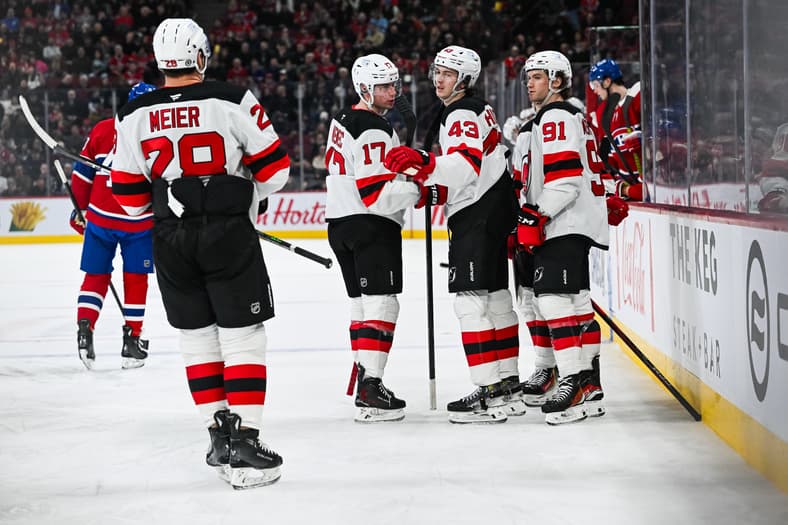
To get a clearer sense of the fit, it helps to line up Spence’s 2025-26 numbers directly against the Devils’ three most offensively inclined defensemen. All played significant minutes in their respective roles, but the differences in results are telling.
Compared to Luke Hughes (68 GP, 18:47 TOI/GP): Hughes remains a dynamic, high-minute piece with strong playmaking instincts, but his on-ice metrics took a step back last season. He posted a 47.4 GF% and 49.0 xGF%, along with middling overall rating (74th percentile) and near-replacement WAR. Spence, in fewer minutes per game, delivered markedly better possession and chance creation (57.4 GF%, 62.2 xGF%) while posting elite rating and WAR percentiles. Spence offers better puck-moving reliability with fewer of the defensive lapses that sometimes plague Hughes in his own zone.
Compared to Dougie Hamilton (77 GP, 16:57 TOI/GP): Hamilton is the veteran benchmark here and still produced solid value, especially in impact metrics (+0.22 average) and rating percentile. Yet his GF% (45.9%) and xGF% (51.3%) lagged behind Spence’s, and he played in a slightly more sheltered deployment at times. Spence’s superior expected goals share and overall season rating suggest he could provide similar offensive contributions from the point while potentially handling a heavier load in transition without the age-related wear that comes with Hamilton’s mileage.
Compared to Simon Nemec (68 GP, 17:26 TOI/GP): Nemec showed real flashes offensively and matched Hamilton in raw impact numbers, but the rest of his profile struggled. A dismal 42.7 GF% and 46.4 xGF%, combined with bottom-of-the-barrel rating and WAR percentiles, point to inconsistency in driving play. Spence clearly outpaces him in nearly every possession and value category, offering a more dependable version of the young, right-shot puck-mover profile without the same growing pains.
Overall, Spence may not have the ceiling of a Hughes or a Hamilton, but he evidently brings a more well-rounded and efficient package right now—particularly in driving positive expected outcomes. He could slot in as a strong complement rather than a direct replacement, giving the Devils more consistency across their top four.
What Could a Deal Look Like?
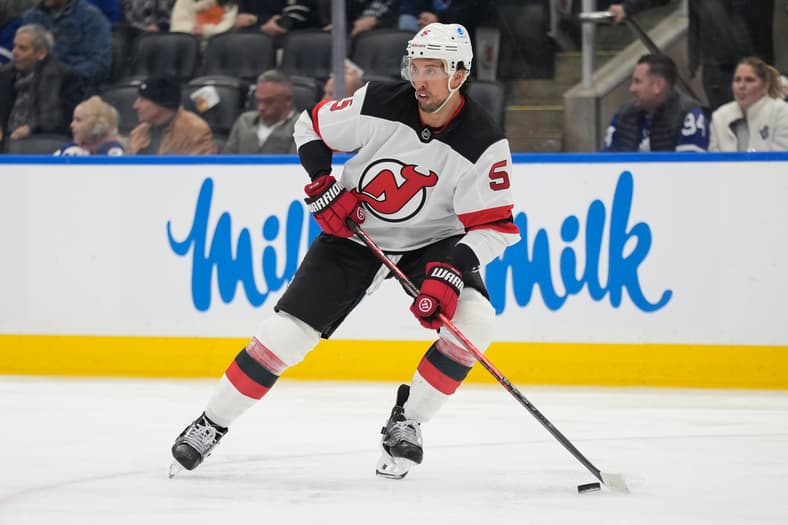
Since Spence doesn’t quite fit the Senators’ mold of bigger, harder-to-play-against blueliners, a trade package that includes a player who brings that sandpaper element could make the deal highly appealing to Ottawa.
Perhaps Nemec and Dillon—who is downgrading to a 10-team no-trade clause on July 1st and provides the hard-nosed game Ottawa seeks—move as a pair in exchange for Spence and a forward with one year left on his contract in Warren Foegele, who would certainly be an upgrade over the likes of Maxim Tsyplakov.
Perhaps a different package, say around Anton Silayev as desirable prospect due to his size and mobility that piques Ottawa’s interest instead.
Because Spence comes with arbitration protection, the ask stays reasonable. Ottawa already invested assets to acquire him last year, so this kind of targeted swap—skill for size and grit—could satisfy both sides.
Devils Reality
Landing Spence wouldn’t magically fix every defensive shortcoming, but it would give the Devils balance across their pairs. Slide him into a second-pair role, and you suddenly have better depth in transition and on special teams which certainly moves the needle.
With the Senators exploring options and Spence’s value still climbing, questions about Nemec’s futre in New Jersey, and the downgrade in trade protection for Dillon, the timing feels right.
For a Devils team that GM Sunny Mehta believes is built to contend, adding a young, improving puck-mover like this could be exactly the kind of smart, understated move that pays off for years.
*Analytics via Hockey Gamebot, contract numbers via Puckpedia, projections via AFPAnalytics