James Nichols
The Brady Tkachuk blockbuster to the Florida Panthers underscores an unfolding truth in today’s NHL. Power is shifting in favor of the NHLs star players. New Jersey Devils fans watching the Hughes speculation might feel uncomfortable. However, they’re not in a Tkachuk-like predicament… yet.
On Sunday, the Panthers pulled off an incredible heist, trading Mackie Samoskevich to the Seattle Kraken in exchange for a first and second round pick, only to flip the assets plus two more first round picks in exchange for Brady.
Now, the youngest Tkachuk is reunited with his brother in Sunrise, which catapults Florida back to the top of the NHLs most dangerous teams.
The situation in New Jersey doesn’t mirror the Ottawa Senators pressure cooker yet, largely because the ingredients that forced the Tkachuks’ moves aren’t fully present here.
Start with the market itself. Jack Hughes plays in New Jersey, an American market without the extra layer of tension that hit some U.S. players in Canadian buildings after Team USA’s Olympic gold.
The post-Olympics reception in certain Canadian markets was noticeably rough for American stars.
That dynamic doesn’t apply to Jack in Newark, where Hughes returned a literal hero to an American market after his golden goal at the 2026 Winter Olympics.
Like it or not, the American market is certainly a factor.
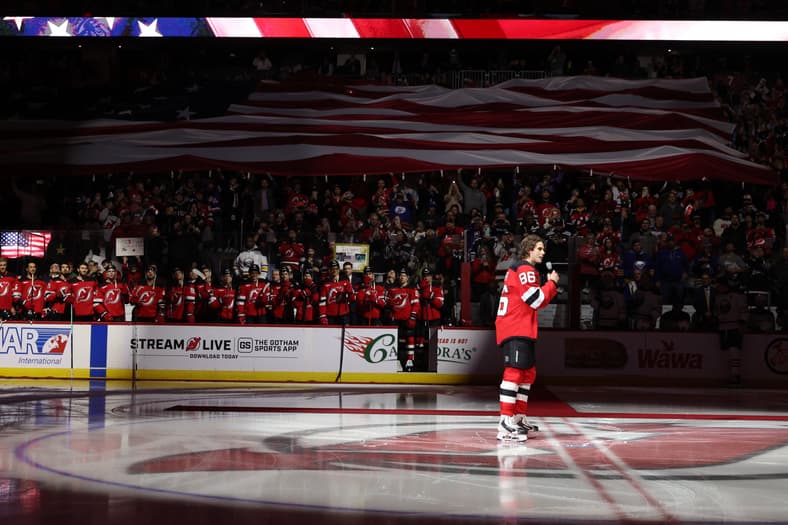
Furthermore, when Jack returned and addressed the Prudential Center crowd, he didn’t just celebrate the gold medal—he spoke emotionally about his pride in representing the Devils organization and the state of New Jersey. Those weren’t throwaway lines. They reflected a genuine connection that’s been there since he was drafted.
Then there’s the winning factor, which reshapes everything. Look at the teams that ended up on Tkachuk’s approved list during his trade process.
Vegas, Carolina, Minnesota, and ultimately Florida.
Those weren’t random. The “tax-free” narrative doesn’t work here given half of the teams on Tkachuk’s list don’t apply.
Instead, they are organizations with recent success, strong cultures, and clear paths to contention. Stars increasingly want to land where the window is open now and sustainable later.
Matthew Tkachuk made a similar calculation when he left Calgary. The common thread wasn’t just family or lifestyle—it was the chance to win at a high level immediately.
And look, you don’t have to like it, but it took just two seasons to prove Matthew right. He went on to win back-to-back Stanley Cups quickly following his exit from Calgary.
For the Devils, that means the real work of retaining the Hughes brothers who are already in New Jersey starts today.
Quinn Hughes landed in Minnesota after Tom Fitzgerald failed to reel in the eldest brother to unite the Hughes’ in Newark.
Since then, Quinn has spoken positively about the fit under Bill Guerin, turning the Wild into a destination that feels stable and competitive. New Jersey can do the same.
The franchise has the young core in place—Jack, Luke Hughes, Nico Hischier, and Timo Meier—and now has Sunny Mehta in the general manager’s chair. Mehta brings experience from the Panthers’ recent championship runs and a background in analytics that helped build those winning rosters. His hiring signals a shift toward sustained contention rather than just potential.
However, those notions need to materialize into action.
The cautionary tales are all around. Players like Dylan Larkin, Zach Werenski, Connor Hellebuyck, and Tkachuk himself either requested moves or became available from organizations that had talented pieces but struggled to turn them into consistent winners.
That’s why you’re hearing rumblings of Auston Matthews out of Toronto, too.

When the wins don’t come, even loyal stars start weighing their options. The Devils have avoided that trap so far because Jack has stayed committed, at least publicly.
None of this erases the natural appeal of three brothers eventually playing together, however.
It’s clear family bonds run deep, and the Hughes trio has never hidden their desire to share an ice surface someday. But desire alone doesn’t override contracts, current happiness, or organizational direction.
Jack’s four-year term and Luke’s recent long-term extension give New Jersey some control. Quinn’s situation in Minnesota looks settled for now. The variable that could tip everything is whether the Devils deliver the winning environment that made Florida and similar teams so attractive in the Tkachuk saga.
They’ve been on the cusp for some time. Now it’s time to break through.
Mehta’s job is straightforward in theory, but difficult in practice. Build a roster that gives Jack Hughes every reason to stay and makes New Jersey the kind of destination other stars want to join.
With four years remaining on Jack’s contract, Mehta essentially has two years to prove to Jack he can make New Jersey a desirable and perennial winning location before he has to go the franchise face and inquire about his long-term future.
If the wins start piling up, the speculation about the brothers scattering fades. If they don’t, the same forces that moved the Tkachuks could eventually test New Jersey’s hold on its own young core.
For now, the Devils hold the stronger hand. Jack has shown he’s bought in and you’d be wrong to assume Quinn’s gravitational pull on Jack is stronger than Luke’s.
The market isn’t pulling against New Jersey the way it did in Ottawa. With the right front-office push toward contention, New Jersey can turn the Hughes story into one of retention and success rather than another cautionary tale about stars leaving organizations that couldn’t quite get over the hump.
Quinn hasn’t put pen-to-paper in Minnesota yet. Time will tell if that comes to fruition.
Regardless, it all starts with building a winning culture.
Winning really does change everything.