

 James Nichols
It’s about time for the New Jersey Devils to figure out Jack Hughes and Jesper Bratt creating magic, only to see it fizzle out without enough help on their flank or at the front of the net. Matthew Knies should be at the top of your wishlist this summer.
Multiple reports continue to suggest the Toronto Maple Leafs are gauging the market on the power forward.
In fact, Knies was almost dealt by the former regime with Brad Treliving at the helm to the Montreal Canadiens in exchange for Alexander Zharovsky, another prospect, and a pair of first-round picks.
However, the Maple Leafs and Canadiens couldn’t consumate the deal after they failed to meet the 3 P.M. trade deadline, thus keeping Knies in Toronto.
Yet, the new regime with John Chayka at the helm are reportedly open to listening to offers on Knies. New reports suggest the ask has changed to a a top-pair defender, a first-round pick, and a secondary player.
The Devils could entertain this situation.
The big, rugged Toronto winger just wrapped a weird, injury-marred season that left a lot of people questioning his trajectory. But dig a little deeper, and the idea of dropping him on Hughes’ line starts to look like one of the more exciting moves the Devils could make.
Knies with Jack & Bratt Could Be Special
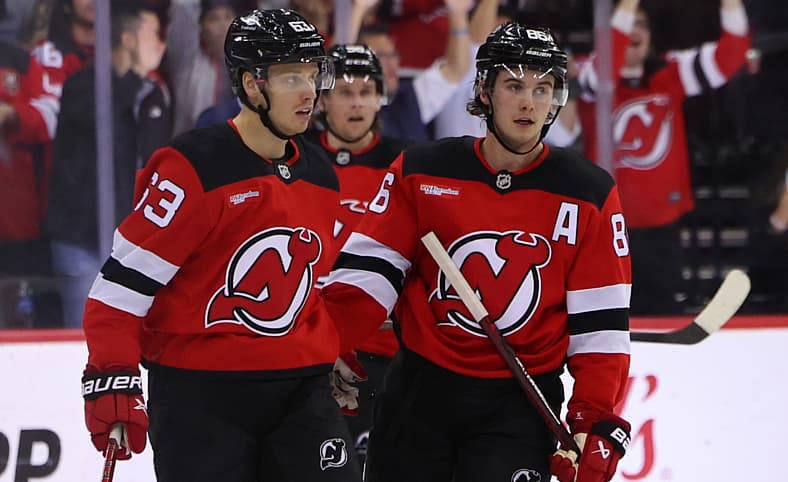
Knies is exactly the kind of forward Hughes has been missing: a 6-foot-3, 230-plus pound guy who isn’t afraid to grind in the tough areas, drive the net, and turn Hughes’ highlight-reel passes into actual goals.
Think about what Hughes does best—he sees the ice like few others and creates chances out of nothing. What he needs beside him is someone who finishes those chances and creates his own mess in the slot. Bratt alongside Hughes can similarly replicate this kind of offense.
Knies has shown he can do both. In his big 2024-25 year, he put up 29 goals while being a physical force. Even in the tougher 2025-26 campaign, his assist numbers jumped, showing he’s developing a real playmaking side with his second-ranked 22 primary assists in Toronto last season.
Put that together with Hughes and Bratt’s speed and vision, and you’ve got a line that forces opponents to make tough choices every shift. Add in Knies’ 73% finishing, and you have the ideal power forward to play with Hughes and Bratt.
What Makes Knies Intriguing
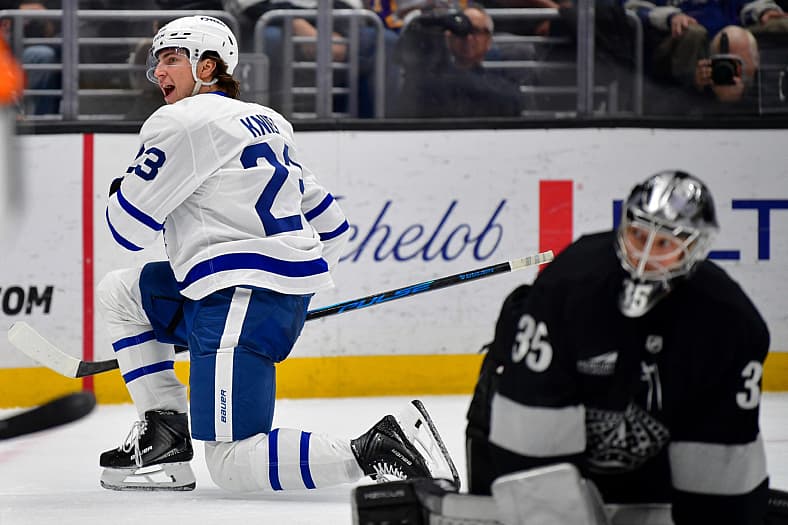
Knies doesn’t just rely on volume. His shot quality metrics hold up well for a power forward. In 2025-26, he maintained solid expected goals per shot (around 0.12 range) and ranked strongly in high-danger shots on goal in the 96th percentile. His average shot distance hovers around 20-21 feet, fitting his net-front game of tips, screens, and dirty-area work rather than perimeter sniping.
Where he really shines is rebound generation. He consistently creates rebounds, registering 18 in 2024-25 over 78 games, but dropped off to 10 in 2025-26 while playing through a knee injury amid Toronto’s total demise.
Knies didn’t just forget how to generate rebounds, however. It’s repeatable skill from his positioning and willingness to battle in front. Even in a down year affected by said knee issue, his per-minute rebound rates stayed respectable. These second-chance plays turn Hughes’ initial setups into extra opportunities, which is gold for a playmaking center.
The injury clearly limited his mobility and overall volume last season, but the underlying quality of his chances didn’t collapse. With better health, these traits should trend back up, potentially giving Hughes a legit finishing threat who also generates his own chaos.
Devils Trade Framework
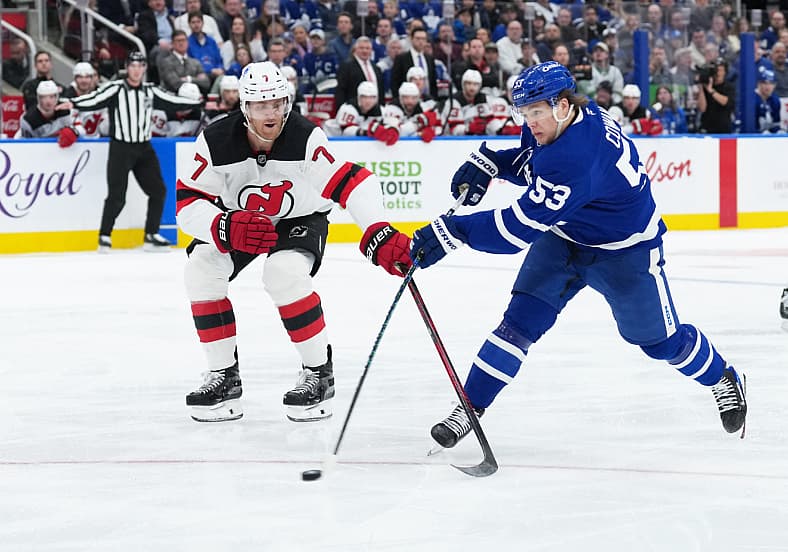
Something like Knies heading to New Jersey in exchange for the Devils’ 2026 first-round pick, Dougie Hamilton, and a prospect—perhaps Shane LaChance—feels like balanced value. Toronto gets immediate help with Hamilton and future assets in the pick and prospect who is near NHL ready and could be a solid depth option.
If New Jersey needs more value, perhaps picks or B-level prospects are attached to Knies.
The Devils land their Hughes complement without completely emptying the cupboard. Toronto might push for a sweetener, but this structure gives both sides real upside without anyone getting fleeced.
And with Hamilton’s brother working in the Toronto organization now, perhaps the Devils defenseman is more willing to accept a trade up North.
The Risks—Because They Exist
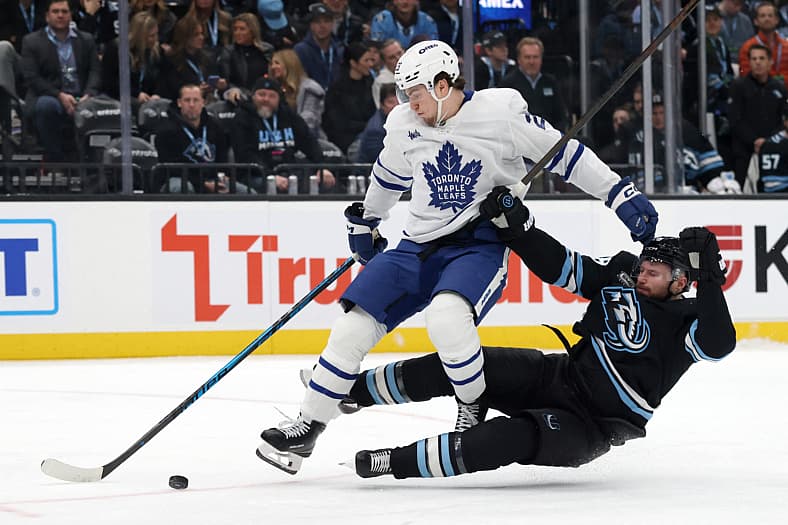
No one’s pretending this is a slam dunk. Analytics folks will point out some legitimate concerns.
His goal-scoring in 2024-25 rode some hot finishing that didn’t carry over. If his shooting luck stays average (or worse), he could settle into the low 20s for goals instead of pushing higher.
Some of his possession and defensive metrics slipped last year too, which isn’t ideal for a guy you’re counting on in big minutes. The Devils play a fast, skilled game—if Knies can’t keep up defensively or adjust to new linemates quickly, it could create problems.
Then there’s the injury history. That knee bug was no joke, and big-bodied forwards who rely on power can have lingering issues. If it flares up again, you’re paying big money for a player who can’t quite dominate the way you hoped.
Yet, you’re betting on the upside of his elite finishing metrics alongside two speedy playmakers and perhaps an improved blueline that can cover up for those deficiencies if they don’t improve.
Chances are they will if he returns to full health.
The Gamble
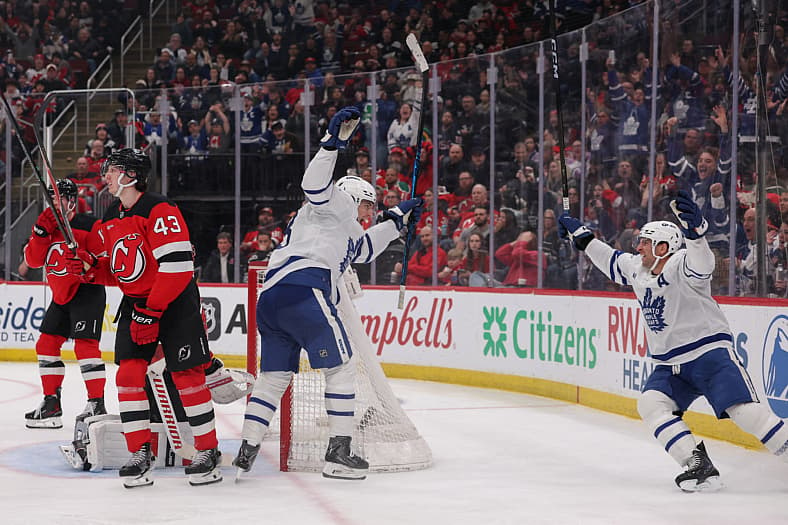
The Devils have the assets and the cap space to make something happen. Knies is signed for the long haul—five years remaining at a $7.75 million average annual value—a number that could look like a bargain if he bounces back even halfway to his best form.
Pairing him with Hughes isn’t a guarantee, but it’s the kind of bet smart teams make when they have a superstar center and winger who needs the right support—especially one who brings high-danger shot quality and consistent rebound creation.
Is it risk-free? No.
But sitting around waiting for incremental improvements hasn’t exactly worked out. Sometimes you have to swing for the player who fits what your best guy needs.
We all know by now Sunny Mehta is a betting man.
The Devils should be calling Toronto. Loudly.
*Analytics via Hockey Gamebot, NHL EDGE, Benchrates & JFresh, contract numbers via Puckpedia.