James Nichols
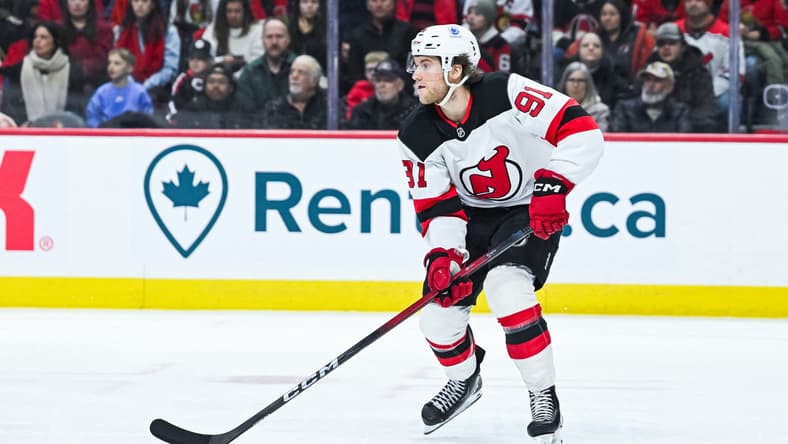
When the New Jersey Devils traded for Cody Glass 14 months ago, they certainly didn’t realize just how important of a piece he would become.
In fact, there was a time when ex-Devils general manager Tom Fitzgerald wasn’t even considering bringing the then 26-year-old back as a pending restricted free agent in the summer of 2025, leaving him unqualified longer than expected which would have saw his RFA status lift and he’d have become an unrestricted free agent.
However, once the free agent pool thinned and an unexpected number of teams showed interest in the former first round pick, Fitzgerald changed his tune, signing Glass to a two-year extension.
That decision turned out to be crucial.
Dawson Mercer, however, came into the 2025-26 season in the second of a three-year contract. Following a subpar 2024-25 season, there were no excuses in 2025-26 for the Devils’ iron man to not see an increase in his production.
They say the best ability is availability, but is that always true in the case of Dawson Mercer?
Glass and Mercer are key pieces to the Devils’ middle-six. They each saw similar offensive production in the goal column, while also playing key roles in the neutral and defensive zones, and on the penalty kill.
Yet, one player is a disappointment, and the other is a pleasant surprise.
Devils Report Card
Dawson Mercer: Steady But Stuck — C+
Final Line: 82 GP | 20G-22A-42P | 18:14 TOI
Mercer once again proved he’s one of the most reliable players on the roster, logging his fifth 82-game season in a row and contributing across special teams.
Early on, Mercer exploded out of the gate. In 26 games to start the 2025-26 season, he registered 10 goals and 21 points. He was scoring at a pace that should have seen him reach a new career-high in points, which would have eclipsed his best season in 2023-24 when he scored 27 goals and 56 points.
Yet the momentum didn’t hold.
As the season wore on, his scoring pace flattened, leaving him with a respectable but unspectacular 42 points.
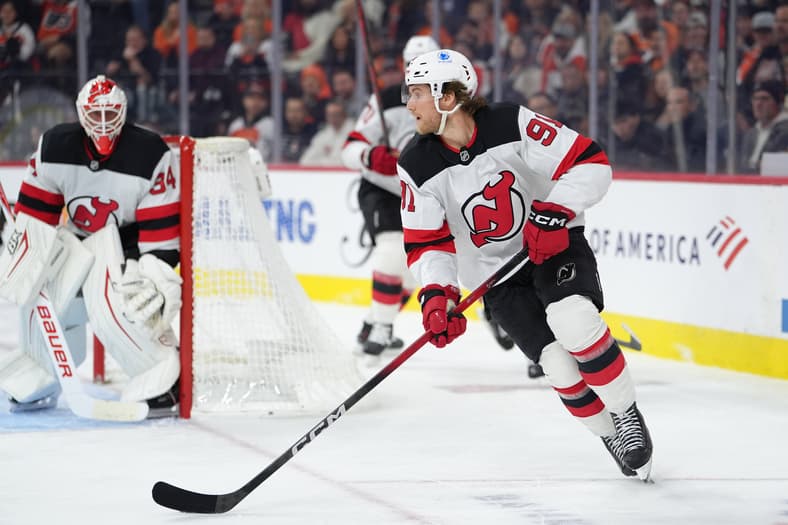
After coming into the 2025-26 season on time to training camp unlike the season previous and with what should have been a prepared mindset, this was supposed to be the year Mercer took a clear step forward as a difference-making middle-six (or higher) forward. Especially given the fact that he rides shotgun to Nico Hischier and Timo Meier on the second line.
Instead, he delivered exactly what fans have come to expect: solid defense, good possession numbers, and occasional scoring bursts without the sustained offensive impact the team desperately needed from its secondary scorers.
And not to mention, much of Mercer’s offense in the final 56 games were empty calorie, as opposed to being a difference maker.
Mercer’s positives are real, which is likely why he’s a desirable trade asset year after year. His durability, versatility, and strong underlying metrics are the reason other clubs look at Mercer and hope to acquire him.
But in a season where the Devils needed their young forwards to elevate, Mercer’s year felt like more of the same rather than the leap many hoped for.
Cody Glass: Unexpected Offensive Depth — A-
Final Line: 70 GP | 19G-7A-26P | +3 +/- | 13:37 TOI
Signed as a depth center with modest expectations, Glass turned in one of the more pleasant surprises of the Devils’ forward group.
He posted a career-high 19 goals despite missing a chunk of games, often anchoring the third line with energy, faceoff reliability, and a knack for finding the net, showcasing an underrated shot.
The career-high 19-goal campaign came out of nowhere. Glass tributes that to head coach Sheldon Keefe—citing the Devils bench boss as the first coach in his career clearly defining his role.
However, finding his offensive form from four seasons ago seemed unlikley after back-to-back six-goal campaigns.
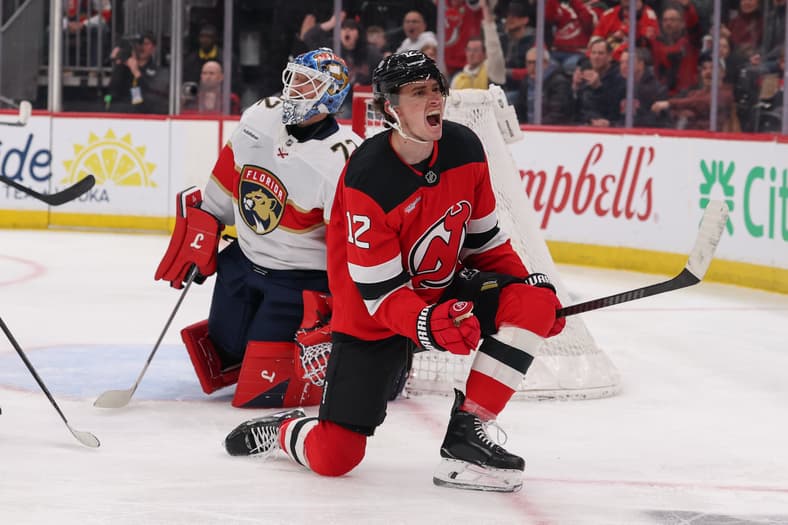
Perhaps, it shouldn’t be a surprise however. After all, Glass is a former sixth overall pick by the Vegas Golden Knights who was passed around by three teams before landing in New Jersey.
Glass wasn’t and won’t be a playmaking wizard. His seven assists in 2025-26 are enough proof. But he brought exactly what a middle-six needs: puck possession strength, physicality in the right spots, a 54% winn rate in the face-off dot, and the ability to chip in timely goals without demanding big minutes.
All while building obvious chemistry with Devils standout rookie Arseny Gritsyuk and a rotation of right wingers consisting of Connor Brown and Lenni Hameenaho.
On a team starved for consistent depth scoring, his efficiency in limited ice time stood out. He faded a bit down the stretch with injuries, but overall he delivered more value than many anticipated.
The Disparity
It’s quite clear why one of these middle-six forwards are passing with flying colors, while the other is essentially coasting by on average production.
Glass exceeded the expectation in his role as a third-line center, while Mercer is producing like a bottom-six player disguised as a top-six forward.
Despite similar goal outputs, their seasons highlight different challenges for New Jersey.
Sure, Mercer carried the heavier burden of expectations playing in the top-six potential with big minutes, yet he plateaued offensively. And that’s a tough pill to swallow given the Devils needed another level from Mercer in 2025-26 amid offensive challenges.
Glass, viewed as a utility piece, quietly outperformed his role, however. He gave the Devils exactly the kind of reliable middle-six production they lacked elsewhere.
This summer will be an interesting one. Fitzgerald was hesitant to move Mercer after teams such as the Nashville Predators and San Jose Sharks previously showed interest.
The Devils are looking for a top-six upgrade, and given Mercer’s age and contract, he could certainly help retrieve one.
Yet, Glass has become a player that you think twice about trading. Sunny Mehta would have to be coming away with a clear bargain.
If both remain, 2026-27 should paint a different picture, and only one of these middle-sixers needs to find another level.