

 Daniel Amoia
It’s another spring that the World Championships are the talking point for the New Jersey Devils, rather than the Stanley Cup Playoffs. Forward Timo Meier put it plainly at exit interviews: “You’d like to play in the playoffs and worry about this later, not now,” he said.
Regardless, the World Championships are a great place to gain experience playing in meaningful games. Here’s how each Devil performed:
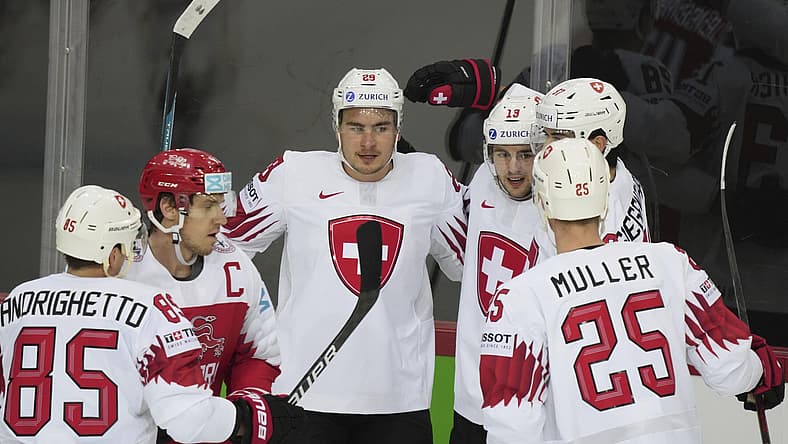
Nico Hischier (10 GP: 6 G, 5 A) | Grade: A- | *SILVER MEDAL*
Hischier’s 11 points ranked fifth among 359 players to participate at Worlds. He was a constant offensive force, outperforming many elite NHL scorers who participated. He excelled defensively, too, with a remarkable plus-10 rating…and was 61.2% in the face-off dot. However, he didn’t register a single shot on goal during regulation time — and just one in 3v3 overtime — in a heartbreaking loss for Switzerland in the Gold Medal Game.
Timo Meier (9 GP: 3 G, 8 A) | Grade: A | *SILVER MEDAL*
Meier was tremendous offensively all tournament. While he tied Hischier for fifth in tournament scoring, he did so in one fewer game as he was suspended for the semifinal. He seemed like Switzerland’s best forward for most of the Gold Medal Game, but couldn’t get one of his team-leading four shots to find twine. In typical fashion, he caused ruckus all tournament with his physicality, getting under the skin of opponents. Like Hischier, he finished with a plus-10 rating.
Nico Hischier, Timo Meier & Roman Josi the 3 players of the tournament for Switzerland! pic.twitter.com/uMnSB6s7Qc
— Bel (@bluebelgeorgia) May 30, 2026
Lenni Hämeenaho (10 GP: 3 G, 5 A) | Grade: A | *GOLD MEDAL*
For a young Devil who showed a lot of promising signs in 2025-26, Lenni Hämeenaho had a tremendous Worlds for Finland. In addition to some great playmaking, his shot became an asset on Finland’s man advantage. He also was great defensively (+5 rating). Most importantly, he came home with a Gold Medal after the Finns took down Switzerland. He only played 11:50 in the final but did draw a penalty and didn’t look out of place whatsoever. If he can play in that atmosphere, he can play in any NHL environment.
Connor Brown (10 GP: 2 G, 2 A) | Grade: B+
Despite Canada suffering a heartbreaking bronze medal upset at the hands of Norway, Brown was solid all tournament. He finished with two goals and two assists in 10 games (+3 rating). While he only got 13:38 of ice time (TOI) per game, he didn’t take many shifts off — often looking like one of their better players, even when they were struggling against some weaker opponents.
Dawson Mercer (4 GP: 0 G, 0 A) | Grade: C-
Mercer barely played all tournament; he was held point-less in four games, averaging just 4:55 TOI in each. His great job screening the goalie led to a Canada goal in game one, but otherwise, that was the extent of his impact. It would be unfair to give him too low of a letter grade since he wasn’t really given much opportunity.
Paul Cotter (8 GP: 2 G, 2 A) | Grade: B
Cotter obviously isn’t an elite scorer like some names in the tournament, but he seemed to rise to the competition when needed. His four points (2G, 2A) in eight games was fourth among U.S. forwards in the tournament. On the larger ice sheet, his speed was super noticeable. His physicality and defensive effort stood out, too — on a lackluster squad where a lot of players had dashes in their plus/minus, Cotter was a +1.
Matyas Melovsky (8 GP: 0 G, 2 A) | Grade: C+
Just getting this experience to play against top-flight NHLers is super helpful for the 22-year-old Melovsky. He didn’t light up the scoresheet but still managed two assists and a +1 rating in 12:14 TOI per game. He was also named Player of the Game against Slovenia. This could definitely be a confidence boost heading into another season with the Utica Comets (AHL).
Overall, there were many positive signs with the Devils who went to Worlds. Now, focus looks towards the 2026-27 season, where they hope to make a deep enough playoff run that Worlds aren’t even a talking point.