Marc Dumont

Most will deny it, but many eyebrows were raised when the Montreal Canadiens named 23-year-old Nick Suzuki the youngest captain in franchise history.
The fact of the matter was that Suzuki had just crossed the 60-point mark for the first time in his career, and despite being an old soul, only had 209 games of NHL experience under his belt.
Navigating the Canadiens through a rebuild is a challenge regardless of the leader put in place.
The intense media coverage, not to mention the obsessive fans, makes it a complicated journey to say the least.
In retrospect, it was arguably the smartest decision the team has made in the last few decades, but much of the impressive and consistent improvements were based on Suzuki’s affinity for setting the example on and off the ice.
While the Toronto Maple Leafs and Ottawa Senators were marred with embarrassing scandals and controversies in the last few seasons, the Canadiens have quietly put together one of the most efficient rebuilds in NHL history.
The focus has been on improving the team rather than locker room shenanigans.
And they owe much of their success to Nick Suzuki.
He’s one of the few players who has managed to improve his production every single season, while maintaining excellent underlying numbers playing on Montreal’s first line.
Nick Suzuki 5v5 Impact
Statistically speaking, Suzuki was not among the most productive players at 5v5, at least when discussing raw points.
He finished the season with 29 goals and 72 points in 82 games, good for 101 points. Only 45 of those points came at 5v5, which means Suzuki finished third in that respect, trailing Cole Caufield (49 points) and Lane Hutson (46 points).
With that in mind, he actually finished among the top 10 centres in 5v5 scoring, therefore, he was far from just a powerplay merchant.
It was his playmaking, in particular, that shone brightest. Suzuki finished the year with 33 assists at 5v5, tied with Edmonton Oilers forward Connor McDavid for fifth among centres.
If there was one criticism to be had about his production, it would be a lack of shots, and consequently, a relatively low number of goals.
That’s quite the nit to pick, but we’re discussing one of the most well-rounded players in the league. He’s a true 200-foot player, a term that’s overused in the NHL, but definitely applies to a cerebral player such as Suzuki.
Nick Suzuki is the 2026 Selke Trophy winner. #GoHabsGo pic.twitter.com/wQk8qfqgoM
— JFresh (@JFreshHockey) June 5, 2026
His true genius was revealed when evaluating the first line’s underlying numbers.
Regardless of whether it was Alexandre Texier or Juraj Salfkovsky completing the top trio, Suzuki and Caufield maintained excellent, if not dominant possession numbers.

During Suzuki’s shifts, the Habs outscored their opponents 72-39 (64.9%) at 5v5.
When Suzuki was not on the ice, the Canadiens were outscored 112-121 (48%).
That’s the difference between a legitimate Stanley Cup contender, and a team that is stuck in neutral.
It’s also one of the main reasons Suzuki was awarded the Selke Trophy, given annually to the forward who excels at the defensive aspect of hockey.
Powerplay Value
While Suzuki was an exceptional shutdown player at 5v5, his offensive skills took to the forefront when the Canadiens were awarded a man advantage.
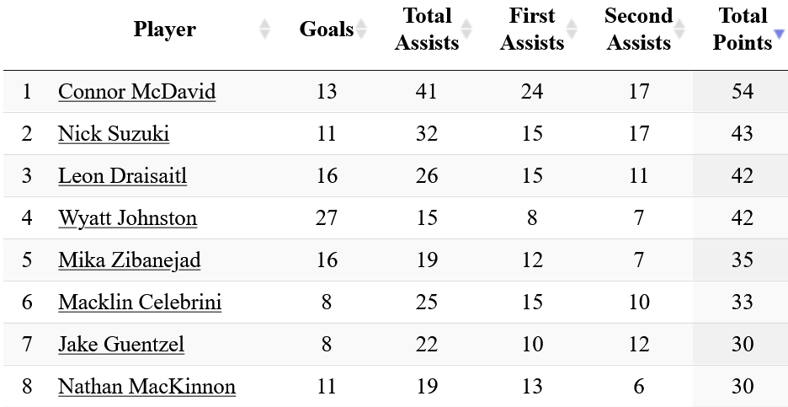
Suzuki scored the second-most points on the powerplay last season, with 43.
Now, some people will try to use this number in a desperate attempt to denigrate Suzuki’s 5v5 impact, but it’s worth noting the players he’s surrounded by in the powerplay scoring race. The list is populated by some of the best offensive players in the league, including McDavid, the only forward who managed to produce more than Suzuki.
Suzuki Player Grade
Even though we praised Suzuki endlessly in this article, we’ve barely begun to scratch the surface.
On any given night, the Canadiens captain will make a dozen quick passes, smart plays, and crucial decisions that do not necessarily show up on the scoreboard, but definitely help his team take the next step in the rebuild.
His stoic approach also invokes memories of Le Gros Bill, a comparison that I do not take very lightly, as Jean Béliveau was arguably the best leader in sports history.
There was some criticism sent his way due to his performance in the playoffs, and while there’s more to it than simply looking at his points, it’s important to note that he finished his playoff push with 16 points in 19 games, while facing opposing team’s best shutdown players.
There’s no other way to put it, Nick Suzuki is the engine that drives Montreal’s success, and the Habs are incredibly lucky to have a level-headed, hard-working leader in place.
Nick Suzuki Grade: A+ (90-100%)
Montreal Canadiens and Nick Suzuki statistics via Natural Stat Trick.