Marc Dumont

As it stands, the Montreal Canadiens are the team that has taken the fewest shots per game in the playoffs.
This includes teams that were already eliminated, though it shouldn’t be a complete surprise, as the Canadiens have focused on quality rather than quantity during their rebuild.
But there’s a point of diminishing returns when discussing high-quality shots.
Especially when you’re not putting enough rubber on net to generate a lot of high-danger scoring opportunities in the first place.
On Monday night, the Canadiens managed just 46 shot attempts (all situations), while allowing the Hurricanes to shot towards their net on 96 occasions.
That’s a +50 advantage for the Hurricanes right off the bat, the type of discrepancy that will almost always lead to a loss for the team taking fewer shots. The difference was reflected in the high-quality scoring chances. The Hurricanes held an 18-7 advantage in all situations, not to mention the upper hand at 5v5, to the tune of 14-4.
Shots On The Menu
It’s very easy to suggest the Canadiens should take more shots, but that’s ignoring one of the most obvious realities of playoff hockey: there’s a lot less time and space available compared to the regular season.
For top line players such as Nick Suzuki, Cole Caufield, and Juraj Slafkovsky, the coverage intensifies to the nth degree, making it a much more difficult situation in which to generate a higher shot rate.
In turn, this should make life a little easier on the rest of the lineup, at least in theory.
However, when evaluating the shots per 60 of the regular season compared to the playoffs, it becomes evident that it’s not just the first line that’s struggling to generate shots.
Montreal Canadiens Shots Per 60 (5v5)
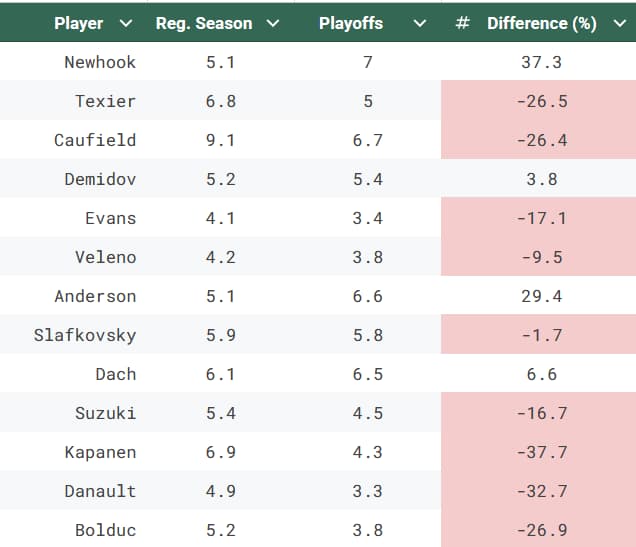
Just four players have increased their shot production: Josh Anderson, Alex Newhook, Ivan Demidov, and Kirby Dach. Full marks to Anderson and Newhook for improving their shooting rate considerably.
The rest of the forwards have suffered through a decrease, but not all downticks are created equally. Slafkovsky is generating roughly the same amount of shots per 60, and Joe Veleno has seen a decrease that’s less than 10%.
I’d argue those are good enough to suggest they’re producing enough shots to help the cause.
But once we start to evaluate the rest of the forwards, the gap widens considerably.
Cole Caufield, Montreal’s best sniper, has taken over 25% fewer shots per 60. Given his role with the team throughout the regular season, which led to 51 goals, this is the type of decline that’s very difficult to overcome. Joining Caufield in the 25% decline range is Zachary Bolduc, and Alexandre Texier, while Oliver Kapanen and Phillip Danault are in the 30% decline range.
Considering Hurricanes netminder Frederik Andersen has been relatively shaky in the series, sporting a .733 save percentage at 5v5, the modus operandi for the Canadiens moving forward should be focused entirely on shot production.
By any means necessary.
This includes considering the possibility of adding veteran Brendan Gallagher to the lineup, as he managed to finish second in shots per 60 (5v5) during the regular season.
All Montreal Canadiens statistics 5v5 unless otherwise noted, via Natural Stat Trick.