

 Marc Dumont
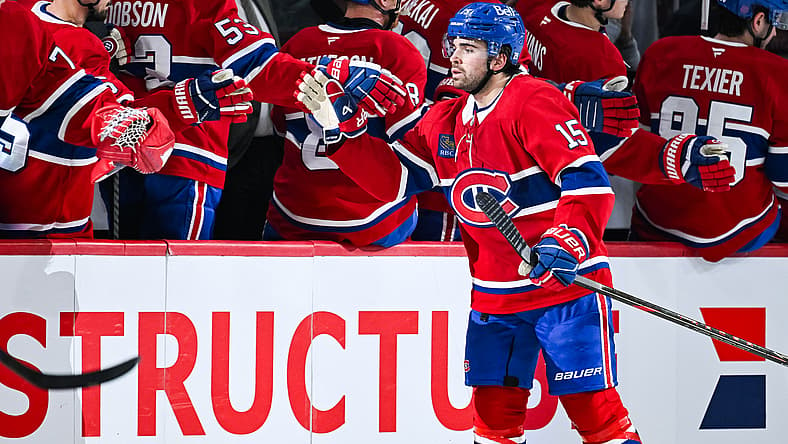
It’s been a tumultuous stretch for the Montreal Canadiens as they attempt to qualify for the playoffs for a second consecutive season.
And while most of the praise in recent games has been given to the usual suspects on the first line, it’s worth noting Alex Newhook has done an admirable job improving the overall lineup, quite a feat when we consider he missed three months following a surgical intervention to fix his ankle.
In 13 games since returning from injury, Newhook has scored four goals and four assists, but more importantly, his presence in the lineup has allowed the Canadiens to reunite one of the most dominant lines in the NHL.
Le 10e de la saison d'Alex Newhook? Le voici!
— Canadiens Montréal (@CanadiensMTL) March 22, 2026
Alex Newhook's 10th of the season? Coming right up!#GoHabsGo pic.twitter.com/Jf0aEUG0EQ
Of course, this also acknowledges that removing Juraj Slafkovsky from the top line was an unforced error by head coach Martin St-Louis, with a certain understanding that his options were limited in the top six. That being said, it’s the ultimate hockey sin to break up a legitimately impressive first line, which was exactly the case when Slafkovsky was no longer player with Nick Suzuki and Cole Caufield.
Montreal Canadiens Top-Six Decisions
There was a certain amount of logic behind the decision to attempt to spread the talent throughout the lineup. Suzuki and Caufield managed to maintain reasonably good numbers alongside the various wingers used in Slafkovsky’s spot, and there’s no doubt Oliver Kapanen and Ivan Demidov did a good job controlling the goals with the 21-year-old Slovak serving as their elder statesman on the second line.
To give you an idea, despite producing very underwhelming underlying numbers, Slafkovsky, Kapanen, and Demidov scored 25 goals while allowing their opponents to score 18. This represents a 58.1% control of the goals during their 5v5 shifts.
This justified keeping Slafkovsky on the second line, as the results were enough to mask the questionable process.
However, now that Newhook has taken over second-line duties, the trio has scored 16 goals and allowed 11 against, which results in a 59.3% goal share, slightly more than what we saw with Slafkovsky in place.
Don’t get me wrong, the underlying numbers are still concerning, but the fact of the matter is that the second line is controlling more goals, while the first line has returned to its dominant ways, with Newhook’s return serving as the catalyst to the significant team improvement.
To give you an idea of the impact of having Slafkovsky on the first line, when he’s playing with Suzuki and Caufield, the Canadiens control over 56% of the shots, 65% of the goals, 58% of the expected goals, and 53% of the high-danger scoring chances at 5v5. That’s the definition of elite.
Ettt voilà pourquoi on le surnomme Monsieur samedi soir
— Canadiens Montréal (@CanadiensMTL) March 22, 2026
Aaaand that's why we call him Mr. Saturday Night#GoHabsGo pic.twitter.com/ybzkoO6bKE
It’s rather clear there’s still an issue on the second line when evaluating their shot share and expected goals, two issues that were already in place before Newhook returned, but it should be noted they’ve actually managed to control 50.6% of the high-danger chances with him serving as a winger, much better than the 44% control that occurred with Slafkovsky.
Simply put, not only has Newhook done a great job replacing his teammate since returning from injury, Slafkovsky has also returned to his ideal role on the first line.
All Montreal Canadiens statistics are 5v5 unless otherwise noted, via Natural Stat Trick.