Marc Dumont

Few Montreal Canadiens defenceman have received as much attention, good or bad, than Mike Matheson.
There was a stretch in which the smooth-skating defenceman was counted upon to serve as Montreal’s No.1 blue liner, which led to a bevy of complaints. Of course, this ignored that he was only making $4.875M per season on his previous contract, quite the bargain when we consider he was one of the busiest defencemen in the entire NHL for a couple of seasons.
Now that Matheson has signed a five-year contract extension that carries a $6M annual average value (AAV), his compensation has aligned with his usage, though it’s worth noting his responsibilities have changed significantly, with the addition of Noah Dobson to the lineup, and phenom Lane Hutson’s quick evolution into one of the most productive defencemen in the NHL.
However, we should guard against the narrative that Matheson’s ice time was essentially gutted, even though he was used sparingly on the powerplay.
Yes, his ice time on the man advantage dropped from three minutes per game down to just 17 seconds, essentially the dregs of the second powerplay unit. But his even-strength ice time actually went up slightly, a reminder that head coach Martin St-Louis still considers him as one of his most important defencemen.
And there’s no doubt that Matheson was incredibly busy on the penalty kill, playing almost four minutes per night, much more than any of his counterparts. His underlying numbers were very respectable as well, relative to the average results of the team.
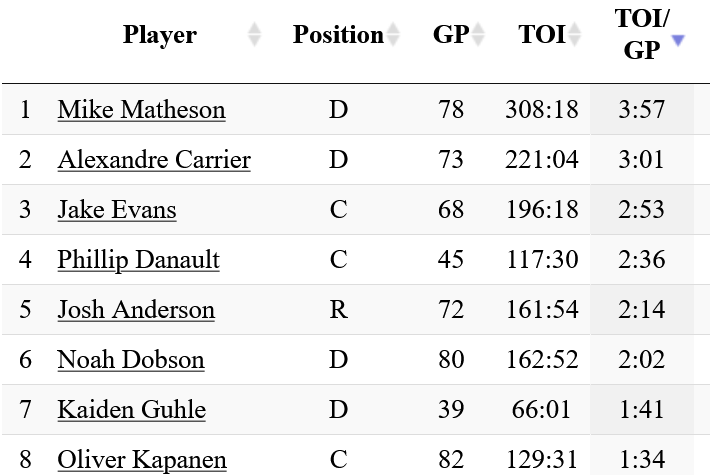
In fact, to put an emphasis on how quickly and smoothly he adapted to his new role on the special teams, no other NHL player spent more time on the penalty kill (TOI/GP) than Matheson, though it’s worth noting Dallas Stars defenceman Esa Lindell wasn’t far off.
5v5 Usage
Matheson’s ice time at 5v5 rose from 18:06 per night to 18:26, a slight uptick in usage.
He was used alongside different partners throughout the year, but for the most part, he was paired with Dobson, often absorbing the most difficult minutes, while Hutson was given second pairing duties, where the open ice would be more conducive to his style of play.
With that in mind, it’s fair to suggest the Dobson and Matheson pairing was far from perfect. They played a ton in a difficult role, but they were essentially outshot and outchanced on most nights.
Matheson Underlying Numbers
What’s particularly interesting about the pairing is that both players performed better when they weren’t playing alongside each other.
Together, they controlled just 45.8% of shots, but apart, Matheson’s shot share rose to 48%, while Dobson’s increased to 51.3%.
Another interesting statistic is their goal share, which was 46.9%. Matheson’s went up to 58% when separated from his partner, and Dobson’s hit 61.8%. The same phenomenon occurs when we evaluate their share of the expected goals.
This tells us that there may be better pairing options heading into 2026-27, but that’s a topic for another day.
Matheson Playoff Value
His usage once again shifted come playoff time. His most common defensive partner was Alexandre Carrier, which ensured he’d be facing very difficult opposition.
And the results were predictable.
They controlled just 35% of the shots, but managed to maintain a somewhat respectable goal differential of -2 at 5v5 (8-10).
As for his offensive contributions, he did score twice at 5v5, which was, believe it or not, the most goals scored by a Canadiens defenceman in that situation during the playoffs.
Matheson Player Grade
The numbers tell us that overall, Matheson did not enjoy a fantastic year.
But once again, we must keep usage in mind.
Without discussing the role of a particular player, underlying numbers lose much of their value.
Context is always key.
In this case, Matheson faces hellish minutes on the penalty kill, as well as 5v5, giving some of his younger counterparts an opportunity to play against easier competition.
All 37 of his points came at even-strength, which also means he managed to produce more this season than the last (31 points), despite being removed from the powerplay.
In the big picture, Matheson did a good job of adapting to a roster that is in constant evolution, while providing some veteran leadership to the youngest team in the league.
Mike Matheson Grade: B (73-76%)
Montreal Canadiens and Mike Matheson statistics via Natural Stat Trick.
Previously published Canadiens player grades: