Marc Dumont
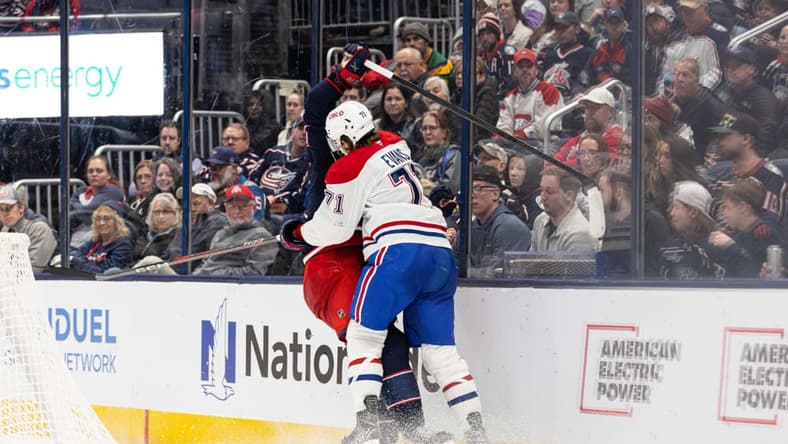
Montreal Canadiens head coach Martin St-Louis has not yet decided on his optimal lines, but the picture is getting clearer by the day.
St-Louis kept two lines from the previous practice intact: Nick Suzuki’s top line and the third line of Alex Newhook, Oliver Kapanen, and Ivan Demidov. This suggests that St-Louis is likely pushing for Kapanen’s inclusion on the opening-night roster, as we predicted on Thursday.
ON TOPIC: Predicting The Canadiens’ Opening-Night Lineup, Final Cuts
Zachary Bolduc, who was dealing with a lower-body injury, did not participate in Friday’s practice, with Joe Veleno filling his spot on the third-line wing. Had Bolduc been healthy, we would likely have seen the same first, second, and third lines as on Thursday, providing insight into the players expected to feature in the team’s top nine once the regular season begins.
Montreal Canadiens Forward Lines At Practice, October 3
Cole Caufield – Nick Suzuki – Juraj Slafkovsky
Joe Veleno* – Kirby Dach – Brendan Gallagher
Alex Newhook – Oliver Kapanen – Ivan Demidov
Josh Anderson – Jake Evans – Patrik Laine
Samuel Blais – Owen Beck – Florian Xhekaj
ON TOPIC: Predicting The Canadiens’ Opening-Night Lineup, Final Cuts
That leaves the fourth line, as well as the 13th forward as the final decisions left to be made, and while it may seem rather straightforward given that Evans has served as the fourth-line anchor for a few years, it’s worth mentioning that the Canadiens are giving a longer look to a few players who are not afraid to throw their weight around, such as F. Xhekaj, Samuel Blais, and Owen Beck.
It’s not a matter of over reacting to the violent preseason game against the Ottawa Senators, however, that was a good reminder that the Canadiens will need to have enough players in the NHL lineup to bridge the physical gap left behind by Michael Pezzetta and Emil Heineman.
Role Players Landing Hits
Before anyone rolls their eyes, it’s important to remember that Pezzetta and Heineman led the physical charge last year when evaluating their hits per 60 minutes of ice time (at 5v5). Of course, their limited usage worked to their advantage in this department, but it stands to reason the players who will replace them in the lineup will also have to deal with minimal opportunities to prove their worth.

F. Xhekaj did not feature in any NHL games last season, and thus we don’t have any semblance of his impact at 5v5 during the regular season, but his preseason games featured a healthy number of hits relative to his ice time.
Again, we’re dealing with a very limited sample size, but it’s no coincidence that most of the young players who were attempting to earn a roster spot in the NHL, including Beck, focused on physical play in the preseason.
Montreal Canadiens Brass Tacks
It’s always interesting to evaluate the impact of physical play. For many years, it was rather easy to identify the teams that struggled throughout the regular season by their high number of hits.
For the most part, teams that are chasing the play tend to land more hits, whereas the best teams in the NHL were focused on the puck, rather than physical play.
But there are some very notable exceptions at play.
For example, the team that led the entire NHL in hits per 60 last season happened to also capture the Stanley Cup for a second consecutive year. The Florida Panthers managed almost 30 hits per 60 minutes (all situations), whereas the Canadiens finished seventh, with roughly 24 hits per 60.
Florida’s physical prowess clearly helped them capture back-to-back Stanley Cups, as the rule book tends to be ignored once the playoffs begin, even more so once there are only two teams left in the mix.
On the other side of the coin, the three teams that finished the 2024-25 regular season with the fewest hits, the Carolina Hurricanes, Dallas Stars, and Edmonton Oilers, are considered legitimate Stanley Cup contenders.
However, these organizations have yet to come close to reaching their full potential in the playoffs. This assessment may seem harsh, given that Edmonton reached the Stanley Cup Final, but their lack of a championship stands out, especially considering they have two of the league’s most dominant players at their disposal, which highlights their unrealized potential, and perhaps the greatest advantage Florida has held in the last two Stanley Cup finals.
From a Montreal Canadiens standpoint, we’re getting a little ahead of ourselves.
Physical play is just one factor in Florida’s recent dominance, and it would be impossible to duplicate their success by simply increasing the number of hits per game, but it’s also fair to say there’s undeniable value in dominating the physical play, as long as the team doing it also puts an onus on maintaining healthy possession numbers.
All Montreal Canadiens statistics are 5v5 unless otherwise noted, via Natural Stat Trick.