Scott Gulbransen
Let me go on record before the Raiders are even on the clock.
Every year I do this. Every year, a few of these age beautifully and a few of them get screenshotted and thrown back in my face by people in my mentions who’ve been waiting since April to do exactly that. Fine. That’s the deal. You want accountable takes, here they are.
Let’s start with the obvious one and get it out of the way.
Fernando Mendoza goes No. 1. I’m really going out on a limb here, right? The Raiders take the Indiana quarterback who went 16-0, won a Heisman, threw 41 touchdowns against six interceptions and completed 72% of his passes in a national championship season. This one requires approximately zero courage to predict. John Spytek has said they’ve gotten calls about the pick and those teams “know where they stand.” That’s GM-speak for stop calling us.
Mendoza’s a Raider by 8:15 Thursday night, Eastern time. Write it down.
Now here’s where it gets interesting.
How the Top of the Draft Plays Out Past Mendoza
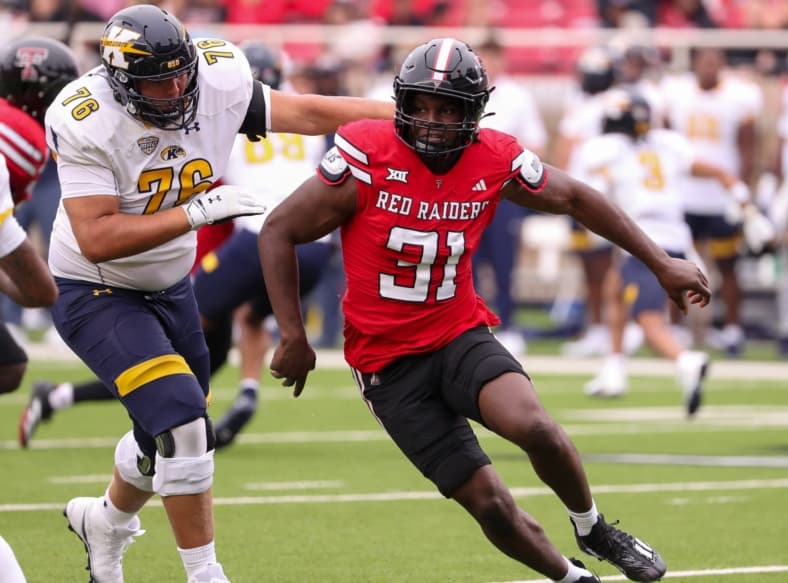
The Jets are at two and I’m going David Bailey, the Texas Tech edge rusher, over Ohio State’s Arvell Reese. I know that’s the unpopular take. Reese is the consensus pick, the athleticism darling, the guy most analysts have circled. I don’t care. The Jets aren’t drafting for upside right now — they’re drafting for production. Bailey led the Big 12 with 14.5 sacks last season, posted 19.5 tackles for loss, and was disruptive every single week against real competition. Reese has the higher ceiling. Bailey has the track record. New York has been trying to replace their pass rush for half a decade and they don’t have the luxury of waiting on a prospect to develop into what Bailey already is. Jets take Bailey, and in two years nobody remembers this was considered a surprise. But, it is the one prediction most of you will screenshot.
Carnell Tate doesn’t make it past pick eight. Most boards have him going somewhere between six and nine, and I’m not arguing with that range. He’s the most complete receiver in this class, a legitimate route runner who drew Justin Jefferson comparisons from people whose opinions I actually respect. Cleveland needs a receiver badly enough that if he’s there at six, they’re not waiting around. If he somehow falls, somebody trades up. Tate is going early, with a smile on his face.
Omar Cooper Jr. is the wild card of the first round. Most of the big boards right now have him going somewhere between 13 and 16 — Dane Brugler at The Athletic has him 21st overall, NFL.com mocks keep landing on the Rams at 13, and Todd McShay has him going in the middle of the first round. Daniel Jeremiah floated the possibility that he falls all the way to the second round. I think the truth lies somewhere between the consensus and Jeremiah. His receiving totals never cracked 1,000 yards in college, and for all the athleticism and yards after catch, NFL teams are going to talk themselves out of him before Thursday night is over. He doesn’t fall to Round 2, but he doesn’t go at 13 either. Cooper lands somewhere in the 18-22 range, and whoever gets him there feels like they stole something.
What About the Raiders in Round 2?
Now — the Raiders at 36.
The receiver board at this spot is actually pretty interesting. Zachariah Branch, Kevin Concepcion, and Isaiah Bond all sit in that late-first to mid-second tier, and in most years at least one — if not two — of them is gone before the Raiders are on the clock. Concepcion, in particular, is a mid-20s player on a lot of boards and probably doesn’t make it this far. If he does, that’s the kind of slide teams sprint to the podium for. Any one of them makes sense here.
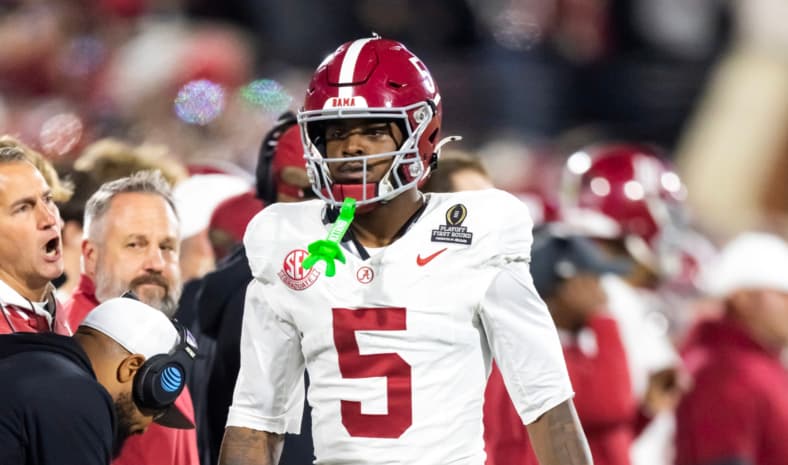
But the name I keep coming back to is Germie Bernard. The Alabama receiver doesn’t have the buzz of the top names in this class, but he’s 6-1, 206 pounds and led the Crimson Tide in catches last season with 50 receptions for 794 yards. Dane Brugler called him a favorite among scouts and coaches specifically because of his versatility across formations and his competitive mentality. He’s not the slam dunk pick here — Branch and Bond both have arguments — but if Spytek is building around Mendoza’s comfort and wants a receiver who can line up in multiple spots and get to work early, Bernard fits that profile better than anyone else in this tier. Kubiak will find ways to get him the ball.
Either way, the Raiders come out of Round 2 with a pass catcher. I’d bet on it.
Raiders in Round 3 and Beyond
When Vegas gets to Round 3 at 67, I think Spytek goes defense. Specifically, defensive tackle. McDonald visited Henderson and he’s the name everyone keeps throwing around, but let’s be honest — Kayden McDonald is a hot prospect. Multiple boards have him in the mid-to-late first round, and if he somehow makes it to the back half of Round 2, Spytek should be on the phone trading up, not sitting and waiting. He will not be there at 67.
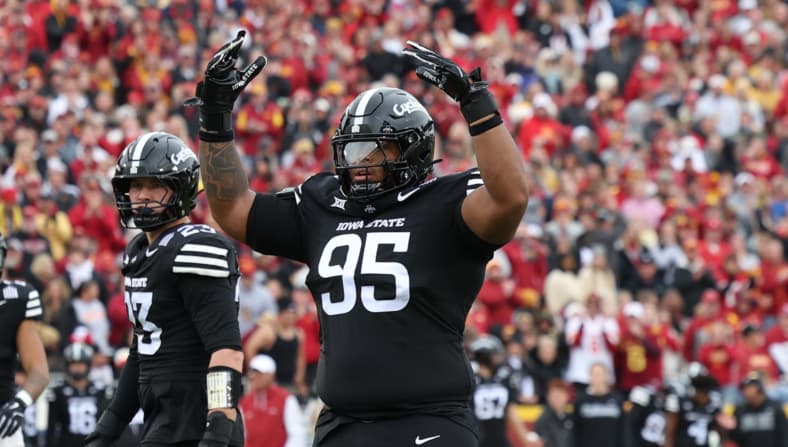
The more realistic target is Domonique Orange out of Iowa State. He visited Henderson, he’s 325 pounds, and he projects as a Round 3-4 pick across the board. He’s not a pass rusher but in Rob Leonard’s 3-4, the nose tackle’s job is to hold the point of attack and keep the linebackers clean. Orange does exactly that.
Missouri’s Chris McClellan is the other name here. He visited, too, and what separates him from Orange isn’t pass-rush production (scouts are skeptical of that part of his game), it’s versatility. McClellan can line up anywhere from zero-tech to 4i, which gives a defensive coordinator more options depending on personnel. One of them is a Raider by Saturday morning.
The secondary gets addressed on Day 3 with at least one of those fourth-round picks. Three fourth-rounders is a luxury. Spytek uses one on a cornerback — my guess is Daylen Everette out of Georgia, who visited. The projection range on Everette is wide, anywhere from late Day 2 to early Day 3, so grabbing him with one of those fourth-round picks is realistic without being a stretch.
The running back comes on Day 3. Kaelon Black from Indiana is the name — physical runner, sound in pass protection, and two seasons running alongside Mendoza in that national championship offense. He projects in the fifth or sixth round, right where the Raiders have picks sitting. You’re not asking him to be a feature back. You’re asking him to give Ashton Jeanty a capable rotation option and contribute on special teams. Black can do that.
Then there’s Logan Taylor, the Boston College offensive lineman who had a top-30 visit with the Raiders. He’s 6-7, 314 pounds and started games at all four positions along the line in college — left tackle, left guard, right guard, right tackle. That’s not a guy who wandered into a position; that’s a guy who figured out how to play football. You don’t need him to start. You need him to give your offensive line room a credible backup who can plug in anywhere inside when things get thin, and that’s exactly what Taylor provides. He’s a Day 3 pick who fits a Day 3 role perfectly.
After that it’s receivers, a safety or two, a linebacker who makes your special teams coach smile. Day 3 is where you throw darts and hope one of them sticks.
Here’s my key takeaway: the Raiders are not going to be a contender in 2026. Anyone telling you otherwise isn’t being straight with you. Six wins, maybe seven, is a realistic outcome in Year 1 of this rebuild. But a good draft — Mendoza at one, a receiver at 36, a nose tackle at 67, secondary depth in Round 4, and a running back with system familiarity late on Day 3 — sets this thing up properly for 2027 and beyond.
Check back Friday morning. I’ll be right here, either taking a bow or explaining myself.
Probably both.