
 Isaac Ciravolo
In the modern era of MLB, offensive evaluation is reliant on batted-ball quality. Front offices and analysts increasingly view hitters through a strict lens of exit velocity, bat speed, and launch angle. The mathematical consensus suggests that without high-end impact metrics, sustained offensive success is highly improbable.
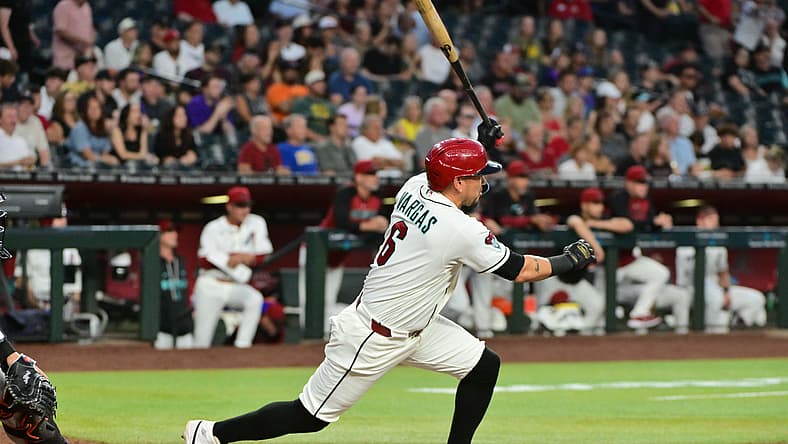
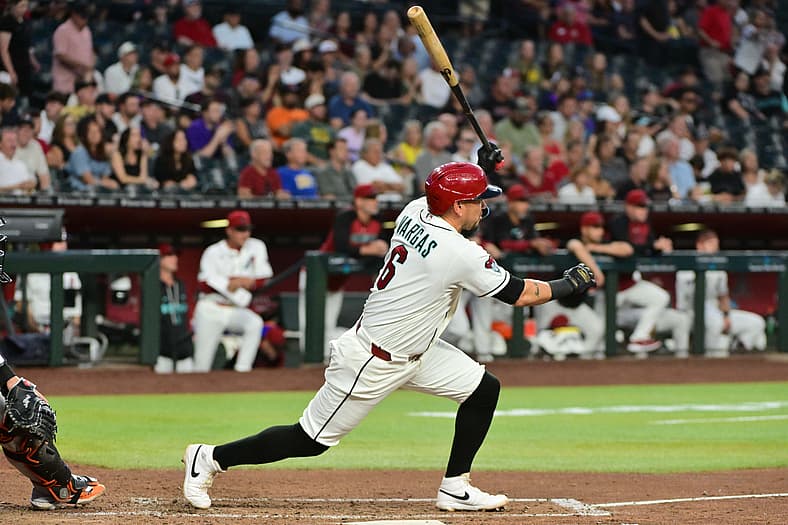
Yet, baseball remains a game capable of defying its own predictive models. Enter utility infielder Ildemaro Vargas in his third stint with the Arizona Diamondbacks.
At 34 years old, the switch-hitting veteran recently completed a historic 27-game hitting streak (24 games to open the 2026 season, plus three carrying over from the end of 2025). The streak concluded on May 2nd at Wrigley Field, but not before Vargas secured a place in the record books. He passed Paul Goldschmidt for the second-longest streak in Diamondbacks history, and eclipsed Wilson Ramos (2019) for the longest streak ever by a Venezuelan-born player.
Related: What are the Longest Hitting Streaks in MLB History
To understand how a defensive-oriented utility man pulled off the longest hitting streak in baseball since 2022, we look to the data.
The Batted-Ball Anomaly
A review of Vargas’s peripheral data, as per Savant, reveals a profile that contradicts conventional sabermetric forecasting. His actual on-field production completely defies his foundational power metrics, highlighting an extreme ability to out-hit his raw exit velocities:
- Expected Batting Avg (xBA) – 94th Percentile – Elite ability to put the ball in play where defenders aren’t.
- Squared-Up % – 94th Percentile – Maximizes contact efficiency by consistently barreling the ball, despite a lack of raw bat speed.
- Expected Slugging (xSLG) – 61st Percentile – Generates above-average outcomes based on contact quality and optimal spray angles.
- Bat Speed – 29th Percentile – Relies heavily on timing and bat control rather than physical strength.
- Avg Exit Velo and Hard-Hit % – 17th Percentile – Demonstrates that while he makes consistent contact, he rarely relies on power to get on base.
The central question is how a player with bottom-tier bat speed and exit velocity manages a 94th percentile xBA and a 61st percentile xSLG. The answer lies in Vargas’s elite squared-up rate and a refusal to swing and miss.
Weaponizing the Spray Chart
While the league environment is currently built on high-velocity swings and an acceptance of strikeouts, Vargas is exploiting the defensive space of the field. He has not implemented any mechanical overhaul; rather, he is utilizing his switch-hitting spray chart to evade defenders.
Instead of hunting walks or prioritizing elevated launch angles, he operates with calculated, extreme aggression inside and outside the strike zone.
- Strikeout Rate – 98th Percentile
- Whiff Rate – 93rd Percentile
- Chase Rate – 4th Percentile
- Walk Rate – 4th Percentile
Vargas swings at nearly everything, as evidenced by his 4th percentile Chase Rate. By eliminating walks and strikeouts from his profile, he maximizes his opportunities to put the ball in play. He excels at dropping hits into the shallow outfield (indicated by his above average Flare/Burner%) and by hitting line drives into the gaps.
He is not hitting the ball hard, but his elite Squared-Up percentage shows he is hitting the ball optimally for base hits. Vargas puts 25% of the pitches he sees in play. In an environment where extreme defensive shifting is restricted, that sheer volume of contact creates immense positive variance.
Sustainability and the Inevitability of Regression
The primary question moving forward is the sustainability of his production.
From a purely predictive standpoint, maintaining an elevated batting average while yielding poor hard-hit rates is a strong indicator of impending regression. When batted-ball variance normalizes, projection systems suggest Vargas will likely return to his established baseline: a high-contact, low-power utility asset with a .700 OPS.
However, until that regression materializes, Vargas provides a compelling case study against standard offensive homogenization. Front offices will continue to hunt for the next Giancarlo Stanton or Munetaka Murakami. But this 34-year-old veteran has proven that, even in the modern game, elite bat-to-ball skills still hold immense value.