
 Isaac Ciravolo
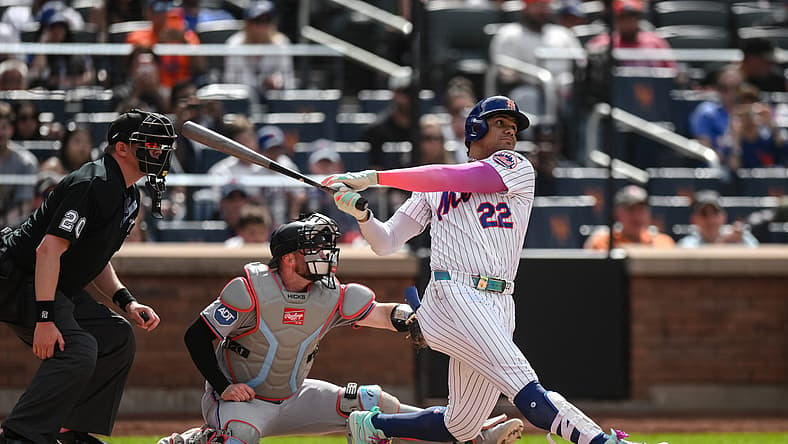
When Steve Cohen green-lit another historic spending spree this past offseason, the objective was simple: buy certainty. Instead, two months into the season, the New York Mets have bought themselves the most expensive predicament in baseball history.
Entering the 2026 campaign with a record-shattering $382 million Opening Day payroll, the Mets were engineered to be a super-team. Yet, on June 1, New York sits a dismal 26-33, seven games under .500 and staring down a massive divisional deficit.
How does a roster featuring the highest-paid player in the sport, and a revamped, star-studded lineup stumble this badly out of the gate? The answer lies in overlapping slumps, organizational streakiness, and a strong division rival, only hoping to be saved by calling up new prospects.
Big Investments, Little Returns
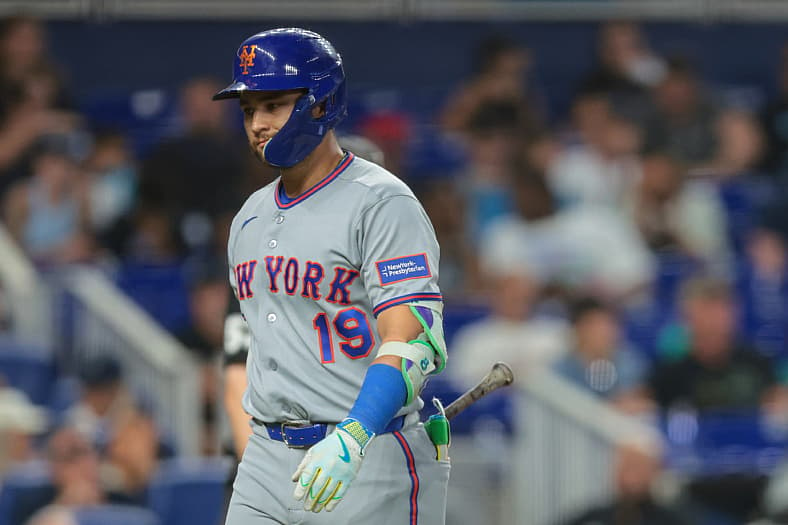
You can’t discuss the 2026 Mets without looking at their most expensive players. The offseason before the 2025 season was defined by the Mets landing Juan Soto on a monumental 15-year, $765 million contract. This past season the Mets brought on another huge contract, inking Bo Bichette to a three-year, $126 million deal. These deals are some of the most impactful for competitive balance tax purposes.
However, financial commitment has not translated to offensive consistency. While Soto is still providing his elite plate discipline (87th Percentile BB%), the lineup around him has fragmented. Bichette, in particular, is navigating a nightmare scenario. Expected to be the dynamic right-handed bat to balance the lineup, Bichette has instead suffered through a career-worst stretch, posting a .266 wOBA, good for bottom 9% of the league. Bichette’s peripherals do not expect him to do much better either. He hosts a .331 xwOBA, good for about league average, but his 6th percentile Chase % does not bode well for him, as per savant. When your $42-million-a-year shortstop is failing to generate extra-base hits and struggling with swing decisions, the offense fails as well.
The Anatomy of a Streaky Franchise
Perhaps the most frustrating aspect of evaluating the Mets is their recent history of extreme, unpredictable momentum swings. For three consecutive years, this franchise has chaotically defied early-season projections.
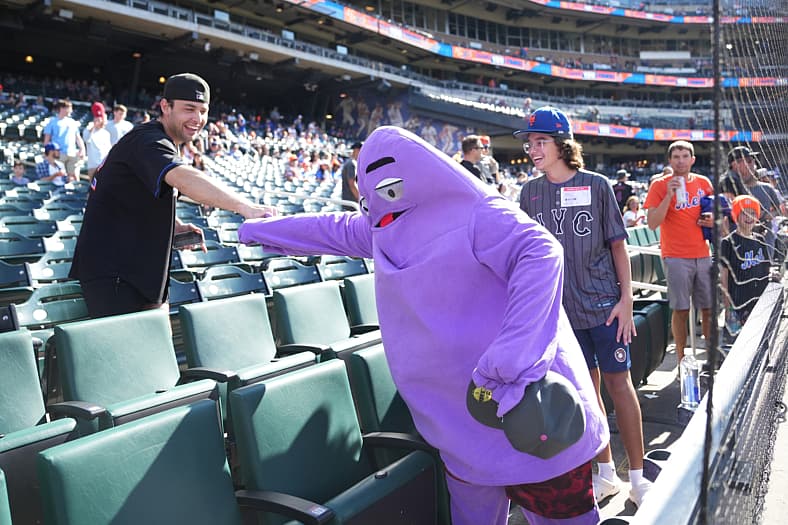
- The 2024 Turnaround: Two years ago, the Mets looked dead in the water, opening the year 22-33 (11 games under .500). Then the lineup suddenly clicked, perhaps due to Grimace. They rolled off 67 wins in their remaining games, falling just two wins shy of the National League pennant.
- The 2025 Collapse: The Mets held the best record in the MLB in mid-June at 45-24. However, they could not hold this lead. What followed was a historic 38-55 free-fall down the stretch, missing the postseason by a single game.
- The 2026 Reality: Now, at 26-33, the narrative hook writes itself. Are the 2026 Mets just like their squad in 2024 gearing for another summer surge? Or was the late-2025 collapse the true-baseline for this core?
Divisional Death Sentence
The biggest problem with relying on a mid-summer surge is the math of the National League East. The Mets aren’t just struggling in a vacuum; they are getting lapped by the Atlanta Braves.
Through the beginning of June, Atlanta has rocketed to a 40-20 record. That pace has buried the Mets in a 13.5-game hole in the division. The sheer amount of ground to make up means the division crown is rapidly slipping out of reach before the All-Star break, putting immense pressure onto securing a Wild Card spot.
The Saving Grace
Faced with a stagnant lineup and a divisional nightmare, the Mets have aggressively turned to their farm system. Accelerating the timeline for several key prospects, management is desperately searching for a spark. When a $382 million payroll isn’t generating wins, you must turn to the kids.
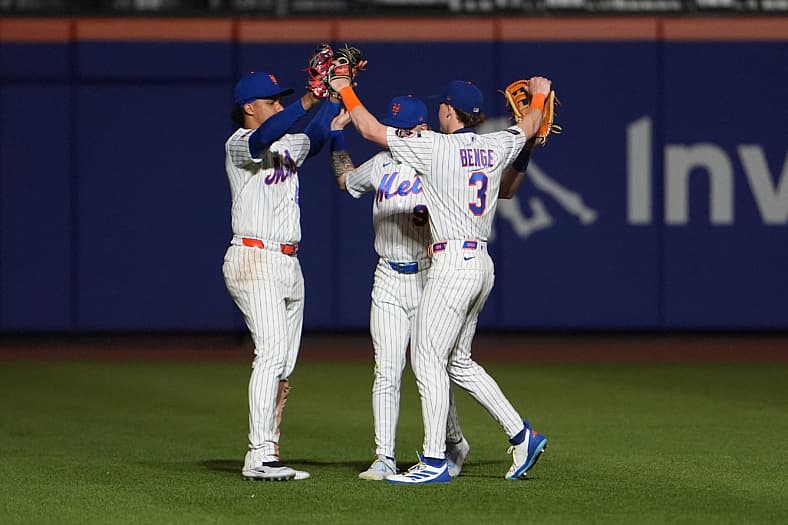
The front office fast-tracked Carson Benge all the way to the Opening Day roster. While he has flashed his run-producing potential with 28 runs scored and 21 RBIs, he is still settling into major-league pitching with a 33rd percentile batting run value.
In mid-May, the front office called up 21-year-old outfielder A.J. Ewing, who provided an immediate jolt by tripling in his May 12 debut and blasting his first career home run two days later against Detroit. He has now cooled off, to a similar level as Benge, with a .308 wOBA.
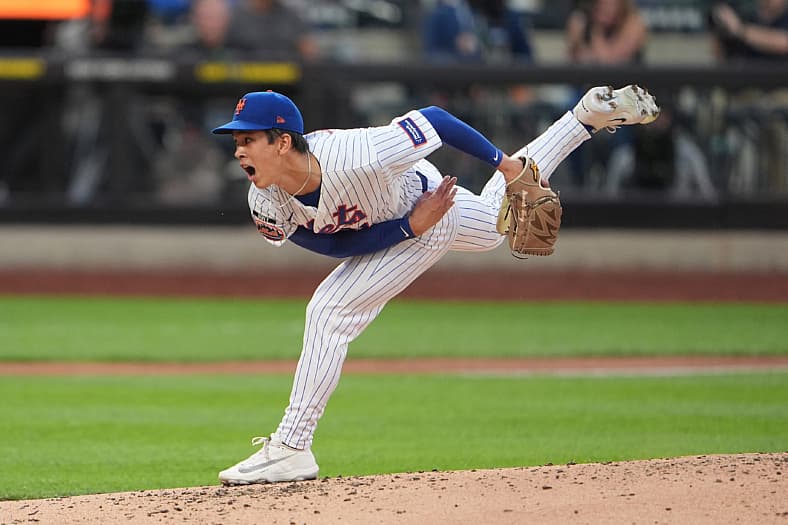
The Mets promoted a third outfield prospect in Nick Morabito. They hoped that his game-changing 55 grade run tool and seasons of 59 and 49 stolen bases would translate into the majors, but the jump has been harsh. Morabito has gone 0-for-11 with nine strikeouts in a short five-game stint. On the mound, the organization is testing Jonah Tong again, whom the organization briefly called up at the end of the 2025 season.. He has recently provided a glimpse of his upside, tossing 6.2 innings of relief without allowing an earned run across two games back in the majors.
While these prospects represent the future of the organization, asking them to carry a floundering, high-priced veteran roster in the present is a massive, and perhaps unfair, burden.
Will the Mets Come Back?
The Mets have the talent, the track record of mid-season turnarounds, and certainly the payroll to fix this. But in baseball, money only buys the roster, it doesn’t buy the results. If the high-priced bats don’t positively regress to their career norms soon, Cohen’s $382 million experiment will go down as one of the most expensive miscalculations in modern baseball history.